


This story was originally published by Grist. Sign up for Grist’s weekly newsletter here.
By Jake Bittle, Grist
When it comes to government spending, Florida Gov. Ron DeSantis is taking a cue from the Trump administration.
As his second term nears its end, DeSantis is spearheading a campaign to slash property taxes, which provide around 30% of local government revenue. He’s also looking to dramatically pare down state-funded programs, and he’s commissioned a state-level version of Elon Musk’s “Department of Government Efficiency” to do so. DeSantis’s DOGE will be run by his hand-picked chief financial officer, the creator of a YouTube show called “Government Gone Wild.” In a signal of his seriousness about cutting spending, the governor’s proposed budget for this year is 10% lower than his 2019 budget in inflation-adjusted and per-capita terms.
To make these cuts happen, the Sunshine State’s climate programs are in the crosshairs.

The DOGE report that the governor’s office published last month singled out local efforts to confront climate change as examples of the “irresponsible spending” that Florida must end. The state task force targeted Jacksonville’s efforts to purchase electric vehicles, St. Petersburg’s hiring of a “sustainability and resilience officer,” and Miami’s efforts to build out buses and rail systems. The report directed specific ire at Palm Beach County’s Office of Resilience, which had a mandate to “reduce resident, business, and natural resource vulnerability” to disasters that “include flooding, more frequent and intense storms, extreme heat, (and) saltwater intrusion.”
DeSantis’s DOGE justified this criticism by appealing to a controversial report from the federal Department of Energy, which concluded that “scientific evidence does not support claims of a long-term increase in so-called ‘extreme’ weather events, including hurricanes, tornadoes, (and) floods.” Yet laws signed by DeSantis himself take the opposite view — and, perhaps as a result, the state’s largest climate resilience program is proving itself immune to the governor’s purge.
During his first term as governor, DeSantis inaugurated a grant program known as Resilient Florida, which doles out millions of dollars a year to ward off flooding and sea level rise. The statute authorizing the program even “recognizes that the state is particularly vulnerable to adverse impacts from flooding resulting from increases in frequency and duration of rainfall events, storm surge from more frequent and severe weather systems, and sea level rise.” It requires that the state conduct a regular assessment of these threats.
In the five years since its inception, the Resilient Florida program has become one of the country’s most robust climate adaptation programs — rivaling not only those of any other state but also federal resilience efforts spearheaded by FEMA. Florida has distributed well over $1 billion in resilience money to local governments who then match the funding. By comparison, FEMA’s Building Resilient Infrastructure and Communities program has distributed around $5 billion to the entire country.
Resilient Florida has funded the construction of “living shorelines” to prevent erosion at the Pensacola naval base and the relocation of an island wastewater treatment plant in Fort Pierce to prevent flooding during high tide events. Palm Beach County, the same jurisdiction that Florida’s DOGE singled out for criticism, has received tens of millions of dollars in state funding. That money has helped raise an island park to protect against sea-level rise and has funded the construction of a $30 million storm drain system on a major road that’s seen routine flooding. (However, DeSantis vetoed an additional tranche of money for that project last summer.)
Jim Mooney, a Republican state legislator representing the Florida Keys, said the program represents an example of smart state spending. Local governments must match each dollar of state grants, and Mooney said he believes the arrangement is a wise use of local property tax dollars.
“The idea is you need to have shovel-ready projects, because getting these grants is hard,” said Mooney, one of the leading supporters of Resilient Florida. “That’s what you’re collecting people’s property taxes for, to some extent — to get that stuff done.” In Mooney’s island district, Resilient Florida has funded subterranean drainage pipes that reduce residential flooding from high tides.
Resilient Florida was originally set to expire in 2025, but the state legislature renewed it last year without any controversy; the bill that reauthorized the program passed both legislative chambers in less than a month and without any “nay” votes. Even as DeSantis is proposing to shrink the state budget by about 10%, his administration has firmed up the revenue source for Resilient Florida. The program will now draw its funding from the Seminole gaming compact, an agreement between the state and the Seminole tribe that governs revenue from online sports betting. It will be funded next year at $150 million. This time, it does not have an expiration date.
“I think it would’ve continued to be funded (without the gaming revenue), it would’ve just been more of a rollercoaster ride,” said Mooney. “There was really no thought that it wasn’t going to move forward.”
Such programs are facing challenges in other parts of the country. The Trump administration has sought to terminate a key federal resilience grant program, and the Department of Homeland Security has paused almost all FEMA hazard mitigation spending. In Louisiana, which has long led the nation on state-level adaptation to climate change, a new governor, Jeff Landry, has halted efforts to fight sea-level rise and prevent coastal erosion. Landry last year canceled a massive sediment diversion project that would have built new coastal land, and the Republican has also meddled with governance for the landmark levee system that protects New Orleans.
Mathew Sanders, a policy expert at the Pew Charitable Trusts who helps states plan for disaster resilience, says the Resilient Florida’s durability comes down to economics. The Sunshine State’s coastline is an integral part of the state’s economy, and future growth depends on functional roads and sewage plants in beachfront towns. Even if the state wanted to cut Resilient Florida spending, it probably couldn’t afford to.
“There’s a direct connection in Florida between the ecological health of the coastline and their ability to generate revenue,” said Sanders. “It’s so reliant on ecotourism, the pure beautiful beaches and the Everglades. The calculus is just different.”
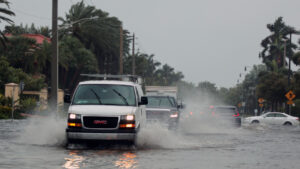
This article originally appeared in Grist at https://grist.org/politics/ron-desantis-resilient-florida/. Grist is a nonprofit, independent media organization dedicated to telling stories of climate solutions and a just future. Learn more at Grist.org. Banner photo: Flooding in Sarasota from Hurricane Debby (iStock image).
Sign up for The Invading Sea newsletter by visiting here. To support The Invading Sea, click here to make a donation. If you are interested in submitting an opinion piece to The Invading Sea, email Editor Nathan Crabbe.
