


By H. Christopher Frey, North Carolina State University
The Trump administration’s plan to unravel many of the nation’s climate policies hinges on rescinding what’s known as the endangerment finding. But its strategy for doing that appears to run afoul of several federal laws.
The endangerment finding is a 2009 determination by the Environmental Protection Agency that six greenhouse gases, including carbon dioxide, contribute to climate change and therefore pose a threat to public health and welfare.
The scientific evidence of these threats has gotten stronger in the years since the endangerment finding was made. That evidence is laid out in multiple national and international reports written by hundreds of scientists who reviewed the data and research.

In contrast, the EPA’s proposal to now rescind the endangerment finding is based in part on a new Department of Energy report written by five people, named as the “Climate Working Group.” All five have been outspoken critics of mainstream climate science. Energy Secretary Chris Wright said he handpicked the group to write the report.
The group’s report cherry-picks information and misrepresents uncertainties. Some scientists whose studies it cites have complained that the authors misrepresented their research. Others are speaking out about factual problems with the report.
I have served in the federal government and on numerous scientific federal advisory committees, and I’ve seen firsthand the rigorous requirements that federal agencies are supposed to meet so that scientific information they disseminate can be trusted by the public.
The Energy Department and the EPA seem to have run afoul of four laws in particular that may be tricky for the administration to get around.
1. Has the Energy Department produced a credible report?
A casual reader might think the Energy Department climate report is credible.
Its inside cover affirms that it “is being disseminated … in compliance with” the Information Quality Act. The word “disseminated” means that this is a final report and not just a draft.
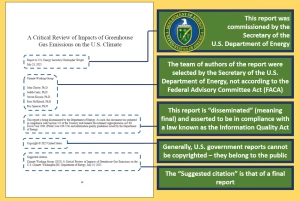
The Information Quality Act, passed by Congress in 2000, requires “ensuring and maximizing the quality, objectivity, utility, and integrity of information (including statistical information) disseminated by Federal agencies.”
This law is the basis for federal guidance on scientific peer review for all agencies. It also requires agencies to provide the public with an opportunity to request corrections in final reports if they were not properly developed or lack balance, accuracy and objectivity. The agency decides whether to grant the request, but there is an appeals process.
Government scientific products considered final also must have previously undergone independent external peer review conducted in an “open and rigorous manner,” according to the White House Office of Management and Budget.
One author of the Energy Department’s report stated that the report was reviewed by “eight scientists/administrators employed by the DOE.” However, this does not meet the government’s standards for implementing the law, which requires a public record of review by scientific experts not affiliated with the department that issued the report.
2. Agencies cannot cherry-pick groups to give answers they want
The Federal Advisory Committee Act of 1972, or FACA, addressed concerns that “special interest groups” could “exercise undue influence” in promoting “their private concerns” on “matters in which they have vested interests.”
The law requires a public process for creating and appointing groups to advise the government and requires that the properly appointed group operates in public view and takes public comments along the way.
According to the DOE’s own guidance, “FACA applies when a group is asked to render advice or recommendations as a group and not a collection of individuals.”
Thus, the group chosen to write the department’s report falls within the scope of FACA. The law requires that a committee representing a fair balance of viewpoints be chartered under FACA and that members be appointed only after a public nomination process with public opportunity to comment on the list of candidates.
Once appointed, a balanced group is also required to deliberate in public and receive public comments in formulating their report. That didn’t happen.
3. Federal agencies cannot be arbitrary or inconsistent in rulemaking
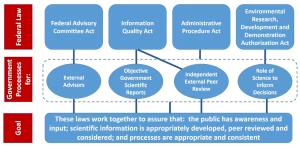
The Administrative Procedure Act of 1946 requires federal agencies to allow public participation in rulemaking processes and to follow consistent procedures and practices when developing regulations.
The law prohibits actions that are “arbitrary and capricious” – meaning decisions made without justification or regard for facts – or an “abuse of discretion.”
Agencies are expected to examine relevant data. They must not only follow applicable laws, such as FACA, but also must follow procedures established to implement those laws, such as balanced membership of the committee and opportunity for public comment when formulating the report.
4. Science Advisory Board review is also required
The EPA is also subject to the Environmental Research, Development and Demonstration Authorization Act of 1978. The act mandated that the EPA must establish a Science Advisory Board. It also requires that agency make available to its Science Advisory Board relevant scientific and technical information on any “proposed criteria document, standard, limitation, or regulation.”
The board must be given time to review the scientific and technical basis of the proposed action – in this case, the disseminated Energy Department report – now that the EPA is using this report to inform its regulatory action.
Under the Information Quality Act, the EPA may not develop a regulation based on a draft report.
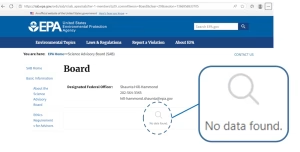
The EPA’s Science Advisory Board website lists zero members as of mid-August 2025. On Jan. 28, 2025, the EPA dismissed all of the board’s previous members. Nominations for new board members were due on June 2. At best, it will be months before the EPA can seat a new Science Advisory Board because of time needed to complete the selection, appointment and ethics review processes.
Either the EPA could follow the law and suspend any proposed actions until the Science Advisory Board is available, or accept legal risk for not following the Environmental Research, Development and Demonstration Authorization Act.
What’s next?
These laws exist to protect the public by preventing the federal government from being unduly influenced by narrow interests when disseminating evidence that informs policy decisions. Science-based agencies such as the Energy Department and the EPA have a legal requirement to follow the science.
The public has a chance to comment on the EPA’s proposal to rescind the 2009 endangerment finding and greenhouse gas vehicle standards until Sept. 15, 2025. And although the Energy Department disseminated its report as a final version, the department is accepting public comments on the report through Sept. 2.
For both, the most effective comments are evidence-based and not merely opinion.
The National Academies of Sciences, Engineering and Medicine, independent nonprofit institutions that advise the government, announced in early August that they will conduct a fast-track review of the science on whether greenhouse gas emissions endanger public health and welfare to submit as a public comment.
Because the Energy Department report is presented as final, it is also subject to the “request for correction” process under the Information Quality Act within 60 days of its initial release.
Given the Energy Department report’s legal vulnerabilities, the Trump administration could consider withdrawing the report and starting over with a legally and scientifically valid approach. If these vulnerabilities are not corrected and the EPA rescinds the endangerment finding based on the Energy Department report, years of litigation are likely to slow the administration’s efforts.
H. Christopher Frey is the Glenn E. Futrell distinguished university professor of environmental engineering at North Carolina State University.
This article is republished from The Conversation under a Creative Commons license. Read the original article. Banner photo: A sign above a door at the U.S. Environmental Protection Agency headquarters building in Washington, D.C. (G. Edward Johnson, CC BY 4.0, via Wikimedia Commons).
Sign up for The Invading Sea newsletter by visiting here. To support The Invading Sea, click here to make a donation. If you are interested in submitting an opinion piece to The Invading Sea, email Editor Nathan Crabbe at ncrabbe@fau.edu.
