


Florida State University researchers have received a $2.3 million National Science Foundation (NSF) grant to develop artificial intelligence tools that will help manage wildfires fueled by hurricanes in the Florida Panhandle.
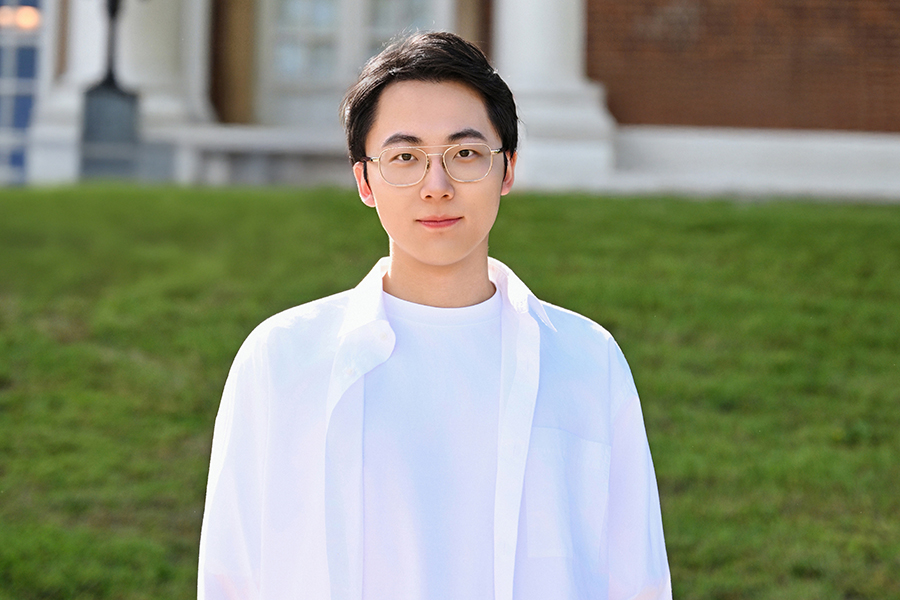
The four-year project will be led by Yushun Dong, an assistant professor of computer science, and is the largest research award ever for FSU’s Department of Computer Science. Dong and his interdisciplinary team will focus on wildfires in the wildland-urban interface, where forests such as the Apalachicola National Forest meet homes, roads and other infrastructure.
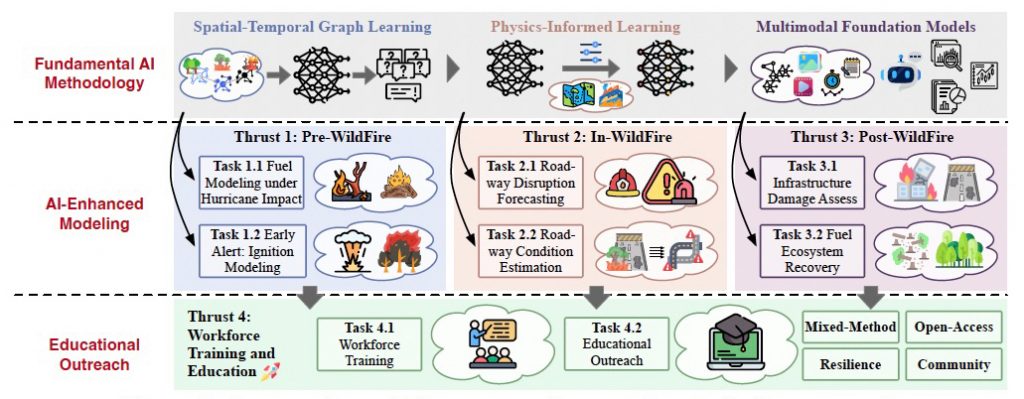
Dong’s project, “FIRE: An Integrated AI System Tackling the Full Lifecycle of Wildfires in Hurricane-Prone Regions,” will bring together computer scientists, fire researchers, engineers and educators to study how hurricanes change wildfire behavior and to build AI systems that can forecast ignition, predict roadway disruptions and assess potential damage.
“The modern practice of prescribed burns began over 60 years ago, which was a huge leap in working with nature to help manage an ecosystem,” said Dong, who joined FSU’s faculty last year and established the Responsible AI Lab at FSU after earning his doctorate from the University of Virginia. “Now, we’re positioned to make another leap: we’re able to use powerful AI technology to transform wildfire risk management with tools such as ignition forecasting, roadway disruption prediction, condition estimations, damage assessments and more.”
The project is funded as part of an NSF program, Fire Science Innovations through Research and Education, or FIRE, which was established last year and funds research and education enabling large-scale, interdisciplinary breakthroughs that realign our relationship with wildland fire and its connected variables.
Two of the four projects funded so far by the competitive program are led by FSU researchers — Neda Yaghoobian, associate professor in the Department of Mechanical and Aerospace Engineering at the FAMU-FSU College of Engineering, was also funded for a project that will analyze unresolved canopy dynamics contributing to wildfires.
“This grant represents the department’s biggest research award to date and cements our leadership in applying cutting-edge AI to urgent, real-world problems in our region,” said Weikuan Yu, Department of Computer Science chair. “The funding enables the development of a holistic AI platform addressing Florida’s hurricane and wildfire challenges while advancing cutting-edge AI research. Additionally, the grant includes educational and workforce development initiatives in AI and disaster resilience, positioning the department as a leader in training the next generation of scientists working at the intersection of AI and wildfire research.”
Why it matters
Fires, especially low-intensity natural wildfires and prescribed burns, can play a vital role in regulating certain forests, grasslands and other fire-adapted ecosystems. They decrease the risk and severity of large, destructive wildfires while supporting soil processes and, in many cases, limit pest and disease outbreaks.
In clearing fallen leaves that pose as hazardous fuel loads, fires lower forest density and recycle nutrients through the ecosystem. But when heaps of trees accumulate, as has happened following recurrent hurricanes in the Florida Panhandle, these fires can exhibit complex dynamics that threaten built infrastructure including homes and roadways in addition to natural landscapes. Understanding this hurricane-wildfire connection is critical for planning evacuations, protecting roads and safeguarding homes and lives.
“I became passionate about applying my research, which achieves responsible AI that directly contributes to critical AI infrastructures, to hurricane-related phenomena after experiencing my first hurricane living in Tallahassee,” Dong said. “I want to use AI techniques to help Florida Panhandle residents better understand and prepare for extreme events in this ecosystem with its unique hurricane-fire coupling dynamics.”
Interdisciplinary collaboration
Eren Ozguven, associate professor in the FAMU-FSU College of Engineering Department of Civil and Environmental Engineering and Resilient Infrastructure and Disaster Response Center director, is the co-principal investigator on this project, and additional contributors include James Reynolds, co-director of STEM outreach for FSU’s Learning Systems Institute, and Jie Sun, a postdoctoral researcher in the Department of Earth, Ocean and Atmospheric Science.
“Yushun’s project stands out for its ambition, insight, and integrative approach,” Yu said. “It zeros in on the unique challenges of Florida’s landscape where hurricanes and wildfires intersect in the wildland-urban interface of the Panhandle. By focusing on hurricane-fire coupling dynamics and working closely with local stakeholders, his project ensures that scientific innovation translates into practical, community-centered solutions. His integrated approach brings the benefit of cutting-edge AI advances directly to major real-world applications, creating a wonderful research lifecycle that’s exceptionally rare in our field.”
To learn about research conducted in the Department of Computer Science, visit cs.fsu.edu.
This piece was originally published at https://news.fsu.edu/news/science-technology/2025/09/10/fsu-researchers-receive-2-3-million-national-science-foundation-grant-to-strengthen-wildfire-management-in-hurricane-prone-areas/. Banner photo: Soldiers of the 753rd Brigade Engineer Battalion clear roadways in 2018 for residents to pass through after Hurricane Michael left many impassable in Panama City (Pfc. Arcadia Jackson/National Guard, Public domain, via Wikimedia Commons),
Sign up for The Invading Sea newsletter by visiting here. To support The Invading Sea, click here to make a donation. If you are interested in submitting an opinion piece to The Invading Sea, email Editor Nathan Crabbe at ncrabbe@fau.edu.
