


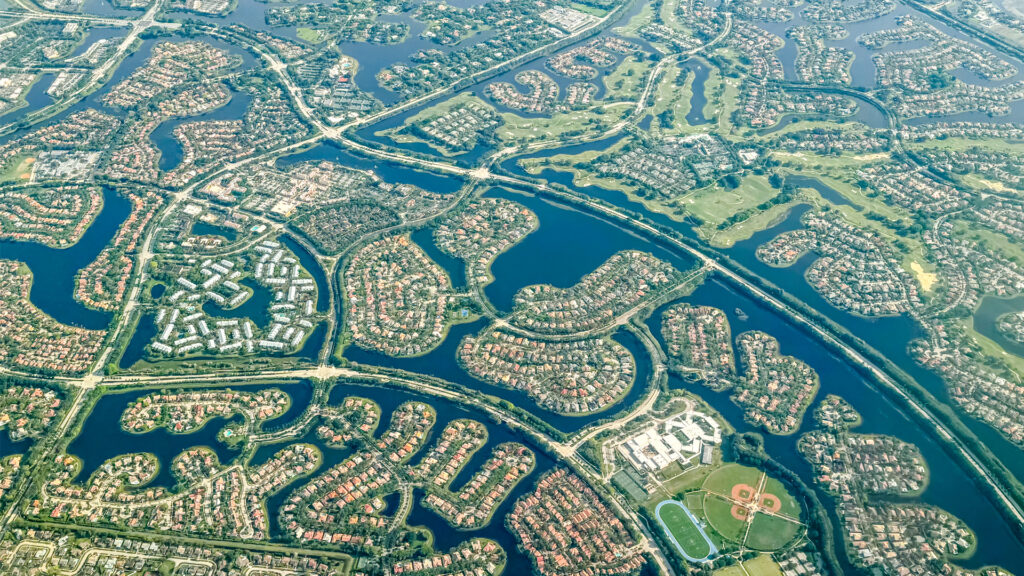
The 2,175-mile system of interconnected, man-made canals crisscrossing Florida, from Orlando to the Keys, has a particularly important role when a hurricane happens to be pinwheeling toward the peninsula: flood control.
Before a storm is set to make landfall, water managers strategically lower canal levels to absorb incoming rainfall and storm surge. But as the tragedies in Texas and Spain have shown, floods are as unpredictable as they are dangerous. And they are getting harder to get a handle on. Weather conditions change on a dime and any sudden shifts can overwhelm conventional flood models.
Traditional physics-based models replicate canal systems in meticulous detail, accounting for factors from water flow to gate operations. While precise, these simulations require enormous computational power and can take close to an hour to complete. In fast-moving storm conditions, delays can hinder timely decision-making.
Real-time systems are needed. That’s why a collaborative team from Florida International University developed an advanced AI model that could transform how water managers predict and respond to flooding in Florida’s vast canal system. The breakthrough, detailed in the Journal of Water Resources Planning and Management, offers near-instant simulations of flood scenarios. It then goes further, suggesting actionable strategies.
“Accuracy is obviously very important to us, because overestimation of water stages can cause false alarms and panic while underestimation can result in unexpected and dangerous flooding events,” said Giri Narasimhan, an FIU Knight Foundation School of Computing and Information Sciences professor.
“We were able to create a tool that provides water managers with the information to either eliminate a flood event or drastically reduce it.”
Recent FIU graduate Jimeng Shi, who led the research as Ph.D. student in Narasimhan’s research group, developed the model to run through complex or worst-case scenarios in seconds.
Using nearly a decade of historical environmental and weather data collected by the South Florida Water Management District, the AI system was trained to recognize how rainfall, tides, groundwater and storm surge interact across the region. Historic storms – including Hurricane Irma (2017), Hurricane Sandy (2012) and Tropical Storm Isaias (2020) – were used to fine-tune the model’s reliability. Researchers tested it on the Miami River, which runs through downtown Miami and drains into Biscayne Bay.
According to the researchers, this is all a part of their broader efforts to make AI a trustworthy tool in real-world, high-stakes scenarios.
Study co-author and director of FIU’s Sea Level Solutions Center Jayantha Obeysekera, who previously served as the chief modeler at the South Florida Water Management District, said the technology has potential beyond immediate flood control.
“The model also holds a lot of potential as a tool to help agencies make longer-term decisions,” he said. “It could guide 20- or 30-year infrastructure investments, such as whether to build new pumps, reservoirs or levees by screening potential solutions efficiently.”
This piece was originally published at https://news.fiu.edu/2025/new-ai-flood-model-gives-water-managers-up-to-the-minute-decision-making-tool. Banner photo: Flooding in Sarasota from Tropical Storm Debby (iStock image).
Sign up for The Invading Sea newsletter by visiting here. To support The Invading Sea, click here to make a donation. If you are interested in submitting an opinion piece to The Invading Sea, email Editor Nathan Crabbe at ncrabbe@fau.edu.
