


By Katie Marie Manning, Clement Sefa-Nyarko and Frans Berkhout, King’s College London
Imagine the escalating conflict between the U.S., Israel and Iran unfolding in a world powered mostly by wind, solar and batteries rather than oil and gas.
In today’s fossil-fueled economy, markets react to Iran’s attacks on oil and gas facilities in the Gulf and the threat to close the Strait of Hormuz. Oil prices jump. Governments brace for inflation. Around a fifth of the world’s traded oil passes through the narrow corridor, linking the Gulf states to the wider world. When tensions rise there, energy markets react instantly.
But in a world where most energy is generated domestically from renewables, would the same threat trigger the same global shock? Would instability in the Gulf still lead to more expensive food and fuel across the world? Or would the economic aftershocks look very different?
To understand what’s at stake, we need to first look at how today’s energy system is structured.
A system built on choke points
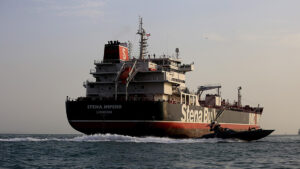
For about a century, the global economy has depended on fossil fuels produced by a few producers in the Middle East. Choke points like the Strait of Hormuz carry enormous strategic weight.
That is why the current conflict between the U.S., Israel and Iran reverberates so quickly through global markets. Even before any sustained disruption to supply, oil and gas prices have surged on the possibility that a major proportion of global flows could be blocked. Because oil underpins transport, agriculture and manufacturing, price spikes ripple rapidly through commodity exchanges, supply chains and into household budgets. Regional conflict can magnify into global economic turmoil within days.
Now run the same crisis in a renewable world
Return to our thought experiment. Now, imagine the same crisis unfolding in a world where energy systems were powered by renewables and electricity rather than oil and gas.
It is the same week. Same military escalation. The same rhetoric about closing the strait of Hormuz. But this time the global energy system has already largely been decarbonized.
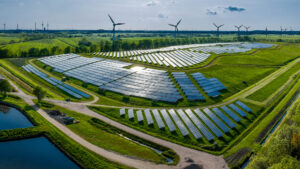
In this alternative world, most electricity globally would be produced within national borders from wind, solar and other low-carbon sources. Road transport would be predominantly electric. Heating would rely on locally available renewable sources, such as heat pumps, domestic biomass, geothermal systems or green hydrogen. These are all tried and tested solutions. They are not a thing of the future, and yet today our global economy still gets roughly 80% of its primary energy from fossil fuels.
In the alternative scenario, what changes?
The immediate macroeconomic shock would be weaker. A disruption at the strait would still matter. Oil would still be traded in some sectors, but it wouldn’t be as central to everyday energy use. Prices would be lower because demand was falling. The automatic link between Gulf instability and global inflation would loosen.
Electricity generation would continue, largely insulated from disruption of gas supply. People with electric cars would be less directly affected by a petrol price spike. Household bills would remain unchanged as energy price rates stay stable. Governments would be less exposed to sudden demands to subsidize fuels and an inflationary shock.
Energy security would become less about controlling distant shipping lanes, and more about building a distributed and resilient domestic electricity grid, more storage capacity and diversified supply chains.
Maritime choke points to mineral supply chains
This does not mean energy geopolitics would disappear. It would mutate.
Renewable systems depend on critical minerals such as lithium, cobalt and so-called rare earth elements, and involve advanced manufacturing supply chains to make solar panels, wind turbines and batteries. New choke points could emerge in mineral processing hubs or semiconductor plants. Already there is geopolitical competition over access to rare earths.
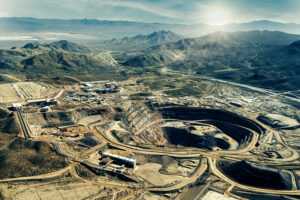
But there are important differences. Fossil fuel reserves are geographically concentrated, which is why global trade converges on a handful of maritime routes: Hormuz, Suez, Malacca (between the Indian and Pacific Oceans) and more. Markets for oil and gas are volatile.
Renewable resources such as sunlight and wind are more widely distributed. While mineral supply chains remain uneven, and still rely heavily on a handful of producers such as China for rare earths, the Democratic Republic of the Congo for cobalt and Indonesia for nickel, they do not converge on a single choke point. Price changes propagate through markets for technologies much more slowly. It is easier to built strategic reserves.
In our imagined Iran crisis, power would be more diffuse, with no single state able to threaten such disruption.
Minerals being more dispersed than oil and gas, and less concentrated in a few places, reduces the kind of centralization and “resource capture” that has historically characterized the oil industry. Global standards on community consent, transparency and environmental protections are now much stronger in mineral supply chains than they ever were for fossil fuels.
This gives local actors more leverage in a renewable-powered world. Mineral-rich regions in Africa, Latin America and parts of Asia would gain new some power – not simply as resource suppliers, but through mechanisms of community consent social license to operate and they are better able to influence whether projects proceed.
This marks a shift from the petroleum age, where power has largely been concentrated between states and multinational oil companies operating at a distance from affected communities.
The geopolitical dividend of decarbonization
Decarbonization is often framed as a climate necessity. It will also lead to a redistribution of geopolitical power, probably toward greater stability.
In today’s fossil-fueled system, the Strait of Hormuz sits at the heart of a global economic system that ties global economic stability to the uninterrupted flow of oil – and to the military power that guards it. The current crisis exposes the fragility of that arrangement.
Running this thought experiment does not suggest that renewable energy dissolves geopolitics. In a post-oil world, the strait would still matter and resource conflicts would not vanish. But it does suggest that our fossil energy system is fragile and conflict can reverberate quickly around the world.
Katie Marie Manning is a lecturer in climate change, business and society; Clement Sefa-Nyarko is a lecturer in security, development and leadership in Africa; and Frans Berkhout is a professor of environment, society and climate; all at King’s College London.
This article is republished from The Conversation under a Creative Commons license. Read the original article. Banner photo: A U.S. jet prepares to launch from an aircraft carrier in support of Operation Epic Fury on Feb. 28 (U.S. Navy photo, Public domain, via Wikimedia Commons).
Sign up for The Invading Sea newsletter by visiting here. To support The Invading Sea, click here to make a donation. If you are interested in submitting an opinion piece to The Invading Sea, email Editor Nathan Crabbe.
