


By Mark McNees
When I drive into Florida, the signs say “Welcome to the Free State of Florida. The Sunshine State.” Well, with plenty of energy, I’m free to live a great life in the … what? That’s right, the Sunshine State. Yet somehow, we’re watching our natural advantage slip through our sunscreen-lathered fingers while power companies scramble to meet tomorrow’s massive energy demands.
Florida adds 1,000 new residents daily, according to the U.S. Census Bureau. But population growth is just the beginning. The International Energy Agency projects electric vehicles will increase grid demand by 40-60% in high-adoption regions like ours. With Florida targeting 3 million EVs by 2030 — equivalent to adding 3 million homes’ worth of electricity consumption — our grid faces unprecedented strain.
Tech giants are also transforming Florida into a data center hub. Energy consultant JLL reports a single hyperscale facility can consume 100 megawatts — enough to power 80,000 homes, running 24-7.
The National Oceanic and Atmospheric Administration projects Florida will experience 30-50% more days above 95 degrees Fahrenheit by mid-century. Massachusetts Institute of Technology researchers found air conditioning electricity use could surge 25-30% by 2045. We need energy for survival, not just comfort.
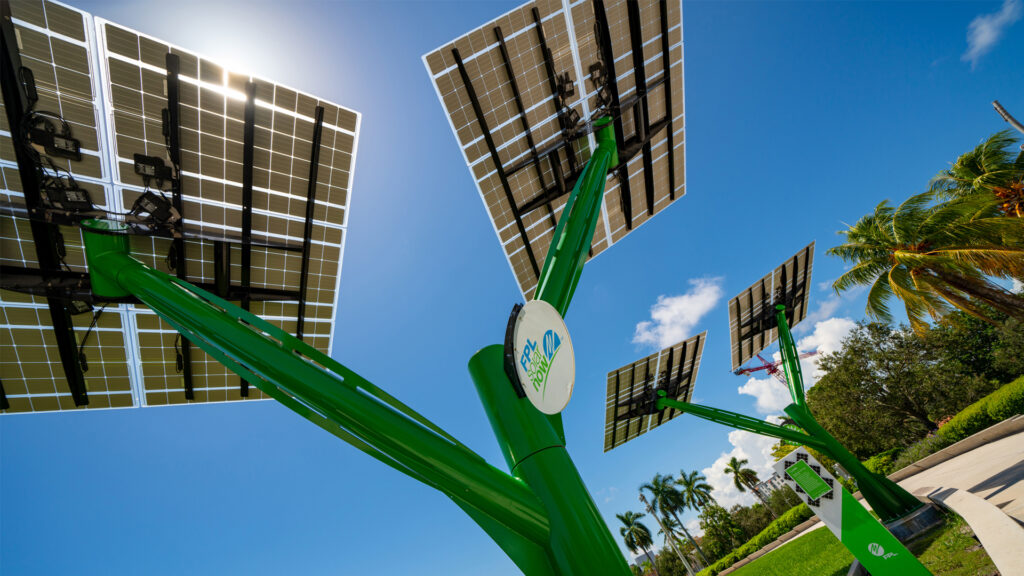
Picture Florida in 2045: with 26 million residents, millions of electric vehicles and data centers powering the digital economy. Power companies know what’s coming — Florida Power and Light plans $30 billion in solar investments, Duke Energy targets 10,000 MW of renewables by 2030 and TECO aims for net-zero emissions by 2050.
While utility-scale solar will dominate with 60% of solar capacity according to energy consultancy DNV and the International Energy Agency, distributed rooftop solar’s 40% share remains crucial — turning every viable roof into a mini power plant exactly where electricity is needed most.
But homeowners need to act fast. The federal solar tax credit drops from 30% to 0% for residential installations after Dec. 31, 2025. Miss this window and solar becomes 30% more expensive overnight.
Building a natural gas plant takes seven to 10 years, per the U.S. Energy Information Administration. Nuclear? The Nuclear Regulatory Commission’s timelines show 15-20 years. By the time we could build enough traditional capacity, Florida’s energy crisis will have already arrived.
The National Renewable Energy Laboratory ranks Florida among the top five states for solar potential. We receive 25% more sunshine than Germany, yet they generate 10 times more solar power.
California proves that distributed solar works. Its grid operator reports that solar provides up to 25% of midday electricity needs, eliminating multiple new power plants. During peak afternoon hours — when Florida’s air conditioners work hardest — solar panels produce maximum power.
Lawrence Berkeley National Laboratory found distributed solar reduces grid infrastructure costs by $2.6 billion annually in California alone. For Florida, that means billions staying in ratepayers’ pockets, so we have money for eggs.
Solar paired with battery storage multiplies benefits. Battery storage installations in Texas prove batteries can replace expensive peak power rates and protect our loved ones from power outages during extreme weather.
The Solar Foundation reports Florida’s solar industry employs around 14,000 workers. Yet we’re operating at a fraction of potential. Texas installed more solar capacity than any other state in 2024 because it understands energy economics, leading the nation with 11.6 GW of new installations, according to the Solar Energy Industries Association.
Florida lawmakers face a defining moment: Harness our sunshine to meet tomorrow’s energy demands or watch electricity bills soar while scrambling to build infrastructure.
We need smart policy like:
- Streamlined solar permitting statewide
- Protected net metering, compensating solar producers fairly
- Statewide PACE financing for all homeowners, not just in some counties
- Solar-ready building codes
- Community solar for renters
- Solar mandate on all new homes
Other states call us the “Sunshine State” with envy. Let’s update that to the “Sunshine-Powered State.” The sun provides reliable, abundant, free energy. We just need the wisdom to capture it before time runs out.
Mark McNees is the director of social and sustainable enterprises at Florida State University and a business consultant at The McNees Group. This opinion piece was originally published by the Orlando Sentinel, which is a media partner of The Invading Sea. Banner photo: A solar installer working on a rooftop in Broward County (Paul Krashefski/U.S. Department of Energy, Public domain, via Wikimedia Commons).
Sign up for The Invading Sea newsletter by visiting here. To support The Invading Sea, click here to make a donation. If you are interested in submitting an opinion piece to The Invading Sea, email Editor Nathan Crabbe at ncrabbe@fau.edu.

Thank you Mr. McNees for the great information and inspiration. Florida does not need to be thinking about expanding fossil fuel and nuclear power energy production when solar is so abundant, inexpensive, pollution free and the price is not dependent on global supply and demand factors.
I’d like to add ‘balcony solar’ as another option for Floridians. Another for Floridians to harvest the energy from the sun, and free themselves, from dependence on utility scale energy providers is to install a small scale solar collector (sometimes on a balcony), and a battery. This solution is very prevalent in industrialized countries like Germany, as well as, developing countries like Pakistan. They can provide enough energy to power several appliances, computers, chargers and AC.
However, we need empowering regulation and standards for these units to be readily accessible and effective. Until then, big box outlets like Home Depot and IKEA will be reluctant to stock them in their Florida outlets.
We need people to show their interest in being free to generate their own electricity by contacting your county building departments and household appliance providers.