


By the Orlando Sentinel Editorial Board
In the howl of hurricane-force winds, in the inexorable rise of floodwaters, there should be no room for politics. Or idiocy.
At such times, we are all Americans — the people caught in harm’s way, supported by a bolster of assistance and sympathy nationwide. We rely on the utility workers from states away who roll into town as soon as the all-clear is called. On the churches and nonprofits that collect food, clothing and cash to send to the aid of communities hit with disasters they can’t hope to handle on their own. And most of all, the experienced emergency-response managers who know what happens in a community after a major disaster strikes, and have the resources to help residents and businesses through the painfully slow slog of recovery.
How long before we have to write that last sentence in the past tense? And what happens to Florida, the nation’s most disaster-vulnerable state, if that federal support goes away?
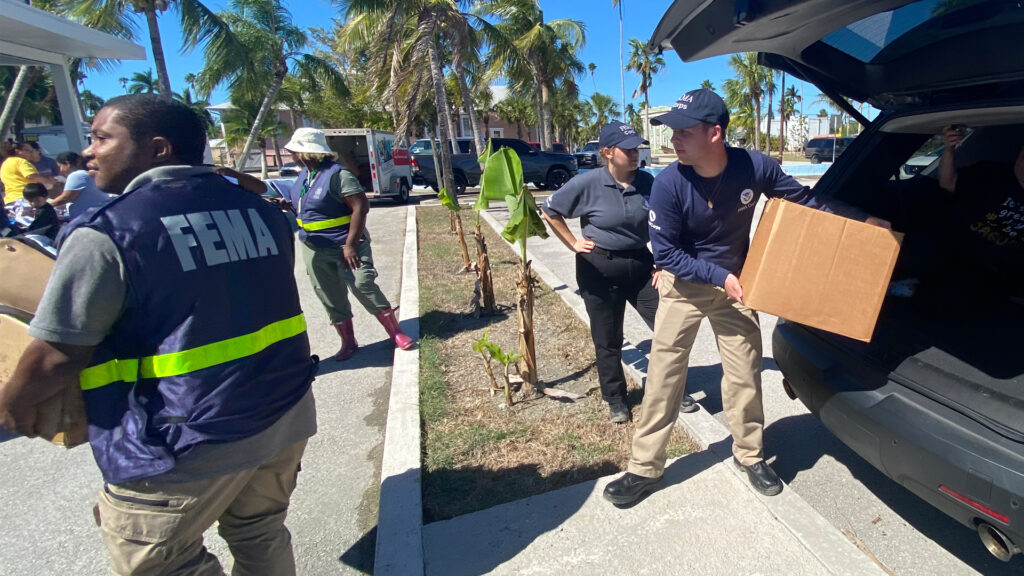
That’s a question many Floridians hoped they’d never have to ask. In just the past decade, Florida has relied on storm-recovery aid from the Federal Emergency Management Agency, or FEMA, including an estimated $12 billion for 2017’s Hurricane Irma, $10 billion in 2022 for Hurricane Ian and a multi-billion-dollar tally for Hurricanes Helene and Milton that is still growing.
FEMA and other federal agencies have also made a significant contribution to mitigation, providing funding that helps communities armor themselves against floods or devastating high winds. And the agency serves a critical role in coordinating relief — right down to those battalions of utility trucks that arrive in Florida from as far away as Texas, New York and Wyoming.
And obviously, the state benefits from the national government’s expertise in predicting and tracking the path of big storms through the National Weather Service. Florida gives as well as takes, sending more than $325 billion in income taxes to Washington, D.C., as well as lending its own disaster assistance when nearby states are hit.
It’s all part of a national safety net — one in danger of unraveling, as starkly described in a warning memo signed by 191 current and former FEMA officials along with business leaders, educators and scientists.
The missive — dubbed “The Katrina Declaration” in memory of the storm that nearly destroyed New Orleans 20 years ago last week — decries the Trump administration’s lack of professional guidance for the agency. It cites six specific concerns:
- Homeland Security Secretary Kristi Noem has imposed a rule that requires her office to approve any expenditure over $100,000. Last month, that bottleneck was blamed for the lethally slow response to flooding in Central Texas that claimed at least 135 lives, including 35 children and counselors at a Christian camp. In the aftermath of that tragedy, the head of FEMA’s Urban Search and Rescue branch quit in disgust. According to the declaration, Noem has also permitted the temporary reassignment of FEMA employees to anti-immigration enforcement.
- FEMA still lacks a qualified administrator, experienced in emergency services. The leadership vacuum carries disturbing parallels to the Katrina response, where prolonged misery was convincingly tied to a lackluster performance by then-FEMA head Michael D. Brown. In the aftermath of that fiasco, Congress passed a wide-ranging law that mandates an administrator with “demonstrated ability in and knowledge of emergency management and homeland security.” Since January, FEMA has been under the temporary oversight of two leaders, neither of whom has been formally nominated by Trump — most likely because they do not meet the demands of the law.
- The FEMA budget for disaster preparation, which can help communities prepare for storms, has been drained. “Mitigation reduces the costs of future disasters, saves lives, protects critical infrastructure, and reduces future response and recovery needs,” the declaration says. “As disasters grow more frequent and costly, removing mitigation initiatives is fiscally irresponsible and puts American lives and property at unnecessary risk.”
- FEMA has also abandoned grants that help state and local governments train for disaster response, build communications networks and early-warning systems, and otherwise prepare for the worst. Without that funding, states and communities might not have the information they need to save lives and homes. They might also miss out on preparedness drills that let officials stress-test disaster recovery systems before storms, floods, fire or other threats loom.
- The Trump administration has gutted funding across the board for climate research, storm prediction and programs that help groups of people most likely to be left in dire straits after a storm, including majority-minority communities, people who do not speak English, homeowners who can’t afford to harden their homes against storms and other disadvantaged groups. Homeland Security is also censoring critical information: In February, a map that predicted community-level disaster vulnerability due to climate change was quietly removed from the FEMA website. A recreation of that map reveals information Floridians need to know: Most of the state is colored in shades of red — the highest level of vulnerability — not only for hurricane risks, but for wildfire and, in coastal areas, flooding.
- FEMA has lost one-third of its experienced staff. Among those who have departed: Managers who know how to put roofs over the heads of people who have lost their homes, bring food to communities with roads made impassible by floodwaters and assist (or prod) insurance companies in getting assistance to their customers.
The petition goes on to ask Congress to double down on the post-Katrina law, requiring that FEMA be taken out of Homeland Security and elevated to its own Cabinet-level agency. It also asks for congressional funding guarantees that prevent any administration from bleeding its coffers dry as well as protection for employees so they aren’t fired by political whim.
The plea for congressional intervention is appropriate — and one Florida’s delegation, Republicans and Democrats alike, should take seriously. FEMA isn’t perfect, but it’s necessary, and there is no excuse for letting a massive, experienced emergency-response system collapse, just as the nation prepares for the likelihood of more frequent and violent fires, floods, storms, earthquakes and other calamities.
Trump has said he thinks disaster response is a job best left to states — but he’s already being proven wrong. Congress should correct his actions, before they become lethal errors.
This opinion piece was originally published by the Orlando Sentinel, which is a media partner of The Invading Sea. The Orlando Sentinel Editorial Board consists of Opinion Editor Krys Fluker, Executive Editor Roger Simmons and Viewpoints Editor Jay Reddick. Banner photo: FEMA Search and Rescue teams search areas of Fort Myers Beach impacted by Hurricane Ian in 2022( Jocelyn Augustino/FEMA via Defense Visual Information Distribution Service).
Sign up for The Invading Sea newsletter by visiting here. To support The Invading Sea, click here to make a donation. If you are interested in submitting an opinion piece to The Invading Sea, email Editor Nathan Crabbe at ncrabbe@fau.edu.
