


By Mark McNees, director of Social and Sustainable Enterprises at Florida State University
On Aug. 7, the Environmental Protection Agency canceled $7 billion in Solar for All grants — funding that would have helped nearly 1 million low-income families access affordable solar.
America faces a defining moment in our energy future. These termination letters, affecting 60 recipients across 49 states, represent more than policy shifts. They signal a fundamental reshaping of how we power our homes, businesses and economy.
The numbers tell a stark story. The Inflation Reduction Act of 2022 channeled nearly $400 billion into clean energy, catalyzing $321 billion in private investment and creating over 300,000 jobs. Now, President Donald Trump’s One Big Beautiful Bill Act (OBBBA), signed July 4, 2025, is dismantling this framework piece by piece.
The real cost of cancellation
The Solar for All program wasn’t just about environmental goals — it was an “America First” economic lifeline for working families. The program projected $350 million in annual electricity savings for low-income households.
In Pennsylvania alone, $56 million in grants now hang in the balance. As Sen. Bernie Sanders noted, “At a time when working families are getting crushed by skyrocketing energy costs … sabotaging this program isn’t just wrong — it’s absolutely insane.”
The timing couldn’t be worse. Data centers alone could account for nearly half of electricity demand growth by 2030, with single facilities consuming enough power for 80,000 homes. We need more energy generation — fast — and solar represents our quickest deployment option.
Jobs lost, opportunities squandered
The OBBBA phases out federal tax credits for wind and solar projects entering service after 2027, potentially impacting 686,000 jobs and $522 billion in announced but unbuilt projects. Energy Innovation analysis projects wholesale electricity prices could increase 25% by 2030 as cheaper renewable capacity is curtailed.
Yet American workers stand ready to build our energy future. Organizations like GRID Alternatives and Goodwill Industries International are training the next generation through their Clean Tech Accelerator program. Nearly 40% of clean energy jobs don’t require degrees — they need skilled electricians, technicians and installers. These are the same workers who maintain our gas turbines and power plants today. Their skills transfer across energy sectors.
Learning from reality, not ideology
Remember Winter Storm Uri in 2021? Natural gas plants failed alongside renewables in Texas, but the state’s diverse energy mix, including the nation’s largest wind capacity, provided crucial backup power.
After Hurricane Ian struck Florida, neighborhoods with rooftop solar and battery storage became community lifelines while the grid failed. These real-world stress tests prove that reliability comes from diversity, not ideology.
The OBBBA’s foreign entity restrictions block projects with Chinese, Iranian, North Korean or Russian involvement. While strengthening supply chains matters, abrupt changes increase costs and complexity when we can least afford delays.
The manufacturing paradox
To be fair, the OBBBA provides immediate 100% tax deductions for new manufacturing facilities and enhanced semiconductor credits. These could spur significant investment in traditional manufacturing. But manufacturing what?
Modern factories run on electricity. Canceling renewable projects while boosting manufacturing demand creates an energy squeeze that benefits no one.
The legislation opens more federal lands to oil and gas development while reducing royalty rates, potentially lowering fossil fuel costs in the short term. But with global oil markets and climate impacts, betting America’s energy security solely on fossil fuels ignores both economic and physical realities.
A pragmatic path forward
America doesn’t need to choose between reliable power and economic growth. We need policies ensuring adequate electricity generation while managing smart transitions:
• Restore renewable tax credits — protecting progress and the jobs
• Workforce development programs helping workers move between energy sectors using transferable skills
• Streamlined permitting for all energy projects — fossil, nuclear and renewable — to meet surging demand
• Grid modernization accommodating diverse generation sources and enhancing reliability
• Honor existing commitments like Solar for All grants already awarded to communities
The clock Is ticking
With the electric vehicle tax credit ending Sept. 30, 2025, and home efficiency credits expiring Dec. 31, 2025, families have months to decide. These compressed timelines demand immediate attention from policymakers and consumers alike.
Vote Solar warns that canceling Solar for All “would leave communities … in the lurch.” They’re right. But this isn’t just about solar — it’s about whether America will lead or lag in the global energy economy.
America First means all energy options

True energy independence means harnessing all of America’s advantages — our natural gas reserves, our wind corridors, our solar resources, our nuclear expertise and, most importantly, our skilled workforce ready to build the infrastructure that powers prosperity.
The question isn’t whether we need more energy — we desperately do. It’s whether our policies will deliver reliable, affordable power while supporting the workers and communities that make it possible. Canceling programs that save families money while creating jobs isn’t “America First” — it’s shooting ourselves in the foot.
We can debate energy sources, we can debate economics, but what is not debatable is that electricity demand is surging. Infrastructure is aging. Climate impacts are mounting. Workers need jobs. Families need affordable power.
These aren’t partisan talking points — they’re American realities. Let’s put America First!
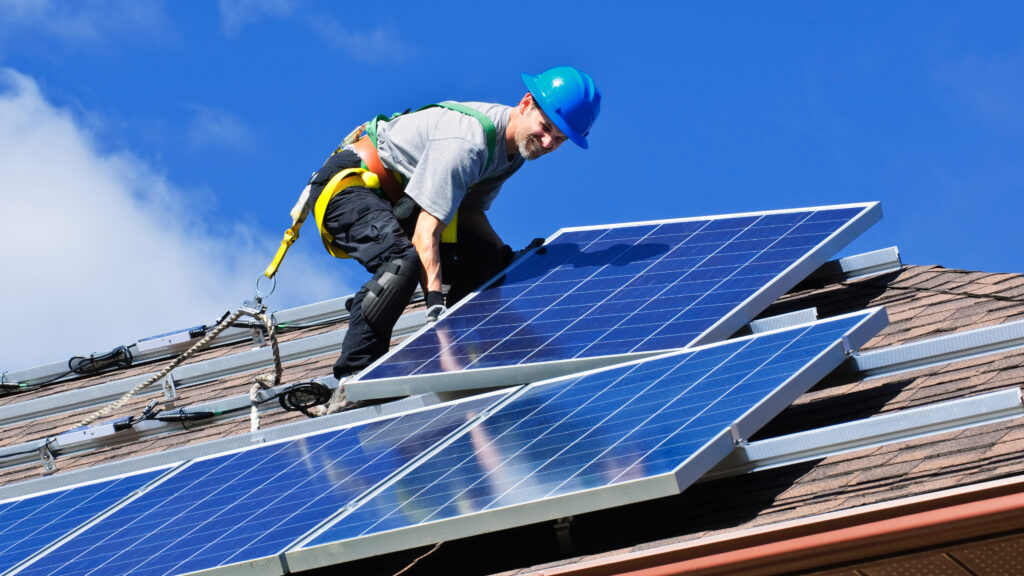
Dr. Mark McNees is the director of Social and Sustainable Enterprises at Florida State University’s Jim Moran College of Entrepreneurship and managing consultant at The McNees Group. Banner photo: A solar panel being installed on a rooftop (iStock image).
Sign up for The Invading Sea newsletter by visiting here. To support The Invading Sea, click here to make a donation. If you are interested in submitting an opinion piece to The Invading Sea, email Editor Nathan Crabbe at nc*****@*au.edu.

Thanks for this insightful column. It helps answer some of the questions I had when I visited South Florida Labor Day weekend. I was shocked that as I drove around Miami I saw not one solar panel on a roof. There were no trees blocks the sunlight. All this sunshine and no solar panels. How could that be? How was that an accident. I realize that this is systemic. I shudder to think of what the future will look like given some of the decisions being made in Washington.