


By Peyton McCauley and Melissa Scanlan, University of Wisconsin-Milwaukee
As demand for artificial intelligence technology boosts construction and proposed construction of data centers around the world, those computers require not just electricity and land, but also a significant amount of water. Data centers use water directly, with cooling water pumped through pipes in and around the computer equipment. They also use water indirectly, through the water required to produce the electricity to power the facility. The amount of water used to produce electricity increases dramatically when the source is fossil fuels compared with solar or wind.
A 2024 report from the Lawrence Berkeley National Laboratory estimated that in 2023, U.S. data centers consumed 17 billion gallons (64 billion liters) of water directly through cooling, and projects that by 2028, those figures could double – or even quadruple. The same report estimated that in 2023, U.S. data centers consumed an additional 211 billion gallons (800 billion liters) of water indirectly through the electricity that powers them. But that is just an estimate in a fast-changing industry.
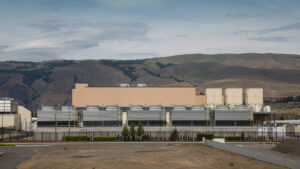
We are researchers in water law and policy based on the shores of Lake Michigan. Technology companies are eyeing the Great Lakes region to host data centers, including one proposed for Port Washington, Wisconsin, which could be one of the largest in the country. The Great Lakes region offers a relatively cool climate and an abundance of water, making the region an attractive location for hot and thirsty data centers.
The Great Lakes are an important, binational resource that more than 40 million people depend on for their drinking water and supports a $6 trillion regional economy. Data centers compete with these existing uses and may deplete local groundwater aquifers.
Our analysis of public records, government documents and sustainability reports compiled by top data center companies has found that technology companies don’t always reveal how much water their data centers use. In a forthcoming Rutgers Computer and Technology Law Journal article, we walk through our methods and findings using these resources to uncover the water demands of data centers.
In general, corporate sustainability reports offered the most access and detail – including that in 2024, one data center in Iowa consumed 1 billion (3.8 billion liters) gallons of water – enough to supply all of Iowa’s residential water for five days.
How do data centers use water?
The servers and routers in data centers work hard and generate a lot of heat. To cool them down, data centers use large amounts of water – in some cases over 25% of local community water supplies. In 2023, Google reported consuming over 6 billion gallons of water (nearly 23 billion liters) to cool all its data centers.
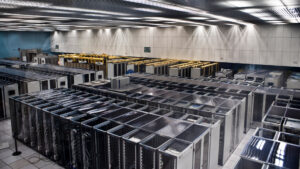
In some data centers, the water is used up in the cooling process. In an evaporative cooling system, pumps push cold water through pipes in the data center. The cold water absorbs the heat produced by the data center servers, turning into steam that is vented out of the facility. This system requires a constant supply of cold water.
In closed-loop cooling systems, the cooling process is similar, but rather than venting steam to the air, air-cooled chillers cool down the hot water. The cooled water is then recirculated to cool the facility again. This does not require constant addition of large volumes of water, but it uses a lot more energy to run the chillers. The actual numbers showing those differences, which likely vary by the facility, are not publicly available.
One key way to evaluate water use is the amount of water that is considered “consumed,” meaning it is withdrawn from the local water supply and used up – for instance, evaporated as steam – and not returned to its source.
For information, we first looked to government data, such as that kept by municipal water systems, but the process of getting all the necessary data can be onerous and time-consuming, with some denying data access due to confidentiality concerns. So we turned to other sources to uncover data center water use.
Sustainability reports provide insight
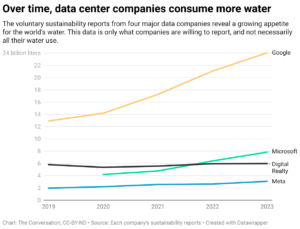
Many companies, especially those that prioritize sustainability, release publicly available reports about their environmental and sustainability practices, including water use. We focused on six top tech companies with data centers: Amazon, Google, Microsoft, Meta, Digital Realty and Equinix. Our findings revealed significant variability in both how much water the companies’ data centers used, and how much specific information the companies’ reports actually provided.
Sustainability reports offer a valuable glimpse into data center water use. But because the reports are voluntary, different companies report different statistics in ways that make them hard to combine or compare. Importantly, these disclosures do not consistently include the indirect water consumption from their electricity use, which the Lawrence Berkeley Lab estimated was 12 times greater than the direct use for cooling in 2023. Our estimates highlighting specific water consumption reports are all related to cooling.
Amazon releases annual sustainability reports, but those documents do not disclose how much water the company uses. Microsoft provides data on its water demands for its overall operations, but does not break down water use for its data centers. Meta does that breakdown, but only in a companywide aggregate figure. Google provides individual figures for each data center.
In general, the five companies we analyzed that do disclose water usage show a general trend of increasing direct water use each year. Researchers attribute this trend to data centers.
A closer look at Google and Meta
To take a deeper look, we focused on Google and Meta, as they provide some of the most detailed reports of data center water use.
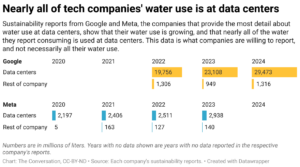
Data centers make up significant proportions of both companies’ water use. In 2023, Meta consumed 813 million gallons of water globally (3.1 billion liters) – 95% of which, 776 million gallons (2.9 billion liters), was used by data centers.
For Google, the picture is similar, but with higher numbers. In 2023, Google operations worldwide consumed 6.4 billion gallons of water (24.2 billion liters), with 95%, 6.1 billion gallons (23.1 billion liters), used by data centers.
Google reports that in 2024, the company’s data center in Council Bluffs, Iowa, consumed 1 billion gallons of water (3.8 billion liters), the most of any of its data centers.
The Google data center using the least that year was in Pflugerville, Texas, which consumed 10,000 gallons (38,000 liters) – about as much as one Texas home would use in two months. That data center is air-cooled, not water-cooled, and consumes significantly less water than the 1.5 million gallons (5.7 million liters) at an air-cooled Google data center in Storey County, Nevada. Because Google’s disclosures do not pair water consumption data with the size of centers, technology used or indirect water consumption from power, these are simply partial views, with the big picture obscured.
Given society’s growing interest in AI, the data center industry will likely continue its rapid expansion. But without a consistent and transparent way to track water consumption over time, the public and government officials will be making decisions about locations, regulations and sustainability without complete information on how these massive companies’ hot and thirsty buildings will affect their communities and their environments.
Peyton McCauley is a water policy specialist and a Sea Grant UW Water Science-Policy Fellow at the University of Wisconsin-Milwaukee and Melissa Scanlan, is a professor and director of the Center for Water Policy in the School of Freshwater Sciences at the University of Wisconsin-Milwaukee.
This article is republished from The Conversation under a Creative Commons license. Read the original article. Banner photo: Servers in a data center (BalticServers.com, CC BY-SA 3.0, via Wikimedia Commons).
Sign up for The Invading Sea newsletter by visiting here. To support The Invading Sea, click here to make a donation. If you are interested in submitting an opinion piece to The Invading Sea, email Editor Nathan Crabbe at ncrabbe@fau.edu.
