


By Matthew Sturchio, Colorado State University
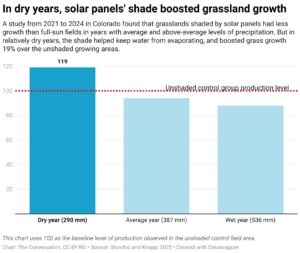
Grasses growing in the shade of a solar array were only a little less productive than those growing nearby in open grassland during years of average and above-average rainfall – but in a dry year, the shaded plants grew much better than those growing in full sun. That’s the result of a four-year study we conducted in a semi-arid grassland of northern Colorado.
When choosing a location for generating solar power, consistent sunlight and interconnection to the electric grid are key criteria. In Colorado the combination of new electrical transmission infrastructure, abundant sunlight and short vegetation that is easy to maintain have made grasslands a prime target for solar development.
Grasslands, like those that dominate the eastern plains of Colorado, provide important habitat for wildlife and serve as a critical food source for livestock. Although these grasslands have long been productive despite their normally arid environment, a warmer climate has increased the potential for more frequent and severe drought. For instance, a recent global study found that previous research likely underestimated the threat of extreme drought in grasslands.
At Colorado State University, biology professor Alan Knapp and I started the ecovoltaics research group to study the effects of solar development in grasslands. Our primary goal is to ensure an ecologically informed solar energy future.
Solar panels create microclimates
Strings of solar panels redirect rain to the edge of panels. Because of this, small rain events can provide biologically relevant amounts of water instead of evaporating quickly.
Simultaneously, solar panels shade plants growing beneath them. Some arrays, including the ones used in our study, move the panels to follow the path of the Sun across the sky.
This results in a combination of sun and shade that is very different from the uninterrupted sunlight beating down on plants in a grassland without solar panels. In turn, patterns of plant stress and water loss also differ in grasses under solar arrays.
How grasses respond to a solar panel canopy
To get a handle on how these different conditions affect grasses, we measured plant physiological response during the early stages of our study. More specifically, we tracked leaf carbon and water exchange throughout daylight hours, 9 a.m. to 5 p.m., over 16 weeks in summer 2022 at Jack’s Solar Garden, a solar array over grassland in Longmont, Colorado.
In general, plants that are adapted to full sun conditions, including most grasses, might not be expected to grow as well in partial shade. But we suspected that growth benefits from reduced water stress could outweigh potential reductions in growth from shading. We call this the “aridity mitigation potential” hypothesis.
Sure enough, we found evidence of aridity mitigation across multiple years, with the most pronounced effect during the driest year.
When water is scarce, increases in grassland productivity are more valuable because there isn’t as much around. Therefore, increasing grassland production in dry years could provide more available food for grazing animals and help offset some of the economic harm of drought in rangelands.
Informing sustainable solar development in grasslands
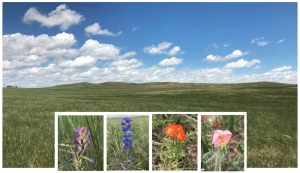
So far, our research has been limited to a grassland dominated by a cool season grass: smooth brome. Although it is a perennial commonly planted for hay, fields dominated by smooth brome lack the diversity of life found in native grasslands.
Future work in native shortgrass prairies would provide new information about how solar panels affect plant water use, soils and grazing management in an ecosystem with 30% less precipitation than Jack’s Solar Garden. We’re beginning that work now at the shortgrass ecovoltaic research facility near Nunn, Colorado. This facility, which will be fully operational later in 2025, was constructed with support from the U.S. Department of Agriculture, through the wider SCAPES project.
Testing the effects of solar panels over grasslands in a native ecosystem with even greater aridity will help us develop a clearer picture of ways solar energy can be developed in concert with grassland health.
Matthew Sturchio is a postdoctoral research associate in natural resources and the environment at Cornell University and a faculty affiliate in ecology at Colorado State University.
This article is republished from The Conversation under a Creative Commons license. Read the original article. Banner photo: Solar panels on grasslands can generate electricity and useful forage or wildlife habitat (Matthew Sturchio, CC BY-ND).
Sign up for The Invading Sea newsletter by visiting here. To support The Invading Sea, click here to make a donation. If you are interested in submitting an opinion piece to The Invading Sea, email Editor Nathan Crabbe at ncrabbe@fau.edu.
