


This story was originally published in the Daily Yonder. For more rural reporting and small-town stories visit dailyyonder.com.
“The natural disaster club is not one anyone wants to join,” said Greensburg, Kansas, administrator Stacy Barnes. But more and more small towns and rural communities are waking up – after a flash flood, tornado, wildfire or hurricane – to discover they are a member, whether they want to be or not.
Greensburg has been a member of the disaster club for almost 20 years now, and the path of its recovery – rebuilding a town from scratch and putting the “green” back in Greensburg – is as remarkable as the surgical precision with which an EF5 tornado wiped out 95% of the town in May of 2007.
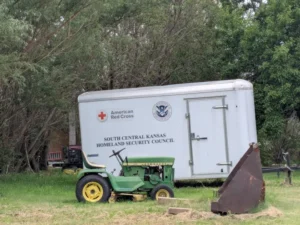
Now heralded as a model green town, Greensburg has been rebuilt for a future that is energy efficient and disaster prepared. Its population of 750 souls is smaller than it was in 2007, but also younger on average than it was before the storm. “The younger families, people with jobs, kids in school, almost without exception, they all stayed, and they’re the ones who rebuilt Greensburg,” said Mayor Matt Christensen.
In 2024, more small towns, including Kerrville, Texas, have unexpectedly joined the disaster club. And down the road from well-known Asheville, North Carolina, the unincorporated town of Swannanoa was hit hard by Hurricane Helene. Ten of the town’s 5,000 residents died that night and townsfolk are still head-down, picking their way through what will be a decades-long recovery process.
George Scott, a local musician and member of the Swannanoa Community Council pointed out that rural communities often don’t have the resources or established governance structure to respond quickly to catastrophic disasters. Scott and other leaders from Swannanoa and Greensburg – some elected, others grown from grist for the mill – offer these tips for how rural communities can prepare for and endure the marathon of recovery after a major natural disaster.
The stages of disaster recovery
Mayor Matt Christenson grew up in Greensburg, but like a lot of young people, never intended to stay after he went away to college. He graduated from Kansas State University with a degree in engineering, the same month as one of the strongest tornadoes on record wiped out his town.
“I thought I’d just come back and help my parents clean up, spend the summer helping out in the community,” he explained. “But then, that fall, I ran for city council on a dare, and things just kind of snowballed. My three-month commitment turned into 10 years on the city council, and I’ve been mayor for the last seven years.”
Over those 18 years, Christenson has been an integral part of all of the stages of disaster recovery, which he rattles off like labels on a blueprint. “The first stage in the immediate aftermath of the disaster is rescue and recovery, trying to minimize loss of life. Then, after that, it’s assessing the damage. What do we have left? What assets? What can be fixed? In Greensburg, the answer was really nothing. The town was all gone. And then you move on to debris removal, which is a monumental task. We were hauling off a whole town — hundreds of homes.”
A year or so out, said Christenson, “There’s a first plan and a second plan. The first plan is how to temporarily sustain the community while you build the permanent things you lost – city hall, a courthouse, a school, a hospital. And then finally, a couple of years in, after all the planning and living in a city-wide construction zone, you get onto permanent construction. That’s another three years to five years. Eighteen years later, we are still a work in progress. And that’s what we want. We believe, never stay where you’re at. Always aim for better.”
Over the decades, as the people of Greensburg have “aimed for better,” they’ve learned other lessons about the rebuilding process, lessons echoed by community leaders in Swannanoa.
The two towns are 2,000 miles away from each other in vastly disparate landscapes. Greensburg is rich in wind and sunshine, with deep roots in a ranch economy. Swannanoa is rich in water and heavily forested mountains that attract hikers, and hip tourists who come for the art, music and beer of new Appalachia. Despite those differences, leaders in both communities emphasized that the most important ingredient in disaster recovery is trusting, listening to and helping neighbors connect with one another.
Build on the strength of relationships
Tissica Schoch bought her grandmother’s house in Swannanoa just six years before Hurricane Helene. She didn’t plan to stay forever, but the house eased her worries about whether she’d be able to afford to live on her income as an accountant for a small consulting firm.
Her house was in a community of old mill houses known as Beacon Village. “The house was built in 1927 when a lot of people didn’t have cars. They just walked to work at the mill. All these houses have shared driveways. So the night of the storm, I was watching large objects float up my street, uphill because of the force of the river, and then I watched some of my neighbors swim up my driveway. They caught hold of my fence, and that was what kept them from being swept out,” she recounted. We brought them inside to our two-story garage. A couple with two teenagers, two dogs, and four cats. They stayed in my garage for five days.”
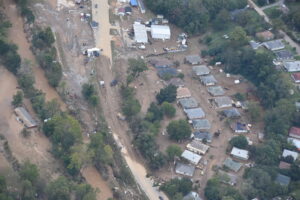
Out of that first maelstrom of just “living in 15 minute windows, figuring out what people needed and doing everything I could to find it,” Schoch emerged as a community leader with a gift for connecting neighbors who need help with those eager to give it.
The residents of Beacon Village, many of whom no longer had homes to return to, began gathering in Schoch’s driveway and later at a neighborhood church that survived the flood. There, they were joined by neighbors from the other side of the river in Grovemont, where, according to Grovemont resident and oral historian Jerry Pope, “Neighbors had also been showing up and offering whatever they could. I’ve got a chainsaw. I’m a nurse. I’ve got a truck. I’ve got a well.”
Most people in Swannanoa didn’t have electricity, cell service, internet or running water for weeks after the storm, but that “be a good neighbor” ethic quickly evolved into an old-school town hall meeting structure. About a week after the flood, people showed up at the church and there were a few town leaders sitting behind a table there ready to answer questions. “Someone suggested why don’t we get rid of the table and just sit in a circle,” said Pope. Thus was born what is now called the Swannanoa Grassroots Alliance, a regular convening of volunteers, non-profit leaders, government officials and imported disaster recovery advisors that continues even ten months after the storm.
Various people facilitate the meetings, which still take place three times a week, but they always begin with the acknowledgement: “We are a community and trauma. And we recognize that we’re all hurting, and make a space for that in our interactions at these meetings. We’re here to hold space for one another through the healing process as neighbors and allies.”
After that, whoever shows up – those who have been dozens of times and those who are in the circle for the first time – introduce themselves and share a need, an announcement, or an idea. After one go around the circle, people stand up and self-select for additional conversations, matching their gift to a need they heard expressed in the circle.
It’s a straightforward, non-heirarchical structure that George Scott calls “an agile approach,” like what tech bros do when they are trying to solve a problem quickly.
Jerry Pope has another name for it: Disaster Recovery Anonymous. Often people come to the meeting as much to tell their story, to be heard and to belong to the recovery club as for concrete solutions to immediate problems. “I still go to every meeting,” said Pope, “just because it feeds me with such positive energy. These are people across religious and political and economic lines who sit down in a circle, and magic happens. The being together is actually what we all need.”
The meetings, heavy on listening and leaning in, are also annotated with nimble communication practices that enable everyone in the circle to “find purpose and service,” said Pope. Everyone is invited to join a What’s App group, broken up into specific focus groups on things like public infrastructure, arts and events, and home repair. The Alliance and non-profits engaged in recovery field calls and regularly refer callers to other members of the group. “You start by just building on the relationships you already have in the community,” said Tonia Allen. Before the storm Allen was a housing coordinator for a local social service agency. She’s now building those connections forward in her new role as executive director of the Swannanoa Resilience Hub.
Give families a reason to stay: schools, child care and jobs
Leaders in both Swannanoa and Greensburg emphasize that after meeting residents’ basic needs – food, water, shelter – it’s essential to provide the things that residents will need in order to stay and continue to be part of the recovery effort. “Our school was destroyed on a Friday evening just a week before graduation,” says Christenson.
“But, within days, the superintendent of our school made the public announcement that the school would be open and accepting students in the fall. We had no idea how we were going to make that happen at the time, but he made that commitment. We raced all summer to set up a temporary school, and that gave a lot of people confidence that, oh, my kid’s gonna have a school to go to, so we’ll stick around.”
Plan with foresight, act with fortitude
Bringing schools, child care, jobs and health care back on-line is a first step to helping a community find its feet again, but people are still traumatized and hungry for a sense of normalcy. Disaster recovery involves so much change – new buildings, new routines, new bureaucratic systems for accessing disaster recovery funds. So devising a plan for rebuilding that includes both innovation and tradition gives people both comfort and a feeling of control over their own future, said Barnes.
In Greensburg, the town drug store, with its old-fashioned lunch counter, was destroyed by the tornado. When rebuilding, the town salvaged as many materials from the rubble as they could, including tables and stools from the lunch counter. The new city hall building is built of bricks salvaged from the rubble, and it includes a soda fountain built from the remains of the lunch counter.
Keeping the familiar helped Greensburg avoid the fear some residents may have had about their home town going green, and the town’s younger residents were strong supporters. The town now has its own wind farm and runs on 100% renewable energy. Energy costs and residents’ electric bills have actually decreased over the last 20 years, according to Christenson.
Planning for a safer and more sustainable future takes foresight and fortitude. Part of Greensburg’s master plan was to convert its small airport into a business park. Nearly twenty years after the disaster, the business park is “shovel-ready,” according to Barnes, with an established road, utilities and a 1 megawatt solar array under construction. But it still has no occupants. “As a small rural community, we’re not going to attract a big company with 500 jobs,” said Barnes.
“But, we have a letter of intent now from a possible company, and we just keeping working on it, adding one job, and then a few more. For us, 10 jobs, maybe 10 more families, is huge. So we are staying the course of sustainability.”
Mark the milestones
One, or 10, or 20 years out from a natural disaster, individual and collective memories of the trauma endure like scars on the landscape. When it rains hard in Swannanoa or a tornado comes close to Greensburg, as it did in May 2025, those who have lived through previous disasters feel the terror all over again.
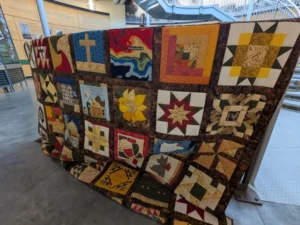
To sustain your community through those triggering events and into what will always be an uncertain future, “It’s important to mark your milestones,” said Christenson. “You have to memorialize the loss and also celebrate the survival of your town and your people.”
In both communities, leaders stressed that art and music have a unique power to commemorate milestones in ways that bring people together behind common goals. In Greensburg, the town’s Big Well Museum includes a stitching circle’s quilted representation of the tornado’s radar signature surrounded by other symbols of how residents have pieced the town back together.
In Swannanoa, where music and art were centerpieces of the town’s economy even before Helene, townsfolk will mark the one year anniversary of the storm with a variety of events including a community potluck, a candlelight vigil, a local artists’ show at the church where SGA meets, and a ceremony at the new bridge connecting residents on both sides of the Swannanoa River where residents can offer prayers, flowers and words to the Swannanoa River.
“We underestimated the river, just as the region underestimated Swannanoa,” said local artist Rebecca Williams. “The river took our homes and our people, but the river and the bridge that connects our community are also our heart and soul. This ceremony is about healing our connection to each other and to this place.”
Build long-term systems
Perhaps the most important advice leaders in both Greensburg and Swannanoa give is this: Volunteers burn out. Long-term systems and positions that sustain effective work over time are essential for long-term recovery.
In Swannanoa, a year out from the disaster, several new non-profits have emerged, with paid staff specializing in specific long-term recovery efforts including housing, business development and environmental resilience. Tonia Allen’s organization is working on future disaster preparedness. “In Helene,” she said, “people were caught off guard. They didn’t have their medications, they needed a generator, but didn’t know how to use it if they had one. Or how to maintain it. We’re working on programs to help the community be more resilient and prepared.”
Formalizing systems to implement long-term plans is essential, said Allen, because the regular folks who are doing the work for the first few months after a disaster are themselves traumatized and vulnerable. “They’re tired, and they are still grieving.”
People can’t be expected to give up their livelihoods and friendships and family responsibilities to be permanent volunteers, but systematizing the work can empower some of the people Schoch calls “street moms” to become paid case workers or non-profit managers. Then, in concert with state and federal disaster recovery systems, they can continue to build their expertise and take action in their own communities.
“Disaster recovery work starts local and it ends local,” echoed Tonia Allen. “It starts with local grassroots efforts and it will end local with the people who are living here and motivated to see our community recover.”
That doesn’t mean that small towns and rural communities have to go it alone. “We’re stronger working together than against each other,” said Christenson.
“And we’re at our best when we’re helping those of us who are in the greatest need. So I very much advocate that the federal and state programs to support disaster recovery continue. Rural communities just do not have the resources necessary to address problems of this scale, and if those programs aren’t available, those little towns just will cease to exist, which is very sad, because small towns are great places to live. They are the beating heart of America.”
This article first appeared on The Daily Yonder and is republished here under a Creative Commons Attribution-NoDerivatives 4.0 International License. Banner photo: Stacy Barnes points to the wreckage of her parents’ house, in a photo of Greensburg on the day after the storm (Photo by Anne Vilen).
Sign up for The Invading Sea newsletter by visiting here. To support The Invading Sea, click here to make a donation. If you are interested in submitting an opinion piece to The Invading Sea, email Editor Nathan Crabbe at ncrabbe@fau.edu.
