


By James H. VanZwieten Jr., Gabriel Alsenas, Mahsan Sadoughipour and Yufei Tang, Florida Atlantic University
The world’s oceans cover more than 70% of Earth’s surface. They’re filled with currents, some much stronger than the fastest flowing large rivers. These currents can be harnessed as clean, marine renewable energy. Marine energy is much more predictable and reliable than many other forms of renewable energy because unlike sun and wind, which regularly do not produce electricity, ocean currents never stop moving around the planet. New research has found that the eastern and south-eastern coasts of Africa have currents that put them among the world’s top potential locations for ocean energy production. Researchers Mahsan Sadoughipour, James VanZwieten, Yufei Tang and Gabriel Alsenas explain what is needed to bring renewable marine energy into African countries’ electricity mix.
How can open ocean currents generate energy?
Ocean currents contain kinetic energy that can be converted to electrical power using turbines.
This is similar to offshore wind farms, or wind turbines positioned in the ocean, that convert wind to electricity. The difference is that converting ocean currents to energy means the turbines would float on the surface or just under the surface of the ocean.
The electricity they generate can be brought to shore using power cables under the sea (as is currently done with wind turbines in the sea). It could also be used to generate hydrogen offshore which could be transported and used as fuel. This would eliminate the need for subsea cables.
What did you set out to find?
We looked at 30 years of water velocity data – measurements of how fast the water moves (currents).
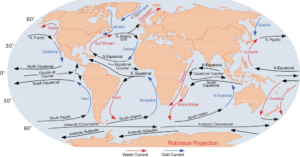
We got the data from drifting buoys in the ocean. These devices are fitted with meteorological and oceanographic sensors that have been sent into the ocean. There are 1,250 of these buoys floating around the world’s oceans today.
They are designed to follow the water circulation in oceans so that they can constantly measure the speed and direction of ocean currents. They aren’t blown around by the wind. They transmit information about ocean currents via satellite so that it can be made publicly available and used by scientists.
We looked at 43 million measurements of ocean current speed and direction at specific locations and times over 30 years. From this, we were able to calculate the amount of energy stored in every metre squared of the ocean. This is known as energy density. This is a foundational step in determining the potential of ocean currents for generating clean and renewable energy. Our research is the first time this information has ever been generated.
Where are ocean current turbines being tested?
Prototypes have been developed and tested at sea from as far back as 1985. But there are no ocean current turbines feeding power to electrical grids at present. This delay between testing the prototypes and getting turbines up and running has happened because of the technical challenges in setting up these systems in deep water offshore environments.
Developers have recently made new advances, however, improving the undersea cables and the microcomputers used in ocean current energy systems, and enhancing the design of the turbine blades. There have also been advances in developing stronger anchors for these systems.
The new and advanced systems are being developed and tested in the waters off Florida, North Carolina, Japan and Taiwan.
Engineers in South Africa and Mexico are also investigating the potential of ocean current turbine systems.
Which African countries could generate electricity from ocean currents?
We’ve identified high energy areas in the waters off Somalia, Kenya, Tanzania and Madagascar. They have some of the most energy dense currents on Earth, higher than the standard for wind energy resource to be classified as “excellent”. These are potential sites for ocean energy production. An area in the ocean off the coast of South Africa also has potential.
For example, we found areas with power densities ranging from 500 to 2,500 watts per square metre over an area around 800km by 30km off South Africa and around 2,000km by 30km off Somalia, Kenya and Tanzania.

To put this into perspective, the average small household in South Africa uses on average about 730 watts of power. Therefore, every metre squared in the ocean that generates power could provide enough power for one small South African household.
More research is needed, however. This is because we haven’t been measuring the currents in the Indian Ocean as long as we have for other oceans. For example, Pacific Ocean currents have been measured since 1979 but the Indian Ocean currents have only been measured since 1994.
Also, most of these high-energy areas are located in relatively deep water (over 1,000 metres deep). This could make it challenging to install ocean current turbines.
On the positive side, these areas are relatively close to shore. There are also areas off South Africa, Somalia, Kenya and Madagascar where strong ocean current energy densities are found in waters as shallow as 100 metres. There is a good chance that relatively shallow and nearshore locations such as these will be the first places where ocean current based electricity will be generated off Africa.
What is needed to make this happen?
Scientists all over the world are conducting research into how to use the oceans’ waves, tides and currents to generate energy. So, what’s needed is for the projects to be developed?
Usually, this starts with a project developer, community or electric company setting up a business to attract investment to get the project started. Then more technical work will be needed. This includes measuring the ocean currents closely to select the precise locations for the turbines, and figuring out how to connect the turbines to shore.
The project developer then needs to bring everything together. Each project will cost a different amount, depending on how big it is and what technology is needs. Finding the start-up funds could be a challenge.
The other stumbling block is that the technologies to harness ocean currents are not commercially viable yet. But they are developing fast.
Ocean current energy is a compelling prospect for African countries in times of climate change.
James H. VanZwieten Jr. is an assistant professor in Department of Ocean and Mechanical Engineering, Gabriel Alsenas is director: Southeast National Marine Renewable Energy Center, Mahsan Sadoughipour is a graduate research assistant in the Department of Ocean and Mechanical Engineering and Yufei Tang is an associate professor and I-SENSE fellow in the Department of Electrical Engineering and Computer Science, all at Florida Atlantic University.
This article is republished from The Conversation under a Creative Commons license. Read the original article. Banner photo: Swirling waters (iStock image).
Sign up for The Invading Sea newsletter by visiting here. To support The Invading Sea, click here to make a donation. If you are interested in submitting an opinion piece to The Invading Sea, email Editor Nathan Crabbe at ncrabbe@fau.edu. To learn more about how ocean currents generate electricity, watch the short video below.

The Canadian government wishes to eliminate diesel-powered generators in Canada’s Far North to provide electricity to those Indigenous nations needing a source of clean energy for their future sustainability. As the climate changes and the arctic becomes warmer, there must be better means of providing that electricity from the environment, and the oceanic currents (which Canada has the longest coastline in the world) should be able to use ocean current turbines to bring clean energy to the northlands. The days of using fossil fuels is over in spite of what the Alberta, BC and Saskatchewan provinces demand further pipelines for Tar Sands bitumen and fracked methane gas for export and combustion in foreign countries. China has the right mindset to bring an end to fossil fuels as should Canada and the USA.
Need Info