


By Joe Murphy
The Rev. Fred Morris, then the president of the Florida Council of Churches, once observed that losing a species to extinction was akin to “tearing a page from the Book of Genesis.” As a person of faith I take these words, and the concept of our responsibility to protect and cherish creation, very seriously.
On an early recent morning, I pondered this thought while I was out looking for birds and all the magic and joy they bring us. My trusty binoculars hung from my neck. My skill and luck with birding and fishing are about the same, so I am deeply thankful for anything I stumble across.
I was reminded of Matthew 6:26 and its call to “look at the birds of the air.” I know there is a deeper and greater meaning to this passage than simply calling on us to look up and take in the wonder of birds in flight, but I enjoy thinking of it as the birder’s passage.
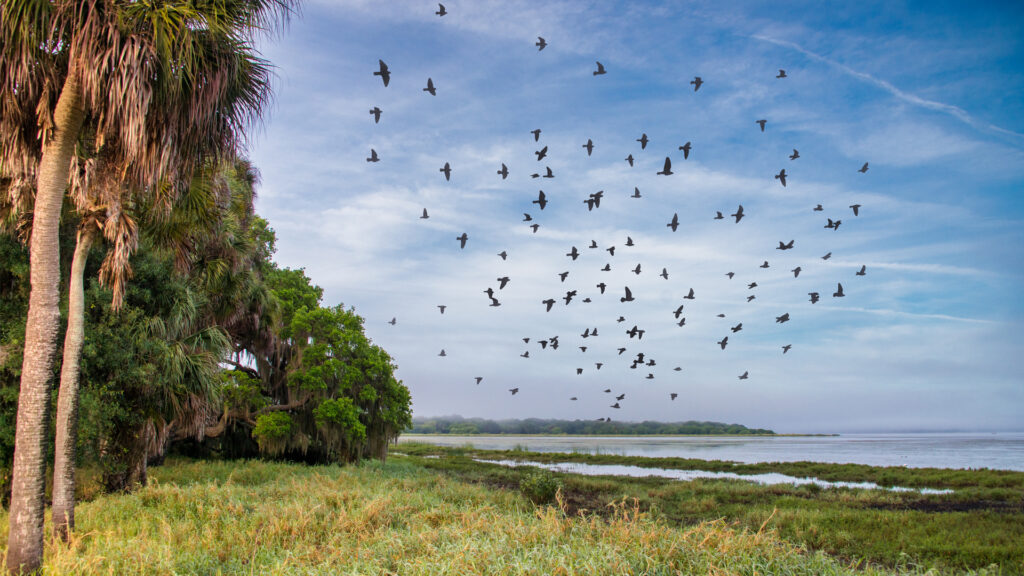
What struck me, though, was the realization that one day we may indeed look for the birds in the air, and they will be gone. Many of the species that we hold dear will have disappeared into the dark night of extinction from which there is no dawn.
So much of the joy brought by our feathered fellow species is in the joyous and robust songs and sounds that accompany their presence in our lives. What if that music, the music of nature, was to disappear? And what have we already lost in terms of the natural music, all the notes and calls in the grand symphony of nature, that we no longer hear?
When I am lucky enough to hear the ancient trumpet call of sandhill cranes, I wonder what it must have been like to hear a cacophony of whooping cranes calling across a wet prairie as dawn emerged in days past in Florida – figures shrouded in the mist of morning, calling out as they had for centuries. That music is mostly silent now.
Generations that came before us in Florida, now long since passed, may have heard the yips and howls of red wolves in the dark night. What an incredible primal experience it must have been to hear them calling to a full moon. That music is silent now.
When I was young, we lived on the banks of the Withlacoochee River, across the river from the Withlacoochee State Forest. This was the 1970s and wild Florida was still strong. One night as we gathered around a campfire we heard a piercing, terrifying scream from across the river. I still remember all the hairs standing up on my neck and the sheer terror of a sound I did not know but instinctively knew to respect.
Our neighbor on the river was deep Florida cracker, born and bred in Nobleton. When the screams faded, he simply turned to us, and in a voice as deep as dark rich cane syrup, simply drawled, “Panther.” I will never forget that moment. I have not heard one since, but harbor hope I may still one day.
The true and abiding sound of nature that I yearn to hear is the call of an ivory-billed woodpecker. The adherent to conservation biology in me knows what extirpation and extinction means in a policy sense, but the dreamer in me still holds out a slim tendril of hope.

When I drive through or explore deep and ancient cypress swamps, river bottoms or flood plains in the Florida Panhandle or the Nature Coast, I always pause and listen. I silently take my ancient ivory-billed woodpecker plush toy out, now over 20 years old, and give it a squeeze. I do it gingerly as I fear the day when the sound making device inside gives out.
I send forth a brief call, in part in expectation of the miracle of a response. But more importantly, a landscape that evolved with that call, that sound, that music, as an integral part of creation for the briefest of moments, has it again.
Without clear, resolute action to cherish and safeguard the wonders of creation in Florida, we may one day look to the air and see nothing. We can and must act to protect imperiled species. Or one day we might simply hear the sounds of extinction, a vast silence of nothingness that eludes even memory.
Joe Murphy is a native and lifelong Floridian who lives in the southern Nature Coast of Florida. Banner photo: Sandhill cranes about to take flight (iStock image).
Sign up for The Invading Sea newsletter by visiting here. To support The Invading Sea, click here to make a donation. If you are interested in submitting an opinion piece to The Invading Sea, email Editor Nathan Crabbe at ncrabbe@fau.edu.

Reading Joe Murphy’s article in the 10/5/2025 Tampa Bay Times, I immediately thought of the pythons in the everglades and how they are devouring so much of the small game and birds, silencing them. While climate change has to be addressed relentlessly, so also more has to be done on eradication of the python.
I read Joe Murphy”s article in Suncoast News-Tarpon-North Pinellas 10/8/25. My river is Brooker Creek. It is the necklace with precious partially protected green spaces (Brooker Creek Preserve, Tarpon Woods Golf Course, Pinellas Trail, John Chestnut Park, Lake Tarpon, Old Tampa Bay) connected by it it and wetlands in between that has so far have resisted development. Pinellas is the most developed county in Florida and these natural areas desperately need protection from those who Pave Paradise for $. Our neighborhoods are activated and looking for allies, lawyers and legal and effective ways to resist development in the Brooker Creek floodplain. This is about environment, safety, recreation, and emergency preparedness. Comments can be sent to daviddmpb@outlook.com