


By Anne Vilen, The Daily Yonder
I drove more than 7,000 miles this summer, from North Carolina to Montana and back, through vast swathes of rural America, tent camping most nights in state or national parks.
This is what I learned: Americans from every ZIP code, walk of life and political persuasion love their public lands.
We don’t want to sell them, develop them or monetize them. In fact, spending time in these co-owned spaces — literally, our common ground — is a great way to build a shared understanding of America’s diversity, strength and resilience.
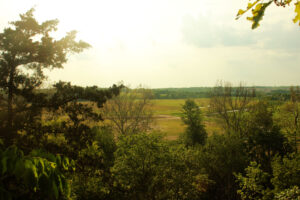
Early in my journey, I spent two nights at Cuivre River State Park, a wild tract of woods and water outside of St. Louis, Missouri. It was hot as a frog in a frying pan that afternoon, but the four 20-somethings who pulled into the campsite next to mine were undeterred. They leapt out of their old Camry, lit up some weed, swore loudly and casually at their janky tent, and started scouring the campground for firewood.
So much for tranquility, I thought.
Then I remembered how my Dad always reached out to make good neighbors across rising fences — even in a campground. I walked over and offered the boys all of my remaining firewood.
Surprised by the gesture of goodwill from a solo woman easily the age of their grandmothers, they ma’amed me multiple times, explained that they were celebrating someone’s 21st birthday and apologized for being rowdy. We parted as the katydids started sawing loudly in the dark trees overhead.
The next morning, as I poured my first cup of coffee, one of the boys came over and gave me a box of energy bars. “We gotta head into work,” he said. “But thanks for the wood.” It was a peaceful outing after all – for all of us.
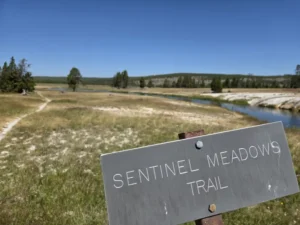
A thousand miles and five states later, I ventured into Sentinel Meadows, on the edge of Yellowstone National Park’s famous geyser basin. Alone, I followed the winding trail beside a rippling creek and then through oatgrass and sedges into a broad expanse of field powdered with the white silica-rich deposits of active steam vents. Far away, near what looked like smoke circles rising from the earth, I was surprised and curious to see an army of little green men!
When I got closer, I learned that the people in neon vests were a group of biochemists from Arizona State University, permitted by the National Park Service to study what lives in the soils around geyser basins. “Why should we care about that?” I asked one young graduate student.
“We want to understand the relationships between the organisms and the water in what seems like an inhospitable ecosystem. Some bacteria thrive in hot water, others live without light. That can help us understand the conditions where life is possible even on other worlds.”
A trail’s turn after I left the scientists, a shaggy coyote burst out of the pines about 30 yards in front of me. We both lurched backward, jaws dropping. For a split second, before she bolted back into the trees, we stared at each other. And in the golden marbles of her eyes, I imagined another world–not human, but sentient and thriving.
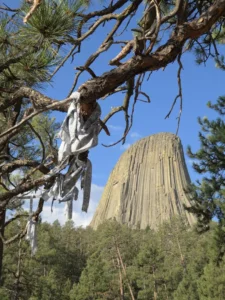
At Devil’s Tower National Monument in Wyoming, I had a different multicultural experience. I arrived nearly at daybreak and circumnavigated the tower on foot before other visitors arrived. Serenaded by bird song and the hush of wind through junipers, I photographed the stone edifice behind fluttering prayer flags, honoring an ancient sacred place.
Back at the visitor’s center by mid-morning, hundreds of motorcycles were roaring into the parking lot, en route to the annual Sturgis Motorcycle Rally. Bearded, leathered and lathered with sweat, they too were enjoying their public lands. To ensure that the bikers, as well as families, a bus load of French tourists, park staff and other visitors stayed safe, a gang of Christian Cyclists was directing traffic. “This is our public service,” one burly tattooed woman told me. “Have a blessed day.”
Road weary in week four of my journey, I pulled into a public rest area outside of Chamberlain, South Dakota, where I was greeted by yet another sacred symbol on public lands. The Dignity of Earth and Sky Statue is a 50-foot-tall, stainless steel rendering of a Lakota woman wrapped in a traditional star quilt. The artist, Dale Cloude Lamphere, I read on the inscription, sculpted this tribute to native women in the hope that “Dignity will . . . encourage all of us to embrace our similarities and celebrate our differences.”
Just down the road, in a public park beside the Missouri River, I saw that hope in action. I shared a walking path with Donna Kocer, a Chamberlain retiree, who volunteers her mornings to pick up trash from the riverbank and beautify the park. “Aren’t there park staff whose job that is?” I asked her. “Maybe,” she said. “But it’s a public park, and I’m the public. I feel responsible for keeping it clean because it’s mine.”
We walked a while together, gabbing about how there’s a lovely surprise around every turn in South Dakota, a state most people prefer to fly over. And then we stopped to watch a group of Amish women in gingham bonnets, long skirts and sneakers playing volleyball next to the pavilion, with the wide Missouri rolling along behind them.
After Minneapolis, Madison and Chicago, I took a wrong turn and impulsively followed a sign to Indiana Dunes National Park–a tiny, vestigial spit of sand and marsh clinging to the edge of Lake Michigan between Gary and Michigan City. I walked out to the shore where a Spanish-speaking family was enjoying a picnic of empanadas and rootbeer on the sand. A few miles down the beach to my left, the massive smoke stacks of U.S. Steel’s midwestern plant belched gray clouds. To my right, the cooling tower of the city power plant rose behind hundreds of rail containers. Just 2% of Indiana lands are public. If it’s up to some in Congress, that fraction too will be privatized, industrialized and monetized.
The story of public lands in America is the story of opposing appetites. One hungers for beauty, solitude and adventure. The other craves conquest, power and progress. Republican senators (and their constituents) objected loudly and successfully to remove a provision from the recently passed Big Beautiful Bill that would have mandated the sale of federal lands.
However, Trump’s Justice Department, going against previous legal determinations, believes the president has the right to abolish national monuments (like Devil’s Tower) without congressional approval.
Another recent action eliminates the Roadless Rule, opening up millions of pristine acres where wildlife and endangered species thrive without habitat disruption from logging, mining and other development.
And finally, a recent effort to revoke the Bureau of Land Management’s Public Lands Rule devalues the work of conservation scientists, like those I met in Sentinel Meadows, so that uses that monetize natural resources, like mining, logging and recreation, take precedence on public lands.
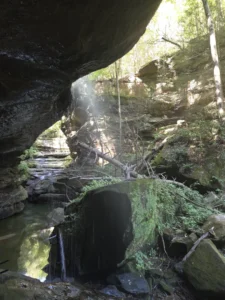
In Kentucky, paddling up Clifty Creek through the Daniel Boone National Forest, I thought about what these incursions into public lands would bring. I watched a wood duck shyly hide itself against the riverbank, behind the veil of a lacy waterfall. Then, turning downriver to take in the sun-bright bluffs arching over cool green water, I spotted a fisherman in another kayak, the first human I’d seen that day.
“It’s a beautiful day out here,” I offered in greeting.
“Isn’t every day a beautiful day out here?” he responded, tipping his paddle at our surroundings.
Suddenly, we both startled as a bald eagle, a species brought back from the brink of extinction by 20th-century conservation efforts, strafed the river and soared into the tree above our heads. The fisherman and I watched in silent awe, and then I whispered the only answer that made sense. “Yes.”
The House Committee on Natural Resources recently convened at Jenny Lake, a popular lodge in Grand Tetons National Park, ostensibly to support park funding, while elsewhere, government officials are busy carving up the pie of public lands that belong to you and me.
The Persian poet Rumi wrote, “Out beyond ideas of wrongdoing and rightdoing, there is a field. I’ll meet you there.” That field – dense with wildflowers and native grasses and buzzing insects, alive with birds and mice and maybe a hunting fox – is where I’d like to take our government decision makers. Up the trail into the mountains, alongside ordinary Americans who’ve come to hike or investigate or pray or celebrate a birthday or fish or just ride their motorcycles through our extraordinary public lands, they too might be inspired to be curious about “the other” people and creatures that inhabit our wild spaces.
And that curiosity is the seed from which understanding and unity grow.
This article first appeared on The Daily Yonder and is republished here under a Creative Commons Attribution-NoDerivatives 4.0 International License. Banner photo: Hikers travel on Sentinel Meadows Trail in Yellowstone National Park (Jim Peaco/NPS, Public domain, via Wikimedia Commons).
Sign up for The Invading Sea newsletter by visiting here. To support The Invading Sea, click here to make a donation. If you are interested in submitting an opinion piece to The Invading Sea, email Editor Nathan Crabbe at ncrabbe@fau.edu.
