


By Janette Neuwahl Tannen, University of Miami News
They are often called the rainforests of the ocean, where a host of different marine life thrives and enchants those fortunate enough to swim around them.
Yet coral reefs are struggling to survive.
In the wake of many devastating global coral reef bleaching events, four University of Miami engineering students created an innovative device to shield corals from strong ultraviolet rays during the summer. This strong light, along with hot ocean water temperatures, often cause corals to expel their algae, bleach and die.
The student team is hoping that their Kanopi shade can prevent more damage to these vital ocean ecosystems. And the students are hoping to test their prototype soon in Florida waters.
“Since 2023, 80% of corals across the world have incurred bleaching-level stress,” said Montale Tuen, one of the team members. “So, the National Marine Sanctuary Foundation wants us to show a pure engineering solution.”
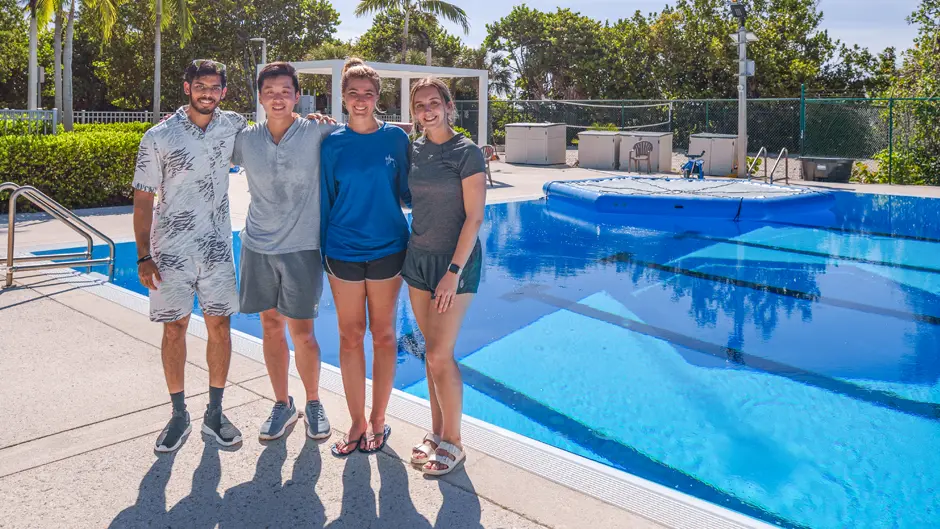
Tuen, along with Danielle Bejar, Kylee Rux and Joshua Prabahar — all graduate students in the University of Miami College of Engineering — came up with the Kanopi as a solution to the Coral Thermal Stress Design Thinking Challenge put forth by the National Marine Sanctuary Foundation last year. Last fall, the team won the competition and earned a grant to manufacture their shading solution.
“We are all very passionate about saving the coral reefs and we understand how important they are to ocean ecosystems, so what we are producing now has the potential to reduce stress on corals internationally,” said Rux. “With these unprecedented warm-water temperatures in the ocean, we needed to design something effective and easily deployable so it has widespread impact on a global scale.”
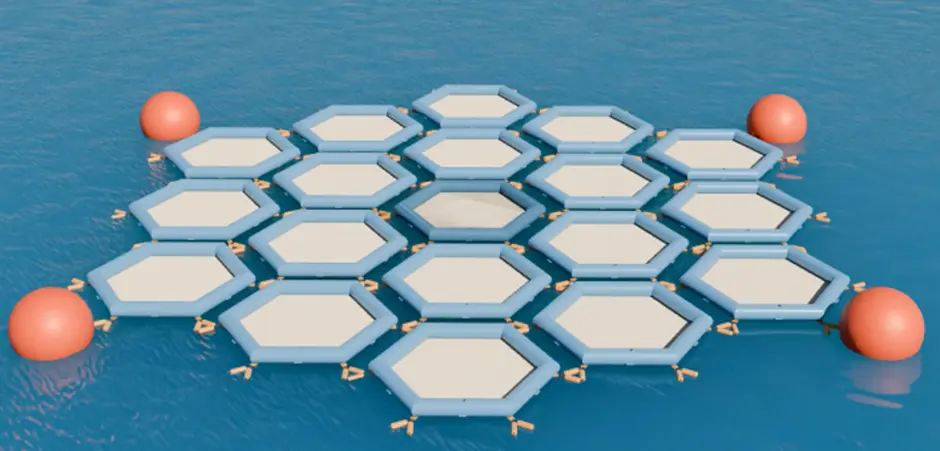
Built from interlocking hexagons, the Kanopi can be expanded or contracted to fit different reefs and will float on the ocean’s surface above coral reefs to protect these vital marine habitats from harmful sun rays.
“Essentially, we designed an inflatable to float above those reefs that are vulnerable to bleaching,” Bejar said.
Since last year, they have worked to refine their idea with guidance from faculty at the College of Engineering and the Florida Keys National Marine Sanctuary. The team also presented at the Reef Futures Conference in Mexico last year, where their innovation was well received by marine science experts, and attended Capitol Hill Ocean Week last spring, where they presented their idea to ocean conservation leaders.
“We had to find a way to create some solutions for coral bleaching beyond the biological solutions that many marine biologists are working on,” said Bejar, a Fort Lauderdale native who also earned a master’s degree in ocean engineering at the University.
While marine scientists are working on breeding thermal-tolerant coral species, the engineers took a very different approach. After studying attempts to create coral shades or umbrellas, they created a design incorporating interlinked hexagons with an inflatable border, forming a thin, floating, blanket-like structure to shade the corals. It will attach to mooring balls, and the main coverage “cloth” will block harmful UV rays, while remaining safe for the marine environment.
“We wanted to create something with minimal impact on the coral substrate,” Prabahar said. “We also did not want to fully block the photosynthetic properties in the coral algae.”
The team has revised its design several times. They recently manufactured and tested their first prototype in a pool at the University. The entire team expects to improve their design with time and hope it will serve as a temporary tool for ocean conservation worldwide.
“The corals that live in the deep sea are safe because UV rays don’t reach that far down, so we are targeting coral that is shallower than 20 meters deep,” Tuen added. “We are hoping to reduce UV exposure so they can survive.”
This piece was originally published at https://news.miami.edu/stories/2025/11/tackling-coral-health-from-a-new-angle.html. Banner photo: A reef with some healthy corals and some corals with signs of bleaching (NOAA, Public domain, via Wikimedia Commons). To learn more about the Kanopi coral reef shade, watch the video below.
Sign up for The Invading Sea newsletter by visiting here. To support The Invading Sea, click here to make a donation. If you are interested in submitting an opinion piece to The Invading Sea, email Editor Nathan Crabbe at ncrabbe@fau.edu.
