


By Arielle Perry, FAU Center for Environmental Studies
Photography can highlight threatened species in distant places, showcase the work of researchers and inspire individuals to become more active stewards of the world around them.
The power of photography in aiding conservation efforts was a key focus of a recent lecture hosted by Florida Atlantic University (FAU).
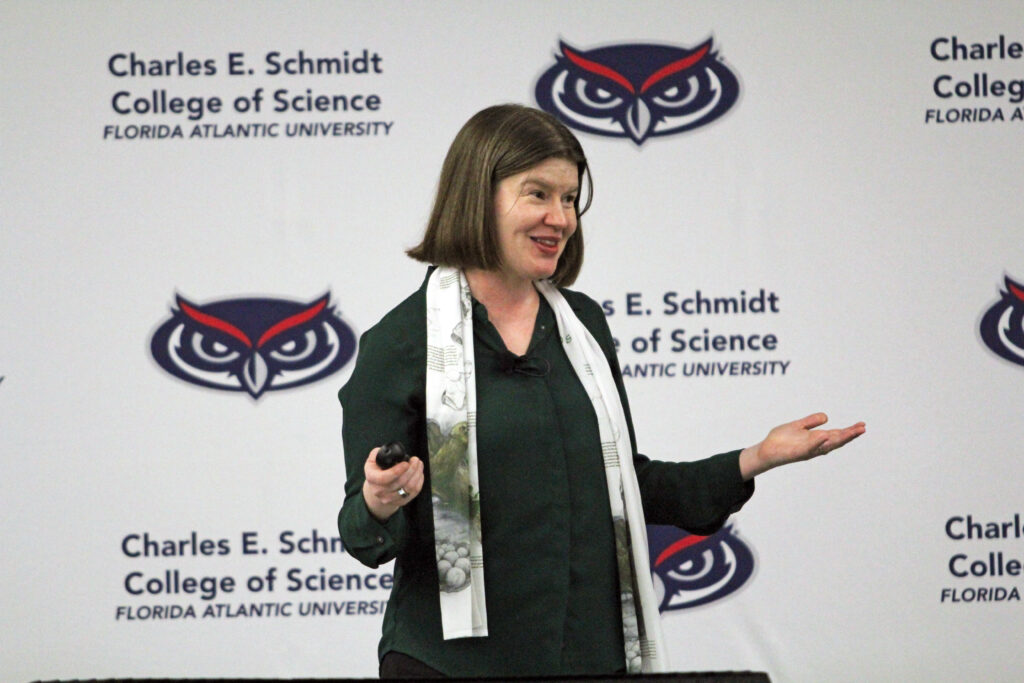
“For the last 15 years, I’ve been regularly joining scientific expeditions as a photographer whose job is to help tell the story of the research and the researchers,” said Gabby Salazar, award-winning conservation photographer and National Geographic Explorer.
Salazar was invited to FAU’s Boca Raton campus to share her experiences photographing faraway locations as part of FAU’s Nat and Dorothy Hyman Science Lecture Series.
Recounting her experiences working alongside scientists in remote corners of the world, Salazar enthralled the audience with striking visuals, behind-the-scenes moments and stories documenting her expeditions in locations such as Guatemala and Mauritius.
Recalling her time on the isolated island nation of Mauritius, Salazar discussed how she sought to photograph the success story of the Mauritius kestrel — once the world’s rarest bird, which was on the brink of extinction in the 1970s. Today, the population has expanded to approximately 600-800 wild kestrels, thanks to a captive breeding and relief program.
“As somebody who worked in conservation, I was really interested in photographing this story, because it’s a hopeful story that shows that if we put our minds together and we work hard, we can help animals recover,” Salazar said.
Salazar also discussed one of her grant-funded projects with National Geographic, a project to study and photograph the first known petrified forests of Guatemala. Incorporating a team of researchers from a variety of disciplines including archeology, paleobotany, cartography and photography, Salazar emphasized how the project underscores the importance of interdisciplinary collaboration.
“What’s fun for me is that when you go out with a team of scientists who are curious people and are asking questions, you never know what you’re going to discover,” she said.
Salazar emphasized that one of the major cornerstones of her career has been telling the stories of scientists across different fields.
“One of the great … privileges of my life has been to be able to be on the front lines, bearing witness to the hard work that scientists do every day to be able to make the discoveries that we read about in the news, that are published in scientific journals,” she said. “It leads to better lives for all of us.”
Salazar also detailed how she was motivated to become a wildlife photographer after seeing people interact with her photo in the Smithsonian National Museum of Natural History, following her win in an international photography contest at the age of 14.
“I would see people stop and smile, or take their own photo of our photos, or talk with each other, and it really helped me understand the power of photography to get people to stop and pay attention — to be curious about the world,” she said.
Arielle Perry is a master’s student in the Environmental Science Program at Florida Atlantic University and is a graduate research assistant at FAU’s Center for Environmental Studies. The center manages The Invading Sea. Banner photo: A Gabby Salazar photo of hikers traversing a glacier in Iceland (Image courtesy of Salazar).
Sign up for The Invading Sea newsletter by visiting here. To support The Invading Sea, click here to make a donation. If you are interested in submitting an opinion piece to The Invading Sea, email Editor Nathan Crabbe at ncrabbe@fau.edu.
