


By Christian Wagley, Healthy Gulf
Walking along the white sand beaches of Pensacola Beach, the tranquil scene of soft sand and gentle waves helps to conceal an epic battle for survival happening in the blue-green waters over the horizon. That’s where a magnificent animal some 40 feet in length fights to exist in an increasingly industrialized sea. It’s the Rice’s whale, one of the world’s rarest and most endangered whales, and one that would be pushed in the direction of extinction by President Donald Trump’s plan to dramatically expand drilling in the Gulf of Mexico.
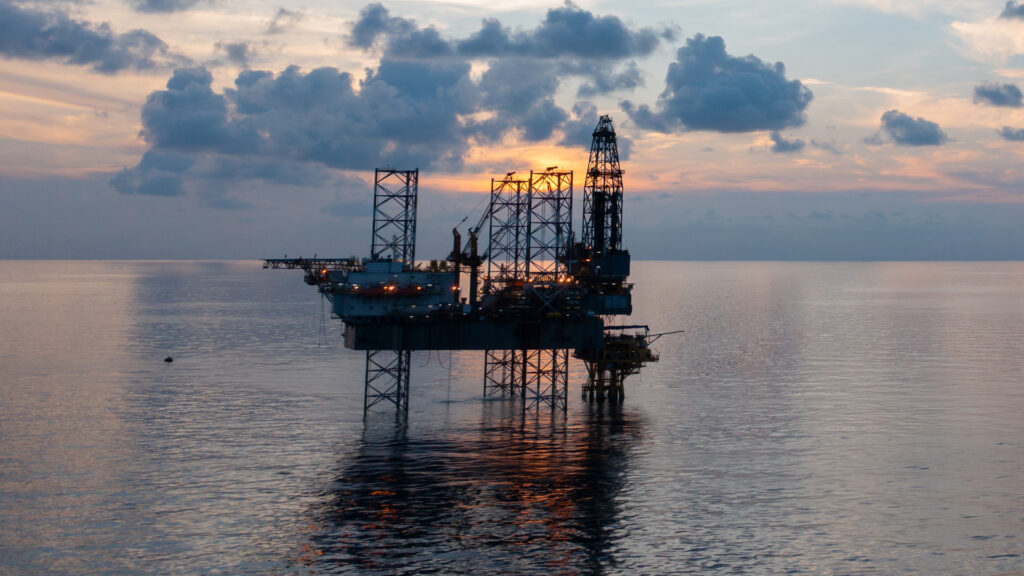
In late November, the Trump administration announced a new five-year plan for offshore drilling that would accelerate leasing for new rigs, and bring drilling closer to Florida than ever before by expanding into a 20-million-acre area of the eastern Gulf. Offshore drilling is a dirty and dangerous business that would have huge negative impacts on Florida marine life, including some of our most beloved animals. We know that because that’s what federal scientists determined.
Last May, the federal government issued a “biological opinion” that forecasts the impacts on marine life from Gulf drilling over the next several decades. The fewer than 100 Rice’s whales remaining live across the Gulf but are most common off Florida, and the opinion estimated that drilling will kill nine Rice’s whales through vessel strikes and seriously injure three more over the next 45 years. This type of impact could mark the end for a species that is already critically endangered. The opinion also estimates that drilling will kill or seriously harm several hundred sea turtles every year through oil spills, ship strikes, air gun blasting, explosives and marine debris.
While that’s a look into the future, we can also look back to the 2010 BP disaster to see what another oil catastrophe could do. That event led to a 22% decline in the population of Rice’s whales, a devastating impact on a species teetering on the edge of survival. Scientists also estimated that 167,000 sea turtles were killed, ranging from hatchlings to adults.
The BP disaster released millions of gallons of oil, which impacted around 1,200 square miles of the Gulf as oil smothered deep sea ecosystems that are still struggling to come back. Only 25% of the oil was recovered, and much of it was forced deeper into the Gulf ecosystem through the use of dispersant, which would likely be used again if another such disaster occurs. Dispersant allowed the oil to literally penetrate into the bodies of marine organisms like tuna and a host of other offshore fish species, and was highly toxic to larval fish.

With the new five-year plan there are even greater risks with drilling as the industry moves farther offshore into deeper water, conducting riskier operations known as high pressure high temperature drilling. This could be devastating for Florida, as the Gulf waters off our shores are currently the only part of the Gulf free from the pollution, noise and chaos of offshore drilling. That allows the eastern Gulf to serve as a desperately needed refuge, a sanctuary for birds, fish, deep sea corals, whales and a range of marine life.
There’s also the loop current that pushes waters of the central Gulf east to the Florida coast, meaning that an oil spill could fowl beaches anywhere from the Everglades to Pensacola. I saw that firsthand on Pensacola Beach during the 2010 BP disaster, which shattered our local economy and a culture and lifestyle that depends on clean beaches.
My enduring memory from that summer is a photo of a man kneeling along a long raft of oil that had just washed ashore, his hand across part of his face to hide his tears. A friend stands behind him, with her hand on the back of his head to comfort him. It’s a scene I hope to never see repeated along the Gulf coast.
More oil drilling in the eastern Gulf doesn’t work for Florida — our coast, our wildlife, our economy or our culture.
Christian Wagley works for Healthy Gulf, a nonprofit organization devoted to clean air and water and public health along the Gulf coast. He lives in Pensacola. Banner photo: A Rice’s whale observed by the Southeast Fisheries Science Center in the Gulf during an aerial survey in 2024 (Credit: NOAA Fisheries/Paul Nagelkirk, Permit #21938).
Sign up for The Invading Sea newsletter by visiting here. To support The Invading Sea, click here to make a donation. If you are interested in submitting an opinion piece to The Invading Sea, email Editor Nathan Crabbe.
