


By Barbara Kates-Garnick, Tufts University
Everyone – politicians and the public – is talking about energy costs. In particular, they’re talking about data centers that drive artificial intelligence systems and their increasing energy demand, electricity costs and strain on the nation’s already overloaded energy grid.
As a former state energy official and utility executive, I know that many of the underlying questions involving energy affordability are very complex and have been festering for decades, in part because of how many groups are involved. Energy projects are expensive and take a long time to build. Where to build them is often also a difficult, even controversial, question. Consumers, regulators, utilities and developers all value energy reliability but have different interests, cost sensitivities and time frames in mind.
The problem of high energy prices is not new, but it is urgent. And it comes at a time when the U.S. is deeply divided on its approaches to energy policy and the politics of solving collective problems.
Rising costs
From September 2024 to September 2025, average U.S. residential electricity prices have risen 7.4%, from 16.8 to 18 cents per kilowatt-hour. Government analysts expect prices will continue to rise and outpace inflation in 2026.
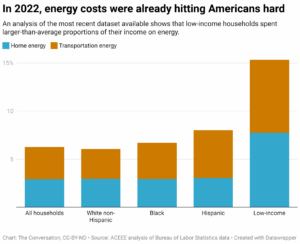
With household earnings basically flat when adjusted for inflation, these increases hit consumers hard. They take up higher percentages of household expenses – especially for lower-income households. Electricity prices have effects throughout the economy, both directly on consumers’ budgets and indirectly by raising operating costs for business and industry, which pass them along to customers by raising prices for goods and services.
The problem
By 2030, energy analysts expect U.S. electricity demand to rise about 25%, and McKinsey estimates that data centers’ energy use could nearly triple from current levels by that year, using as much as 11.7% of all electricity in the U.S. – more than double their current share.
The nation’s current electricity grid is not ready to supply all that energy. And even if the electricity could be generated, transmission lines are aging and not up to carrying all that power. Their capacity would need to be expanded by about 60% by 2050.
Orders of key generating equipment often face multiyear delays. And construction of new and expanded transmission lines has been very slow.
A Brattle Group analysis estimates all that new and upgraded equipment could cost between US$760 billion and $1.4 trillion in the next 25 years.
The reasons
The enormous scale of the work needed is a result of a lack of investment over time and delays in the investments that have been made.
For instance, since at least 2011 there has been an effort to bring Canadian hydropower to the New England electricity grid. Political opposition to cutting a path for a transmission line through forestland meant the project was subjected to a statewide referendum in Maine – and then a court case that overturned the referendum results. During those delays, inflation raised the estimated price of the project by half, from $1 billion to $1.5 billion – an added cost that will be paid by Massachusetts electricity customers.
That multiyear effort is just one example of how the vast web of companies that generate power, transmit it from power plants to communities, and distribute it to homes and businesses complicates attempts to make changes to the power grid.
State and federal government agencies have roles in these processes. States’ public utilities commissions oversee the utility companies that distribute power to customers. The Federal Energy Regulatory Commission oversees connections of power generators to the grid and the transmission lines that move electricity across state lines.
Often, those efforts aren’t aligned with each other, leading to delays over jurisdiction and decision-making.
For instance, as new generators prepare to operate, whether they are solar farms or gas-fired power plants, they need permission from FERC to connect to the transmission grid. The commission typically requests technical engineering studies to determine how the project would affect the existing system. Delays in this process increase the timeline and cost of development and postpone adding new capacity to the grid.
The costs
A key question for regulators and consumers alike is who should pay for adding more electricity to the grid and making the system more reliable.
Utilities traditionally charge customers for the costs of generating and delivering power. And it’s not clear how much power the data centers will ultimately require.

Some large data centers have taken to paying to build their own on-site power plants, though often they can supply energy to the grid as well.
In some states, efforts have begun to address public concern about electricity bills. In November 2025, two utility commissioners in Georgia, who had consistently approved electricity rate hikes over the previous two years, were voted out of office in a landslide.
New Jersey Gov. Mikie Sherrill has pledged to declare a utility-price emergency and freeze costs for a year.
In New York, Gov. Kathy Hochul has paused implementation of state law, driven by environmental concerns, requiring that all new buildings over seven stories tall only use electricity and not natural gas or other energy sources. Hochul has said that requirement would increase electricity demand too much, raising prices and making the grid less stable.
In Massachusetts, Gov. Maura Healey has filed legislation seeking to provide energy affordability, including eliminating some charges from utility bills, capping bill increases and barring utility companies from charging customers for advertisement costs.
The solutions
Clearly, there are no quick fixes or easy solutions to this complex situation.
However, innovation in regulation, combined with new technologies and even AI itself, may enable creative regulatory and technical solutions. For instance, devices that can be programmed to use energy efficiently, time-sensitive pricing and demand monitoring to smooth out peaks and valleys in electricity use can potentially ease both grid load and customers’ bills. But those solutions will work only if all the players are willing to cooperate.
There are a lot of ideas about how to lower the public’s burden of paying for data centers’ power. New ideas like this need careful scrutiny and possible revisions to ensure they are effective at lowering costs and increasing reliability.
As the country grapples with the effort to upgrade the grid, perform long-deferred maintenance and build new power plants, consumers’ costs are likely to continue to rise, further increasing pressure on Americans. Existing regulations and government oversight may no longer lower electricity costs immediately or help people plan for the rising costs over the long term.
Barbara Kates-Garnick is a professor of practice in energy policy at The Fletcher School at Tufts University.
This article is republished from The Conversation under a Creative Commons license. Read the original article. Banner photo: High-voltage electricity towers (iStock image).
Sign up for The Invading Sea newsletter by visiting here. To support The Invading Sea, click here to make a donation. If you are interested in submitting an opinion piece to The Invading Sea, email Editor Nathan Crabbe.
