


By Oliver Wood, Florida Student News Watch
The Guana River is a Wildlife Management Area (WMA) in northeast Florida. Located between Jacksonville and Saint Augustine, the area is a haven for wildlife and a nursery to the sea.
Guana is a hidden gem within the St. Johns County communities that surround it. Fisherman crowd either side of the road as the pavement transitions to a sandy gravel pathway. Tree branches arch over the trailhead, serving as a gateway into a coastal paradise that is flourishing with native flora and fauna. Its ecological importance is hard to overstate, and its beauty is untamed. Yet, it is still being threatened by development.
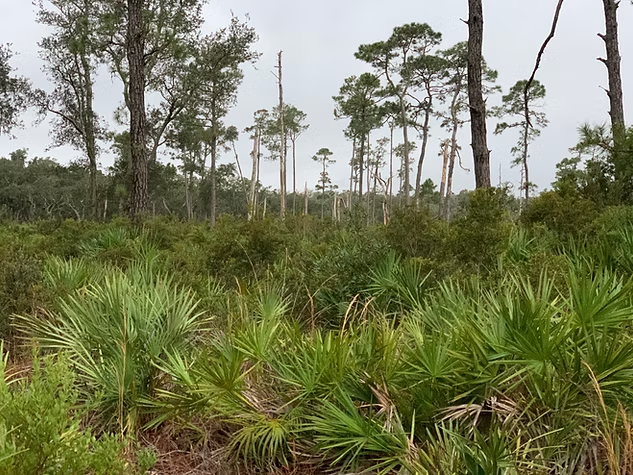
In May, officials from the Florida Department of Environmental Protection proposed to trade 600 acres of conservation land in the Guana River WMA for 3,000 acres of land spread across four different counties. The land was to be swapped with 1,392 acres in Lafayette, 252 acres in Volusia, 1,201 acres in Osceola and 220 acres in St. Johns County. Additionally, DEP gave the public only a week to react before agency officials planned to meet with the State Acquisition and Restoration Council to discuss the proposal.
This proposal was met with public outcry.
Local non-profit organizations such as Save Guana Now and Friends of the Guana Tolomato Matanzas (GTM) sent out a plethora of emails, Save Guana Now organized a protest on May 17 at Mickler’s Beach, and an online petition gained an astonishing 50,000 signatures. This led Upland LLC to withdraw the application. However, the proposal still exposed a scary reality for environmentalists in Florida: Just how permanent is the protection of conservation lands?
The Florida Legislature’s ability to focus on conservation efforts and protect beautiful wetlands and wildlife is harder than ever due to an increasing need for residential land. According to the United States Census Bureau, Florida’s population growth of 467,347 people was second only to Texas over the last year, and Florida’s population has been growing at a rate of over 2% annually since 2021.
Despite this flood of people moving to Florida, land conservation efforts are still holding strong. According to the 2024 Annual Assessment of Florida’s Conservation Lands, over 31% of all land in Florida is designated for conservation purposes.
Dale Viger, Friends of GTM Research Reserve’s executive director, offered some insight into this process. Viger defines conservation areas as lands with natural resources, habitats, ecosystems and biodiversities that are to be protected and managed.
“The lands are typically safe-guarded, if you will, under state and federal conservation easements, management agreements and public ownership,” Viger said. “The primary goal is to preserve ecological integrity and provide the habitat for native wildlife and of course, to offer public access for education and recreation that is still sustainable to the natural environment.”
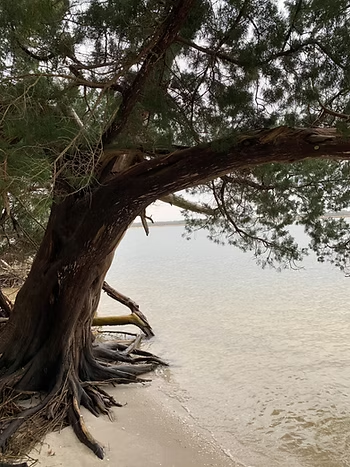
Under Florida Statute 253.42, the Internal Improvement Trust Fund’s board of trustees has been authorized to exchange lands owned by the state for other lands within Florida, including properties owned by counties, local governments, or in this case, individual or private entities. These lands can be exchanged as long as the board agrees that the new lands have equal or greater conservation value. Evaluating conservation value looks into a land’s biodiversity impact, water resources and ecosystem connectivity, among other details. Essentially, this law was put into place to lower the cost of expanding conservation areas by trading instead of buying land.
Many people, including state Rep. Kim Kendall, a Republican whose district includes Guana, believe that this statute is too open ended, and in the case of the proposed Guana land swap, was used incorrectly.
“I think we always thought the conservation lands were strongly protected and we had the safeguards in there,” Kendall said in a recent interview with the News Watch. “We found out last year, with the state parks, that wasn’t the case and now with this land swap, I think that brought to our attention some of the loopholes, if you will.”
Kendall feels adamant about changing this legislation in three ways after this event: clarity, transparency and proper notice.
“I want to see that this Florida Statute is cleared up so that people understand this is supposed to be a land swap side-by-side on similar land, and not something that allows a request of 600 acres in Guana for 3,000 acres across four different counties,” Kendall said. “That’s not the intent of the bill.”
Kendall also wants to add a level of transparency to the process.
“These are public lands. These are taxpayers’ lands. We need to have full information,” Kendall said, arguing for proper notice.“The timing of alerting the public needs to be changed from seven days to 30 days, and there needs to be a local community meeting and signage and things that make it very clear that this is happening.”
At the Friends of the GTM Research Reserve, Viger underscored how important public input can be in situations such as this.
“Changing the status or use of conservation land should not be a simple process,” she said.
“Recent events like the proposed land swap underscore how vital it is for communities to stay engaged and informed. Public advocacy plays a powerful role in ensuring that conservation protections remain strong, intact and respected.”
This story was originally edited by Florida Student News Watch mentor CD Davidson-Hiers. It was originally published at https://www.studentnewswatch.org/post/while-forecasting-is-improving-for-toxic-red-tide-southwest-florida-still-fears-economic-pain. Banner photo: A family walking together along at the Guana River Wildlife Management Area (Kathryn Hennessy, CC BY-SA 4.0, via Wikimedia Commons).
Sign up for The Invading Sea newsletter by visiting here. To support The Invading Sea, click here to make a donation. If you are interested in submitting an opinion piece to The Invading Sea, email Editor Nathan Crabbe at ncrabbe@fau.edu.
