


By Stacey Balkan
Henry Flagler’s railroad to Key West, completed in 1912, was a true engineering marvel — a watershed moment in the development of Florida’s infrastructure. Upon its destruction by the 1935 Labor Day hurricane, the tracks would be replaced by poured cement in service to what is now the Overseas Highway.
If you have ever sat in traffic on that highway, you understand why the railroad might be seen as a superior means of conveying residents and tourists in the event of environmental cataclysm. Although, if you understand the history of automobile and traffic infrastructure, you also know that it is not logic, but profit, that drives decisions about infrastructure — even when such projects mobilize public dollars.
Flagler’s train may have been destroyed by natural forces; but his company, Standard Oil, would become one of a number of private interests (including General Motors and Firestone) that would famously destroy another piece of public infrastructure, far away in San Francisco. In the interest of supporting automobility over public modes of transport like the Bay City’s electric trolley, these companies artificially incentivized ridership on private jitney buses by offering “rock bottom” prices against which the public entities just couldn’t compete.
Not to mention, they were vying with a popular imagination that was completely smitten with the automobile, and the fuel-injected “freedom” that it promised. One imagines the opening lines of Upton Sinclair’s famous muckraking novel “Oil!” — “… smooth and flawless, precisely 14 feet wide, the edges trimmed as if by sheers, a ribbon of grey concrete rolled out over the valley by a giant hand … unmarred by bump or scar, waiting the passage of inflated rubber wheels revolving seven times a second.” However potent Sinclair’s critique, the myth of the open road would prove far more galvanizing than any claims to the common good.
While urban planners across the nation now look toward trains as a smart alternative to automobility, as even Flagler once did, Florida’s legislature seems content to simply add lanes to the grotesquely congested interstate. Trains, it seems, exist for only two reasons: 1) to ferry goods on the slow-moving freight lines that are the frequent scourge of motorists; or 2) to provide a comfortable means of escape from the drudgery of the daily grind, and the extraordinary traffic that would otherwise mar the joy of a Friday night Heat game.
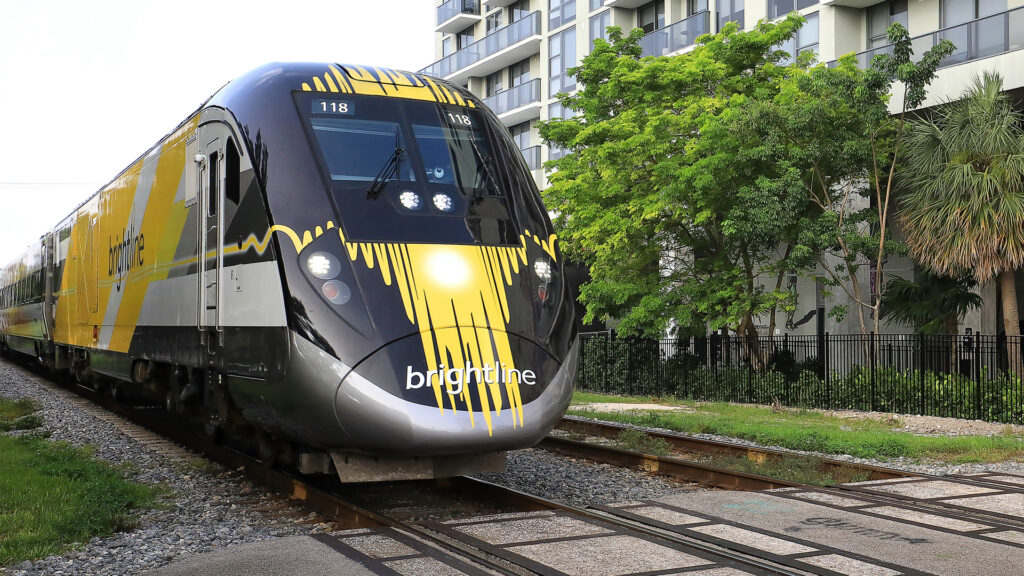
Indeed, Florida’s newest addition to the traffic landscape, the Brightline, was not designed as a commuter train. The Brightline operates in service to a particular form of mobility: one framed by commerce and consumption.
The Brightline is a public-private partnership that appeals to community members who see the train as a luxury. Sleek, quiet and fast, the Brightline has become incredibly popular. It may be comparatively pricey, but it offers a few things that its public competitor lacks: a far more expansive timetable, a vaster geography and a full bar. That’s what happens when private investors are entreated to public infrastructure in the form of already-existing tracks — i.e., few capital costs at the outset, virtually no regulatory hurdles and significant returns on investment.
Beyond the veneer of a private venture that isn’t actually using public monies, Brightline has also been successful on another front: the N.I.M.B.Y. critics who reject the notion of mobility as a common good, and would prefer not to hear noisy trains in their yards, have successfully lobbied for “quiet zones.”
By even the most modest accounts, such “quiet zones” — which translate into high-speed trains silently transecting suburban landscapes — are the single-greatest reason for the extraordinary number of deaths that the Brightline has also caused in its brief tenure. Yes, this so-called “killer train” has now killed 184 people in its two years of existence; that’s 1 every 13 days. The company claims that they are mostly suicides, although critics have pointed out the feckless choices that culminate in a 125 mph train with no horn.
But the Brightline, whose individual ticket prices are far beyond the reach of most working families, is not the only option. Also moving along those tracks is the stalwart Tri-Rail. It may be a bit slower than the Brightline, but it is certainly far faster than the traffic creeping along Interstate 95.
Of course, there’s no bar. There is simply, and brilliantly, a convenient and modestly priced mode of conveyance that humbly offers to ferry passengers — whether between various towns and cities, or to the Miami and Fort Lauderdale airports in a fraction of the time that it would take to drive.
Admittedly, coming from New York City I can hardly cognize the choice to drive in South Florida when the Tri-Rail awaits. And yet, it is apparently so contrary to the outlaw caricature of the stereotypical Floridian to embrace common-sense public transportation.
To be fair, it isn’t just anti-Floridian to take the train; such transgressions are seen as fundamentally un-American. Public transportation is for the indolent, the poor; it is surely not for the industrious and the self-reliant. Thus, not only would we prefer the “freedom” to sit in endless hours of traffic and to then spend our precious bits of free time looking for parking; we seem to exhaust our political might fighting for more lanes, more parking, more traffic, instead of fighting for more infrastructure such as our embattled Tri-Rail system.

The Florida Department of Transportation is poised to cut funding to $15 million annually from $62 million. It is predicted that the decreased funding will culminate in the death of our public train by 2027 – also adding, per Palm Beach County Mayor Maria Marino, at least an additional lane of traffic on I-95 daily. South Florida Regional Transportation Authority (SFRTA) Executive Director David Dech has correctly remarked that whether or not you use the Tri-Rail, you “sure would like the other people on 95 to be taking that train.”
Meanwhile, the argument for defunding seems to be that the public train doesn’t promise significant returns for Florida taxpayers, who are subsidizing track maintenance. But this assumes that Florida taxpayers are gleaning comparable benefits from highway expansions that their tax dollars are also subsidizing.
The point is: Public transportation benefits the common good, and it affords great possibility for commuters and tourists alike. The funding that the Tri-Rail has historically received contributed to a vital network for the conveyance of Floridians — to the tune of 4.5 million riders last year! They either see the clear wisdom in such choices or cannot afford the increasingly prohibitive costs of automobility.
Stacey Balkan is an associate professor of environmental literature and humanities, and program coordinator for the undergraduate minor in environment and society and graduate certificate in environmental studies at Florida Atlantic University. Banner photo: A Trail-Rail train passes through Fort Lauderdale (iStock image).
Sign up for The Invading Sea newsletter by visiting here. To support The Invading Sea, click here to make a donation. If you are interested in submitting an opinion piece to The Invading Sea, email Editor Nathan Crabbe at ncrabbe@fau.edu.
