


By Bonnie Jean Feldkamp
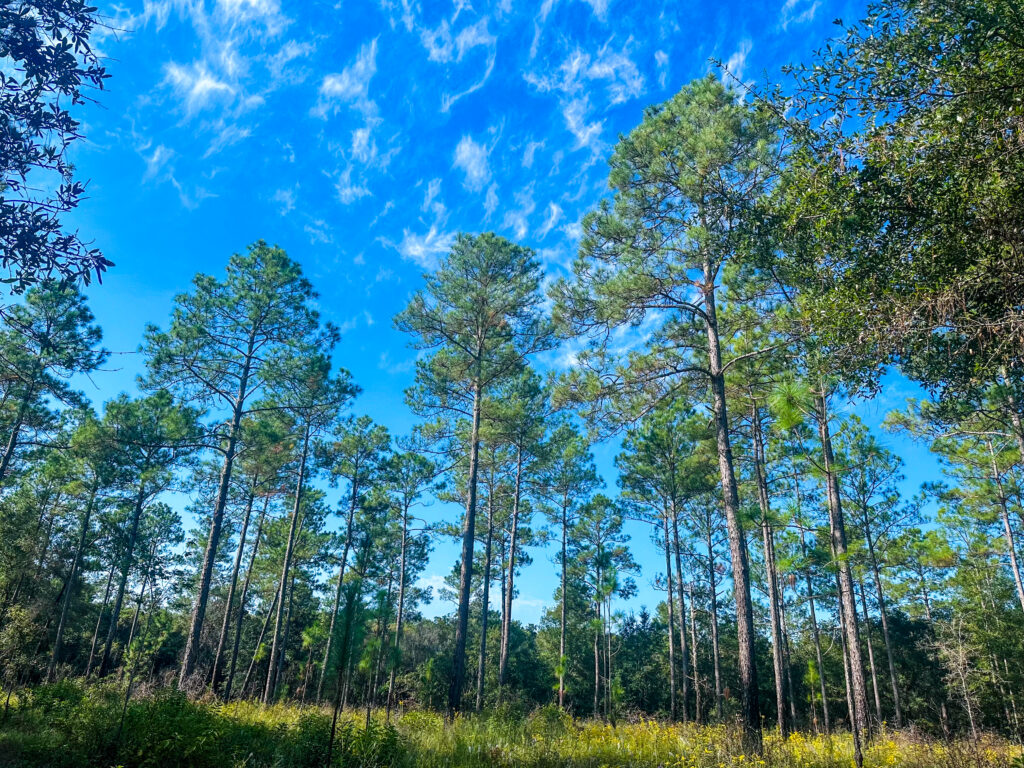
Standing in the restored longleaf pine forest of the Nokuse Preserve in northwest Florida, I learned that it borders Eglin Air Force Base. At first glance it felt insignificant, but I soon understood that their close proximity was strategic and collaborative. In the middle of a government shutdown, it is a great reminder that government entities with differing objectives can find common ground and work toward solutions that benefit everyone.
When you think of wildlife conservation, the Department of Defense probably doesn’t come to mind, and when you think of protecting endangered species, our military might not be your first thought either — but maybe it should be. In 19 locations across the United States, the Department of Defense, the Department of the Interior and the Fish and Wildlife Service all work together in partnership with state and local governments as well as private organizations on what are known as sentinel landscapes.
It’s why I wanted to talk to Kent Wimmer with Defenders of Wildlife. Kent is the northwest Florida senior representative and coordinator for the northwest Florida sentinel landscape. He said sentinel landscapes are “really all about our partners working together.”
Conservation efforts on military installations have a long history. Eglin Air Force Base was even the foundation for the fish and wildlife conservation program in 1949. What makes the sentinel landscapes program special is that it reaches beyond installation boundaries, taking a community and collaborative approach.
Sentinel landscapes are designated geographic areas that give special priority to projects to protect military missions, conserve habitat for listed species and maintain working lands. Joint Base Lewis-McChord in Washington was the first one established in 2013. It’s collaborations like these that give me hope.
Kent pointed out that “the eastern half of the Gulf of Mexico is the largest testing and training range in the continental United States.” Northwest Florida received its sentinel landscape designation in 2022.
At 725 square miles, Eglin Air Force Base is the Air Force’s largest installation with special-use airspace that supports testing and training missions. Eglin is the anchor military installation in the northwest Florida sentinel landscape, which includes nine DOD installations vital to military training. We’re talking weapons testing, special operations, joint cyber warfare and aviation pilot training for the Air Force, Navy, Marine Corps and Coast Guard.
What does any of this have to do with wildlife conservation?
Military installations and endangered species share a common plight — development. Military areas are kept wild for a reason: It makes training missions more authentic and effective for soldiers. Residential, commercial and industrial development encroaches on military installations that used to be remote. This not only presents a challenge for military training but also pushes more wildlife onto military property as their last resort for habitat.
Development around military perimeters also affects airspace, especially since training includes low-altitude flight maneuvers. Roads with streetlights, neighborhoods and parking lot lighting can also undermine training with night vision devices and limit flight path options.
National security is, of course, top priority for the armed forces. However, the need to buffer military areas from development makes partnerships with conservation groups and working lands ideal. Through the Readiness and Environmental Protection Integration Program, the Department of Defense has supported compatible land-use projects for decades, including the adjacent Nokuse Preserve I visited.

The northwest Florida sentinel landscape also aligns well with the Florida Forever program, a state-funded land acquisition program working to protect conservation and recreation lands. Large protected lands such as the Eglin Air Force Base and Apalachicola National Forest are great, but without a protected connecting corridor, the region’s rich biodiversity exists in isolated pockets while military routes are choked off. By protecting a 100-mile connecting corridor of land in the Florida Panhandle, the state preserves critical habitat while also protecting important low-level flight areas for military use.
Florida wants to be the most military- and veteran-friendly state in the nation. Gov. Ron DeSantis has said so many times. The military is not only vital to national defense but also to Florida’s economy, just as the state’s natural environment drives billions through tourism and outdoor recreation. Both depend on protecting the land.
“Whatever they can do to protect the military mission, they’re all for it,” Kent said. “And if we can protect some gopher tortoises or flatwood salamanders or RCWs (red-cockaded woodpeckers), that’s just icing on the cake.”
Bonnie Jean Feldkamp is a syndicated columnist. Find her on Instagram @WriterBonnieJean. Banner photo: Airman 1st Class Caleb Pavao documents endangered wildlife conservation efforts on Hurlburt Field in 2017. The U.S. Fish and Wildlife Service worked with Eglin Air Force Base staff to create artificial nesting cavities in trees on Hurlburt Field for the red-cockaded woodpecker (U.S. Air Force photo by Staff Sgt. Marleah Cabano, via Defense Visual Information Distribution Service).
Sign up for The Invading Sea newsletter by visiting here. To support The Invading Sea, click here to make a donation. If you are interested in submitting an opinion piece to The Invading Sea, email Editor Nathan Crabbe at ncrabbe@fau.edu.

Eglin AFB and Hurlburt Field have a long history of enlightened relations with their environment. In 1996 I was commissioned to do a survey of Hurlburt to identify habitats of endangered species or Species of Special Concern. The DOD’s objective was to steer development as much as possible away from sensitive areas. At the same time there was a very large Nature Conservancy project on Eglin to find the most effective methods for restoring longleaf-wiregrass habitat restoration. Incidentally, both projects in aggregate generated several hundred full and part-time jobs.
The U.S. military footprint has gotten a lot of heavy criticism for its destructive effects on the environment. It’s comforting to see that, at least in some corners of that footprint, a more healthy and positive relation still persists.