


By Simon Chin-Yee, Mark Maslin and Priti Parikh, UCL
As the sun set on the Amazon, the promise of a “people’s COP” faded with it. The latest U.N. climate summit – known as COP30, hosted in the Brazilian city of Belém – came with the usual geopolitics and the added excitement of a flood and a fire.
The summit saw Indigenous protests on an unprecedented scale, but the final negotiations were once again dominated by fossil fuel interests and delaying tactics. After 10 years of climate (in)action since the Paris agreement, Brazil promised COP30 would be an “implementation COP.” But the summit failed to deliver, even as the world recorded a devastating 1.6 degrees C (2.88 degrees Fahrenheit) of global warming last year.
Here are our five key observations:
1. Indigenous groups were present – but not involved
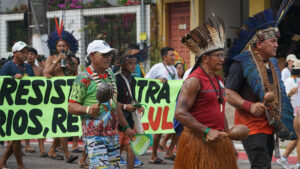
Located in Amazonia, this was branded the summit for those on the frontlines of climate change. Over 5,000 Indigenous people were there, and they certainly made their voices heard.
However, only 360 secured passes to the main negotiating “blue zone,” compared to 1,600 delegates linked to the fossil fuel industry. Inside the negotiating rooms it was business as usual, with Indigenous groups remaining as observers, unable to vote or attend closed-door meetings.
The choice of location was nicely symbolic but logistically tough. Hosting the conference in the Amazon cost hundreds of millions of dollars in a region where many still lack basic amenities.
A stark image of this inequality: with hotel rooms full, the Brazilian government even docked two cruise ships for delegates, which per head can have eight times the emissions of a five star hotel.
2. The power of protests
But this was the second largest U.N. climate summit ever, and the first since Glasgow COP26 in 2021 to take place in a country that permits real public protest. That mattered. Protests of various sizes happened every day during the two-week conference, most notably an Indigenous-led “great people’s march” on the middle Saturday.
The visible pressure helped obtain recognition of four new Indigenous territories in Brazil. It showed that when civil society has a voice it can secure wins, even outside of the main emissions negotiations.
3. U.S. absence creates a vacuum – and an opportunity
In Donald Trump’s first turn as president, the U.S. sent at least a skeletal group of negotiators. This time, in a historic first, America did not send an official delegation at all.
Trump recently described climate change as “the greatest con job ever perpetrated on the world,” and since returning to power the U.S. has slowed renewables and expanded oil and gas. It even helped scuttle plans for a net zero framework for global shipping last month.
As the U.S. is rolling back its ambition, it is allowing other oil producing countries like Saudi Arabia to ignore their own climate pledges and to try and undermine others.
China has stepped into the void and become one of the loudest voices in the room. As the world’s largest supplier of green technology, Beijing used COP30 to promote its solar, wind and electric vehicle industries and court countries looking to invest.
But for many delegates, the absence of America came as a relief. Without the distraction of the U.S. attempting to “burn the house down” as it did at the shipping negotiations, the conference was able to get on with the business at hand: negotiating texts and agreements that will limit global warming.
4. ‘Implementation’ through side deals – not the main stage
So what was actually implemented? This year, the main action happened through voluntary pledges, not the binding global agreement.

The Belém pledge, backed by countries including Japan, India and Brazil, committed signatories to quadruple sustainable fuels production and use by 2035.
Brazil also launched a major trust fund for forests, with around $6 billion already pledged for communities working to protect rainforests. The EU followed by pledging new funds for the Congo Basin, the world’s second largest rainforest.
These are useful steps, but they highlight how the biggest advances at U.N. climate summits now often happen in the margins, rather than in the main talks.
The outcome of those main talks at COP30 – the Belém package – is weak, and will get us nowhere near the Paris agreement’s target of limiting global warming to 1.5 degrees C. Most striking is the absence of the words “fossil fuels” from the final text even though they were central to the Glasgow climate pact (2021) and the UAE consensus (2023) – and of course they represent the main cause of climate change.
5. The Global Mutirão text: a missed opportunity
One potential breakthrough did emerge in negotiating rooms: the Global Mutirão text, a proposed roadmap to “transition away” from fossil fuels. More than 80 countries signed it, from EU members to climate-vulnerable Pacific island states.
Tina Stege, climate envoy for one of those vulnerable states, the Marshall Islands, urged delegates: “Let’s get behind the idea of a fossil fuel roadmap, let’s work together and make it a plan.”
But opposition from Saudi Arabia, India and other major fossil fuel producers watered it down. Negotiations stretched into overtime, not helped by a fire that postponed discussions for a day.
When the final deal was agreed, key references to a fossil fuel phase-out were missing. There was a backlash from Colombia, due to the lack of inclusion of transition away from fossil fuels, which forced the COP presidency to offer a six-month review as an olive branch.
This was hugely disappointing, as earlier in the summit there seemed to be huge momentum.
A widening gulf
So this was another divisive climate summit. The gulf between oil-producing countries (in particular in the Middle East) and the rest of the world has never been wider.
One positive to come out of the summit was the power of organized people: Indigenous groups and civil society made their voices heard, even if they weren’t translated into the final text.
With next year’s summit to be held in Turkey, these annual climate summits are increasingly migrating to nations with authoritarian leanings where protests are not welcome or completely banned. Our leaders keep stating that time is running out, yet negotiations themselves remain stuck in never ending circles of delays.
Simon Chin-Yee is a lecturer in international development; Mark Maslin is a professor of Earth system science and UNU lead for climate, health and security; and Priti Parikh is a professor of infrastructure engineering and international development, all at UCL.
This article is republished from The Conversation under a Creative Commons license. Read the original article. Banner photo: A roundtable discussion among national leaders on “Climate and Nature: Forests and Oceans” at the COP30 U.N. climate conference in Belém, Brazil (Lula Oficial, CC BY-SA 4.0, via Wikimedia Commons).
Sign up for The Invading Sea newsletter by visiting here. To support The Invading Sea, click here to make a donation. If you are interested in submitting an opinion piece to The Invading Sea, email Editor Nathan Crabbe.
