


By Rock Aboujaoude Jr.
When you hear people discuss the Amazon, you often hear it described as a timeless place, vast and untouched, the “Lungs of the World” in many documentaries and adventure stories.
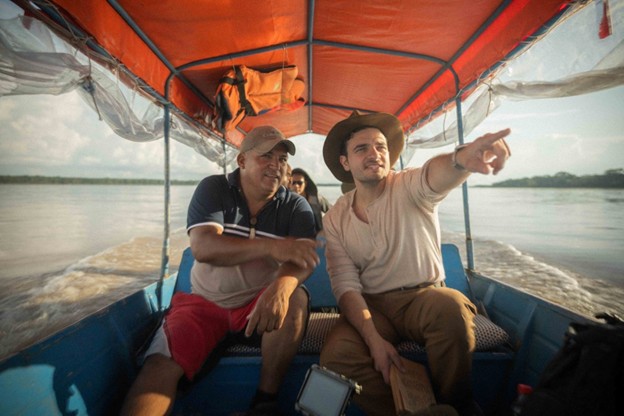
But after having spent weeks traveling its length taught me quite the opposite: The Amazon is changing faster than my team and I could ever imagine and in ways that are visible to those who have never even picked up a climate science textbook.
That is why the U.S. withdrawal from the United Nations Framework Convention on Climate Change (UNFCCC) matters. It is a retreat from the global system meant to keep places like the Amazon from being pushed past the point of no return.
This past November, our team traveled more than 2,560 miles, from where the great Amazon River begins to where the river finally meets the Atlantic. We set out to film a climate documentary and bring that footage to COP30. Along the way, we conducted more than 50 interviews with Indigenous leaders and river communities whose lives are shaped by the forest and the river’s changing rules.
A river that can’t decide what it is anymore
One of the most consistent themes we heard across Peru, Colombia and Brazil was exhaustion from sheer instability. People spoke about the river behaving in unfamiliar ways. Severe flooding one year, severe drought the next. Agriculture, hunting, fishing – all of these important and fundamental characteristics of their lives fully upended by instability.
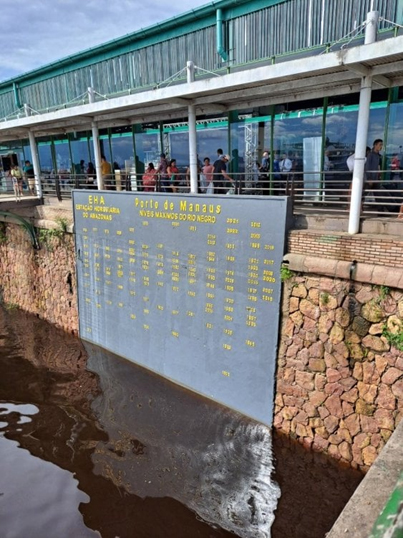
In Manaus, we saw a flood-level wall that serves as a public ledger of the river’s annual peaks. It ends in 2022. Our guide told us the water has since surged beyond what the wall can record.
On the flipside, these same communities now experience heavy drought, even during the same years in which historic flooding is seen.
By 2024, water levels at the port of Manaus (the port with the flooding wall record), fell to their lowest level since 1902, a striking benchmark for an area measured in centuries.
The cruel math of the climate crisis
Many of the people our team interviewed had never taken a flight. Many had no connection to the industrial drivers of emissions. Yet they are living on the frontline of a crisis they did not create.
One person we interviewed was locally known as a “Monteras,” or a master of the forest. These specialists have existed in the Amazon for thousands of years, carefully attuning their bodies and senses to track and hunt the once plentiful forest to feed their village. But he told us that for the first time in his family’s history, he may not be able to pass his skills on to his son.
The forest is changing, wildlife is disappearing and the knowledge that once sustained generations is becoming harder to use in a world that no longer behaves predictably.
COP30
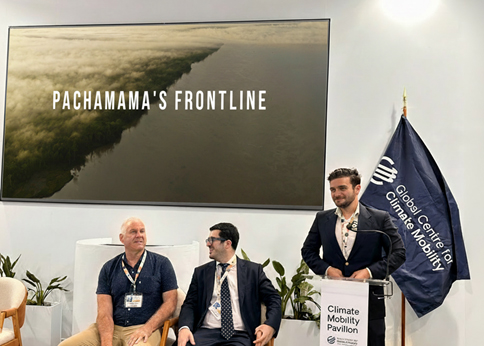
About 2,560 miles later, when we reached the U.N. COP30 climate conference, we carried something we believed could cut through the abstraction of global climate politics: footage of lived experience from people navigating real impacts now.
We expected urgency. Instead, what we often encountered from official delegates was something closer to polite detachment, a kind of procedural calm that can feel shocking when you have just been face-to-face with communities living through a destabilized environment.
To be fair, the scale of COP is enormous, and the machinery of negotiation can be emotionally numbing. But this calm also felt like a symptom of U.S. retreat: After America stepped away from the Paris Agreement, and with an exit from the UNFCCC looming, it was hard to ignore the sense that ambition had been replaced by caution – urgency with retreat.
The US withdrawal from the UNFCCC
The UNFCCC isn’t just another organization. It serves as the benchmark of almost all global climate diplomacy. And now the United States is poised to become the first country in history to withdraw from it.
The White House has framed this as part of a broader retreat from international institutions in what they believe to be “U.S. interests.” But the climate reality is unforgiving: The 2020s are already a narrowing window for action, and removing U.S. leadership from the world’s primary climate architecture is a blow the planet cannot afford.
And it raises an uncomfortable question: What happens when the people with the greatest capacity to lead decide instead to leave?
As a climate scientist, I truly fear our remaining margin for error is disappearing.
We can’t quit because the politics are unstable
Despite everything, I didn’t leave the Amazon feeling completely hopeless.
In fact, much of my inspiration now comes directly from the people we met in Peru, Colombia and Brazil. The communities along the river were not waiting to be saved. They are adapting in real time.
That resolve has stayed with me.
There is no reason to stop now, even in the face of unstable, short-term election political shifts at the national level. The tools exist. The science is clear. The suffering is already visible. And the responsibility to act does not vanish simply because a government chooses retreat.
Rock Aboujaoude Jr. is pursuing a Ph.D. at the University of Florida in climate science and is director of Campus Climate Corps. Banner photo: The area where the Ucayali and Marañón rivers meet to form the Amazon (Drone shot by Samuel Saum).
Sign up for The Invading Sea newsletter by visiting here. To support The Invading Sea, click here to make a donation. If you are interested in submitting an opinion piece to The Invading Sea, email Editor Nathan Crabbe.

The clock is tiking- the Doomsday Clock- is at 85 seconds. It will continue to drop as we do nothing .