


By Joe Murphy
Recently lovers of all things wild, both in Florida and around the globe, celebrated World Migratory Bird Day. I am making the sweeping declaration that it should be extended to a month! So, throughout the month of May, let us celebrate those brave and amazing avian travelers who take epic journeys of migration.
Each year, an astounding 4 billion to 5 billion birds migrate seasonally between North and South America. Florida is a critical and essential step in the journey for birds migrating along the Atlantic Flyway, traveling to the Caribbean and South America.
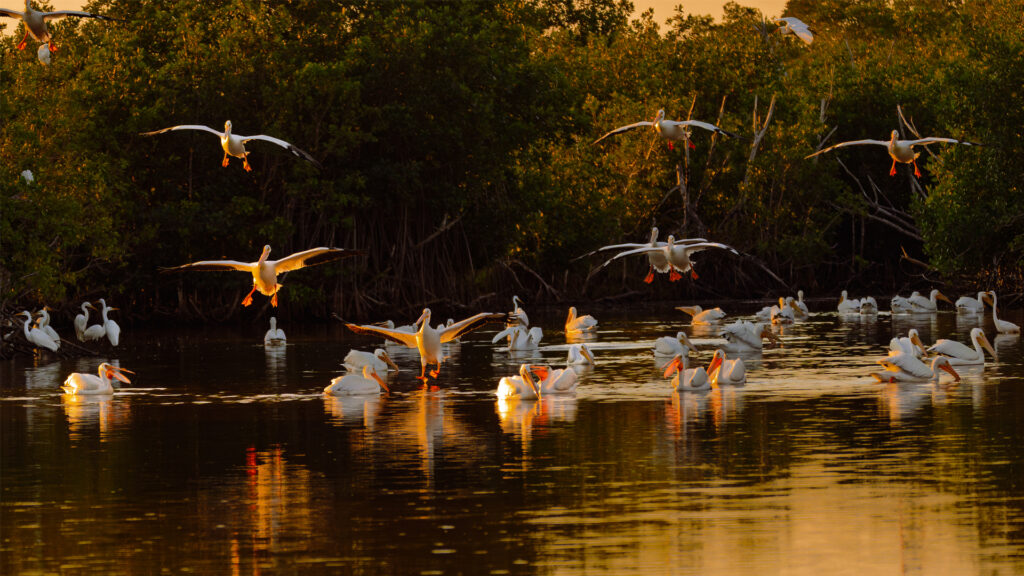
One of the truly magical and miraculous aspects of the journey is that birds navigate these vast distances using the Earth’s magnetic fields. Evolution and natural selection, over thousands and thousands of generations, have imbued migrating birds with the ability to “see” or sense magnetic fields with specialized, light-sensitive proteins in their eyes. Outstanding! But it is no easy journey.
Ponder this: You are a creature of small stature. You might be as small as a human hand (or smaller!). You weigh next to nothing, and to survive you must migrate across great distances. You must cross vast bodies of water. You must press on, wings in constant motion, when there is nowhere to land.
You rely on the stores of energy you have gathered into your body before you take flight. Nature, evolution and geography all intertwine, and you have just barely enough energy to reach landfall across a vast and open Gulf of Mexico.
When you do at great long last make it to landfall, the resources you need to just barely survive may be gone. Human activities threaten to end what evolution spent millions of years setting in motion.
Despite all the amazing tools nature has provided migrating birds, there are still massive and logistical challenges simply posed by nature itself. Now those challenges have grown exponentially with climate change, sea-level rise, structural obstacles and collisions, habitat loss that limits bird’s ability to find food and shelter, invasive species and pollution.
While your ancestors made the journey endless times, you must make it in a world that is rapidly changing. The landscapes and natural patterns you evolved to anticipate and endure have changed beneath you. The journey has become exponentially harder.
It’s not easy to be a migratory bird.
As we celebrate World Migratory Bird Month, let us commit to doing what we can to ensure migratory birds survive. There are specific, effective things we can do in the hope that what nature set in motion over a millennium is not torn asunder in our lifetimes. Consider doing the following:

- Support public lands acquisition and management: Natural habitat, preserved where it is and managed for wildlife, provides safe refuge, a resting place and food for migratory birds when they need it most. Programs like Florida Forever, when fully funded, can protect key coastal and inland habitats birds that rely on for survival as they pass through.
- Create havens for migratory birds and other wildlife in your own yard: You can provide migratory birds with a small refuge with food, water and shelter. Year-round bird species will benefit from a small piece of habitat as well. Think of food, water, shelter and a place to nest. Use native plants, support pollinators and think like a bird. Visit https://www.audubon.org/plantsforbirds.
- Support groups like the Audubon Society, the American Bird Conservancy and the Avian Research Conservation Institute: These groups advocate for all the things needed to stop avian extinction, restore bird habitat, recover bird populations and protect migration of birds throughout the Americas. Support bird advocates with your time, funding and political support.
Migration is a timeless cycle. We must do our part to support and conserve it. We must cherish it. The threats facing migration are vast and daunting. Our hope and action can prove more powerful.
Celebrate our world’s migratory birds by giving them refuge and giving them voice.
Joe Murphy is a native and lifelong Floridian who lives in Brooksville. You can follow Joe on Facebook at https://bit.ly/joemurphyfacebook. To learn more about what you can do, please visit https://www.audubon.org/florida, https://abcbirds.org/and/or https://www.arcinst.org/. Banner photo: A swallow-tailed kite in flight over the Florida Everglades (iStock image).
Sign up for The Invading Sea newsletter by visiting here. To support The Invading Sea, click here to make a donation. If you are interested in submitting an opinion piece to The Invading Sea, email Editor Nathan Crabbe.
