


By Carlos Beck, FIU News
Florida International University researchers found that some of the most common trees in Florida can significantly shield homes from extreme wind, decreasing suction forces applied to critical regions of the roof by as much as 50%. The findings were recently published in the Journal of Wind Engineering and Industrial Aerodynamics.
The urbanized part of Miami-Dade County is home to an estimated 36 million trees, and city planners want even more in the years to come. About 20% of Miami-Dade County is covered by the branches and leaves of trees, known collectively as the urban tree canopy. For homeowners, the canopy can provide shade and protection, but during hurricanes trees can also become hazards.
So, what exactly are all these trees doing during storms? Which trees are more likely to become hazards, and which help shield homes from wind?
To answer these questions, Amal Elawady, an associate professor in the Civil and Environmental Engineering Department, Haitham Ibrahim, a postdoctoral associate, and Fouad Elazaka, a Ph.D. candidate, gathered data on more than 40,000 trees across Florida. They then tested how a set of the most common trees in Florida interact with extreme wind and nearby homes at FIU’s Wall of Wind, a world-leading facility capable of simulating a Category 5 hurricane and conducting full-scale testing.
The research grew out of questions asked by insurance and construction partners working with FIU’s Wind Hazard and Infrastructure Performance Center (WHIP-C). They wanted to understand how trees influence damage risk to homes during extreme wind events.
WHIP-C is a partnership among FIU, Texas Tech University, the National Science Foundation and insurance and construction industry partners focused on improving infrastructure resilience to extreme wind.
With data on 40,000 trees, the research team was able to develop more precise risk models. As Ibrahim explained, “this means that with just two readily available data inputs, like tree species and crown diameter, we can estimate the other characteristics, like trunk diameter and crown height, that we need to predict tree failure from extreme wind.”
“By capturing these changes in drag behavior, we can better predict the conditions under which a tree’s natural change in shape fails and estimate the resulting risk to nearby homes,” said Fouad Elazaka, a Ph.D. candidate in the Department of Civil and Environmental Engineering.
The team then designed a wind-tunnel experiment testing how trees impact the wind force on nearby low-rise buildings, like single-story family homes. They selected species that represented the most common trees in the sample, and according to Elawady, are among the most common trees found across Florida — think pines, oaks and palms.
The wind tunnel results showed that the placement of trees around a low-rise building can have large shielding effects, reducing the wind pressure on segments of the structure by as much as 50%, particularly when trees are directly in the path of wind.
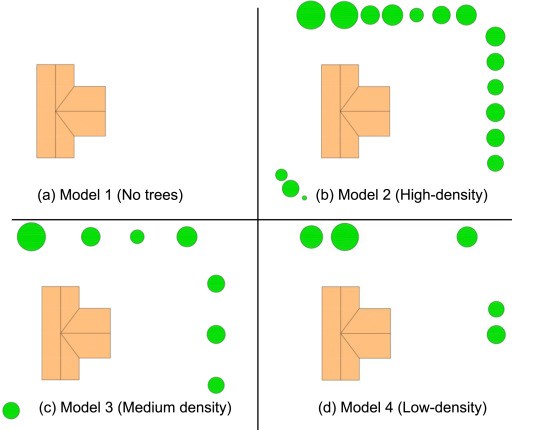
Surprisingly, the study authors also learn ed that trees could increase the wind pressure on parts of the building. When wind struck the structure at 45-degree and 210-degree angles, the pressure being applied to parts of the roof and walls increased. The researchers suspect that the specific placement of the trees in this experiment may be acting as a wind tunnel, but further testing is needed to corroborate their suspicions.
These results could help homeowners not only pick better tree species to plant but also help them better determine how and where trees should be planted around a home. Insurance companies could also use these models to predict the potential risk posed by trees near homes and other buildings. In some cases, Elawady notes, “such risk-based assessments could influence insurance premiums, coverage conditions or even decisions about insurability.”
Elawady predicts that the research will be beneficial to a wider community than just homeowners and insurance companies. She notes how emergency management agencies, utility companies and local governments could use the models to estimate potential tree debris following wind events, identifying areas at higher risk of road closures.
“The models could also help officials anticipate possible disruptions to power lines and transportation networks,” she said.
Elazaka is working with Elawady on the next steps of the research, which would examine how tree failures damage homes during extreme wind. They would then expand their model to include these results.
The researchers can then use these estimates to measure the risk that trees will break, fall over or become uprooted entirely. The findings could eventually help inform recommendations for homeowners and help them select trees that are more likely to resist hurricane-force winds.
Such information could support more effective disaster preparedness, resource allocation, debris-removal planning and post-storm recovery efforts. Overall, the research could help communities become more resilient by improving their ability to prepare for and respond to severe wind events.
This piece was originally published at https://news.fiu.edu/2026/fiu-researchers-find-trees-can-shield-homes-from-storms. Banner photo: Wind blows palms in front of a Florida home (iStock image).
Sign up for The Invading Sea newsletter by visiting here. If you are interested in submitting an opinion piece to The Invading Sea, email Editor Nathan Crabbe.
