


By Gisele Galoustian, FAU News Desk
Florida Atlantic University ’s Charles E. Schmidt College of Science has been awarded a $700,000 grant from the U.S. Environmental Protection Agency Gulf of America Division to support a novel research project aimed at advancing water quality monitoring in one of Florida’s most critical freshwater ecosystems.
Led by Natalia Malina, Ph.D., principal investigator and an assistant professor in FAU’s Department of Chemistry and Biochemistry within the Charles E. Schmidt College of Science, the three-year project titled, “Developing an Approach for Monitoring of Emerging Contaminant Phototransformation in Freshwater Lakes,” will focus on understanding how common contaminants – such as pesticides, pharmaceuticals and personal care products – change after being released into freshwater environments.
These substances often undergo phototransformation, breaking down and forming new chemical products when exposed to sunlight in surface water. Alarmingly, these new products are frequently more persistent or more toxic than their original compounds.
“Lake Okeechobee is not just Florida’s largest freshwater reservoir; it serves as a vital resource for millions of people and supports the ecosystems that surround it,” said Malina. “This funding will allow us to develop a much-needed approach to monitor not only which contaminants are present in the lake water, but how they transform over time and space. These transformation products are often of greater environmental and health concerns than the original chemicals, and most current monitoring programs don’t account for the transformation processes. Our work will help close that gap.”
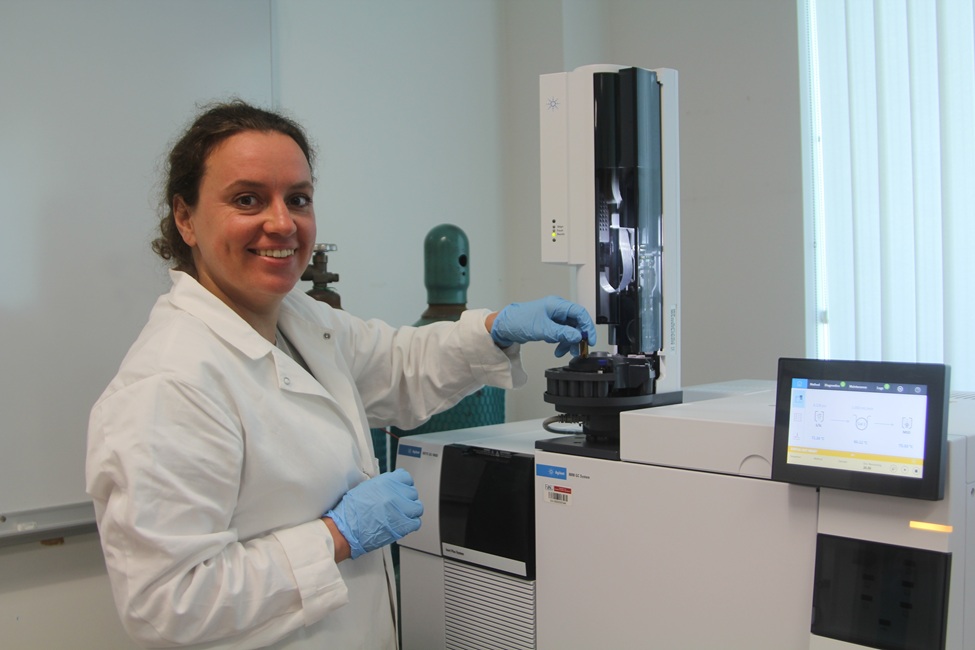
Over the course of the project, Malina’s team will deploy passive sampling devices across eight stations throughout Lake Okeechobee to capture seasonal and annual variations in contamination. The research will also incorporate cutting-edge chemical analysis, including carbon isotope ratio measurements, to determine degradation processes and identify which phototransformation mechanisms are occurring in real-time. This will enable researchers to predict which contaminants are likely forming dangerous byproducts – all without the need for complex screening of unknown compounds.
This research comes at a critical time, as water systems throughout the U.S., particularly in regions impacted by agricultural runoff and urbanization, face increasing pressure from “emerging contaminants.” These include a wide range of chemicals that enter waterways through farming, industry, household use and wastewater. While some of these compounds are regulated, many are not, and their transformation products are often invisible to standard monitoring tools.
“Current environmental monitoring frameworks are simply not designed to track what happens to contaminants after they enter the water,” Malina said. “With our new approach, we’ll be able to link the presence of certain compounds to specific transformation mechanisms, and from there, assess their potential environmental and health risks. Our findings can help guide the development of future regulations that consider the risks associated with the contaminant transformation process in aquatic ecosystems.”
Lake Okeechobee, covering more than 730 square miles in southern Florida, serves as a crucial water source for agriculture, municipalities and natural ecosystems including the Everglades. It is a Class I Potable Water Supply and is a source of water for approximately 8 million people. As such, maintaining the lake’s water quality is a public health and environmental priority.
Malina’s project will generate detailed data on contaminant concentrations, their seasonal patterns and how they evolve under environmental conditions – a dataset that could prove invaluable for scientists, regulators and policymakers alike.
“This vital grant from the EPA allows us to address a critical, and often invisible, threat to our water systems, and empowers innovative, solution-driven science that addresses real-world challenges,” said Valery E. Forbes, Ph.D., dean of the Charles E. Schmidt College of Science. “Dr. Malina’s project fills a critical gap in how we detect and monitor chemical pollutants in our water systems – an issue with far-reaching implications. The insights gained will not only benefit Florida but also provide a scalable model for communities across the country. This is impactful science –advancing environmental protection, safeguarding public health and helping to ensure a sustainable future for clean water.”
In addition to advancing scientific understanding, the project will also offer hands-on research opportunities for graduate and undergraduate students and contribute to the development of new tools and models that can be used by environmental agencies at both the state and national levels.
With fieldwork scheduled to begin this month and continuing through 2028, the project promises to deliver new insights into the fate of emerging contaminants and inform smarter, more adaptive strategies for managing freshwater resources in a rapidly changing world.
This piece was originally published at https://www.fau.edu/newsdesk/articles/water-quality-lake-okeechobee. Banner photo: An aerial view of Lake Okeechobee (iStock image).
Sign up for The Invading Sea newsletter by visiting here. To support The Invading Sea, click here to make a donation. If you are interested in submitting an opinion piece to The Invading Sea, email Editor Nathan Crabbe at ncrabbe@fau.edu.
