


By Diana Udel, University of Miami News
A study led by scientists at the University of Miami Rosenstiel School of Marine, Atmospheric, and Earth Science and the National Center for Atmospheric Research (NCAR) reveals how a major global climate pattern influences the African weather systems that help seed Atlantic hurricanes. The findings, published July 30 in the Journal of Climate, could lead to better seasonal forecasts of rainfall, drought and tropical cyclone activity across the Atlantic basin.
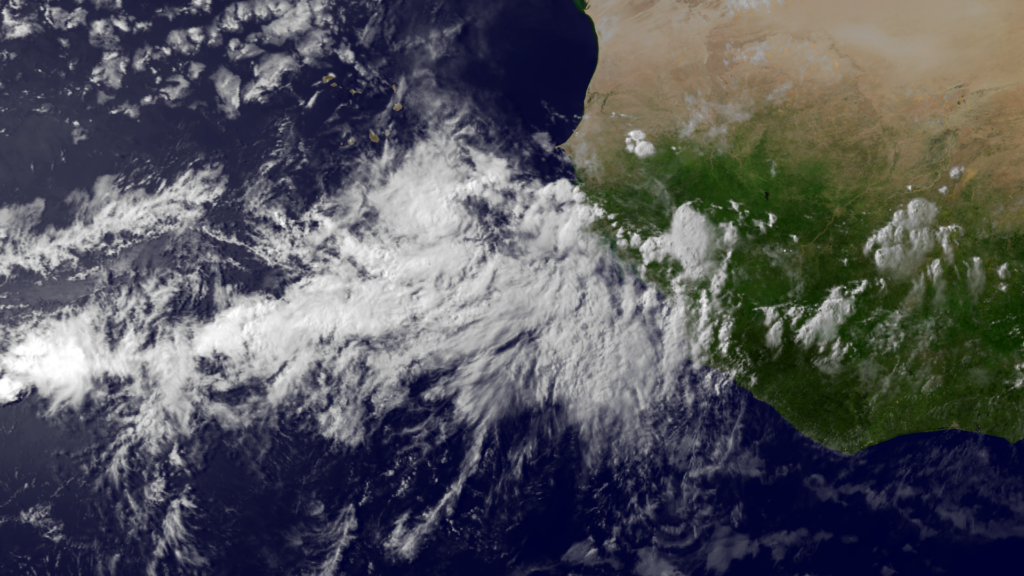
African easterly waves (AEWs) — atmospheric disturbances that travel across the African continent — play a crucial role in both West African rainfall and the development of most Atlantic hurricanes. The new study shows that the El Niño–Southern Oscillation (ENSO) strongly shapes how these waves behave.
“We found that during La Niña years, AEWs are stronger, moister and have more thunderstorm activity compared to El Niño years,” said Quinton Lawton, a doctoral alumnus of the Rosenstiel School and now a scientist at NCAR. “These seasonal changes could impact local weather patterns and may be another piece of the puzzle in explaining why Atlantic hurricanes are more active during La Niña.”
The study began as an undergraduate research project by Brooke Weiser, who developed it into her honors thesis under the advisement of Lawton. Weiser, now an analyst at Moody’s Insurance Solutions, collaborated with Lawton and Sharan Majumdar, a professor in the Department of Atmospheric Sciences at the Rosenstiel School. Together, the team analyzed more than four decades of global weather data using an innovative tracking tool called QTrack, developed by Lawton during his doctoral studies at the Rosenstiel School and now widely used by forecasting centers and researchers worldwide.
“Our research presents a detailed climatology of AEWs and their year-to-year variability, allowing us to examine their characteristics and links to climate oscillations with greater precision than before.” Weiser said.
“This work highlights the opportunities our undergraduates have to contribute to high-impact meteorological research,” said Majumdar. “It’s also a great example of graduate-undergraduate mentorship and collaboration between the Rosenstiel School and NCAR.”
By clarifying how ENSO impacts AEWs, the study paves the way to more accurate seasonal predictions that can benefit communities across Africa, the Caribbean and the Americas. Better forecasts of rainfall, drought, and hurricane risk can give farmers, emergency managers, and residents more time to prepare.
The study titled, “On the Interannual Variability of African Easterly Waves and Its Relationship with the El Niño – Southern Oscillation,” was published on July 30, 2025 in the American Meteorological Society’s Journal of Climate
The research was supported by the National Science Foundation (NSF), including an NSF Graduate Research Fellowship, NSF Grants AGS-1747781 and AGS-2438140, and through the NSF cooperative agreement sponsoring NCAR.
This piece was originally published at https://news.miami.edu/rosenstiel/stories/2025/09/decades-of-data-show-african-weather-disturbances-intensify-during-la-nina.html. Banner photo: African easterly wave convection moving over Africa into the Atlantic captured by the Meteosat Second Generation Satellite (Image: EUMETSAT).
Sign up for The Invading Sea newsletter by visiting here. To support The Invading Sea, click here to make a donation. If you are interested in submitting an opinion piece to The Invading Sea, email Editor Nathan Crabbe at ncrabbe@fau.edu.
