


By Robert C. Jones Jr., University of Miami News
With the sky shrouded in a thick haze, the five investigators walked onto the pier near Darwin Beach on Virginia Key on an early Thursday, setting up evidence-detection devices that would remain there for the next two days.
“If there are DNA signatures here, we’ll find them,” said one of the investigators, Luis Angel Niño Barraet, as he donned a protective gown and surgical mask.
Niño Barraet is not trying to catch a thief. The University of Miami College of Engineering Ph.D. student is searching for the DNA profiles from hundreds upon hundreds of species of birds, insects, spiders, plants and other creatures.
He is collecting those signatures of life not through hair or blood samples left behind by those creatures, but from the DNA those organisms release into the air either through breathing and shedding skin cells or some other biological process.
“It’s DNA that’s been transported thousands of miles across the Atlantic Ocean by Saharan dust from Africa, reaching Caribbean islands and the U.S. East Coast,” Niño Barraet said. “It’s quite a fantastic journey.”
Analyzing that dust is part of the emerging field of environmental DNA, or eDNA, testing. “It allows us to monitor biodiversity and the health of different organisms in a unique way,” Niño Barraet said.
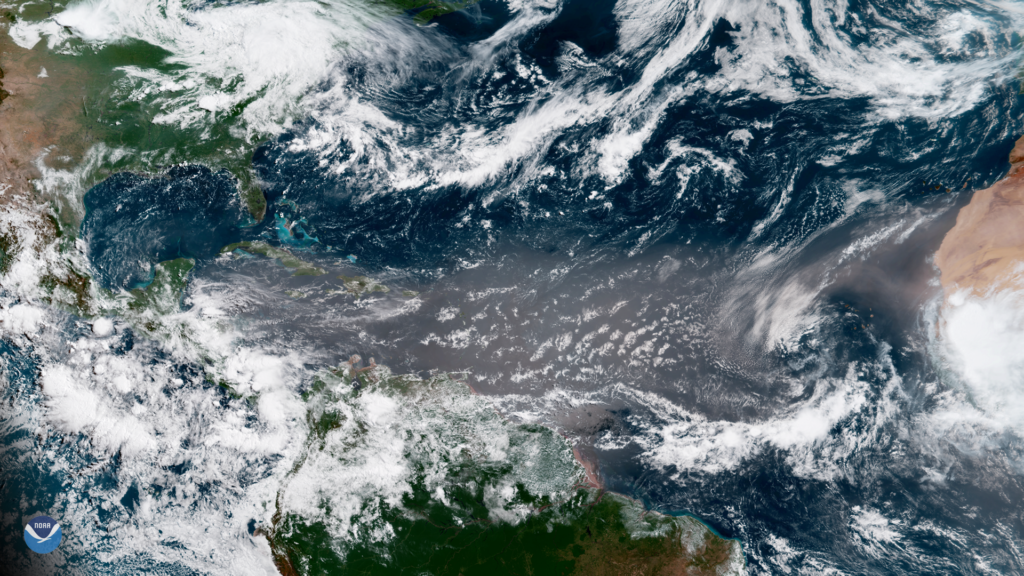
During a Saharan dust outbreak that created hazy skies over South Florida this summer, he and four of his colleagues deployed special instruments on the pier at the Rosenstiel School of Marine, Atmospheric, and Earth Science to capture dust samples from the event.
Using two types of filters and a device that captures airborne particles directly into a liquid medium, the researchers collected dust particles over two days, taking the samples back to a freezer at the College of Engineering where they will be preserved at minus 80 degrees Celsius until DNA analysis can begin.
Since the amount of genetic material in the particles will be miniscule, extracting robust DNA samples will prove challenging. But Niño Barraet, who wore personal protective equipment on the day he collected dust particles to ensure that his own DNA would not mix with the samples, will overcome that challenge by using a laboratory technique called polymerase chain reaction, or PCR, which rapidly replicates a single strand of DNA into millions of copies, allowing it to be studied in detail.
The researchers, part of the Center for Aerosol Science and Technology, will also study the effect of Saharan dust on the airborne microbiome, the diverse communities of microorganisms such as bacteria, viruses and fungi that are suspended in the atmosphere and travel over great distances.
“The dust being carried from the Sahara desert does not come alone,” said Sudheer Salana, a College of Engineering postdoc studying the health impacts of exposure to fine particles. “It carries with it certain microbes like bacteria and fungi. Once they reach places like the Caribbean and South Florida, they can change the composition of the bacteria and fungi that are already airborne in those regions. Inhaling those dust particles can affect our health. So, our goal is to help understand whether Saharan dust can change the toxicity of airborne particulate matter and contribute to negative health effects that are observed during those dust events.”
Their results could help pave the way for new techniques to monitor the emergence of new pathogens and diseases. “We still have questions about how the COVID-19 pandemic started,” Niño Barraet said. “There are some recorded events of the dispersion of some plant diseases from other countries and how frequent those events happen. What we’re doing could help us prepare for and perhaps avoid those kinds of events in the future.”
The use of a new device developed by Chang-Yu Wu, chair of the Department of Chemical, Environmental, and Materials Engineering, will prove critical to the study results. The BioSpot-VIVAS, or VIiable Virus Aerosol Sampler, collects aerosol particles into a liquid medium, maintaining the viability of the samples for a longer period.
“There’ll be less damage to the DNA fragments,” said Amin Shirkhani, who is working toward his Ph.D. in the application of condensation growth tube samplers like VIVAS.
The device, he noted, proved successful in collecting viable novel coronaviruses from air in a hospital room occupied by a COVID-19 patient. “But we had never used it in an outdoor setting,” Shirkhani said. “So, this research is a litmus test of sorts for the device.”
With their results, the scientists hope to build a database other researchers can mine for future studies.
This piece was originally published at https://news.miami.edu/stories/2025/09/on-the-trail-of-dna-in-saharan-dust.html. Banner photo: Luis Angel Nino Barreat works on a pier at the Marine Campus to prepare the liquid medium for the VIVAS device that collects Saharan dust samples (Photo: Matthew Rembold/University of Miami).
Sign up for The Invading Sea newsletter by visiting here. To support The Invading Sea, click here to make a donation. If you are interested in submitting an opinion piece to The Invading Sea, email Editor Nathan Crabbe at ncrabbe@fau.edu.
