


By Robert C. Jones Jr., University of Miami News
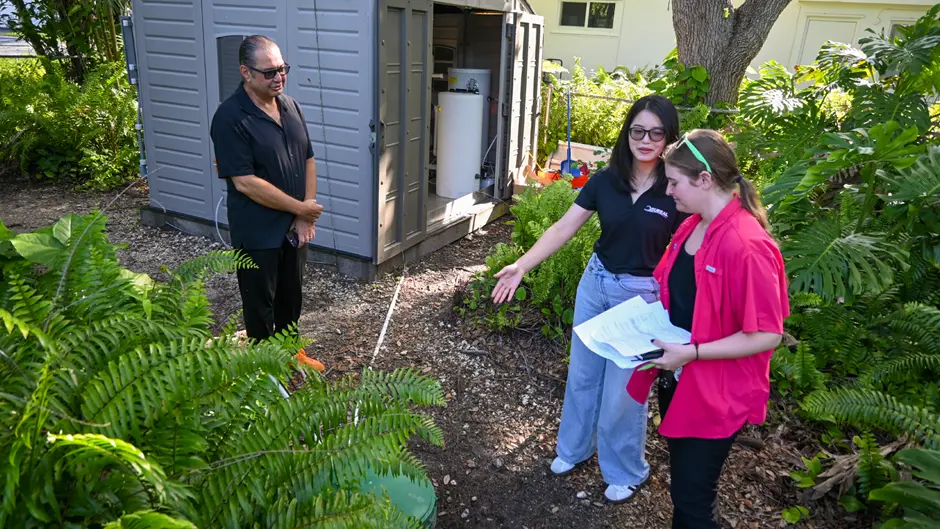
The small toolshed in the backyard of one Palmetto Bay home doesn’t contain a lawnmower, hedge trimmer, rake or shovel. Not even a pruning shear. Instead, it is packed with electrical control panels, reactors and wires that run everywhere.
While such high-tech tools will not keep a lawn neatly manicured, they hold the promise of helping to safeguard the environment, from preventing harmful chemicals from leaching into the water supply to stemming the growth of algal blooms in nearby lakes and canals.
The gadgetry is part of an electrohydromodulation (EHM) system developed by a team of University of Miami College of Engineering researchers that recovers nutrients like phosphorous and nitrogen directly from wastewater while simultaneously treating it.
“In Miami-Dade County, we have tens of thousands of homes that rely on septic systems for their wastewater management because there is no public utility sewer service available in certain neighborhoods,” said Esber Andiroglu, a professor of practice in the Department of Civil and Architectural Engineering who is spearheading the development of the system in its final stages. “But higher water tables that are the result of extreme flooding events can infiltrate and overwhelm those septic systems, causing them to leach untreated waste into the environment.”
The EHM system uses an electrical charging process instead of chemicals to change the pH level of wastewater, harvesting nutrients before they escape into the environment.
“Septic systems are underground and unseen, but the threat to the environment they pose after being compromised is real,” Andiroglu said. “The EHM system we’re working on is designed to mitigate total organic carbon and inactivate pathogens and enable nutrient recovery from septic tank effluent.”
Andiroglu doesn’t take credit for the technique, as it was a method perfected to a high degree of success in early laboratory experiments conducted by professor of environmental engineering James Englehardt and his Ph.D. students. “They used synthetic wastewater,” Andiroglu recalled. “And while the experiments they took on were done at a very small scale, they were successful in isolating and harvesting phosphates and nitrates at over 85 percent scale capacity.”
A forward-thinking researcher, Englehardt saw the value of his research and knew it could potentially be ramped up and adapted to a residential septic system. So, with funding from the Electric Power Research Institute and the Florida Department of Environmental Protection (FDEP), he partnered with Andiroglu and Ph.D. student Wafa Dastyar to ramp up the project, designing a larger, residential version of the EHM system.
But when Englehardt passed away shortly after the initial plans to develop a scaled-up system were rolled out, concern mounted that the project would be discontinued. His widow saw to it that the project would go on. After accessing her late husband’s emails and other communication on the project, she came to understand the magnitude of his work and reached out to Andiroglu, urging him to press on with the project.
Now, the project has garnered additional DEP funding through Andiroglu’s efforts and is currently in its pilot stage in the backyard shed of the Palmetto Bay home, according to Qiufeng Lin, a postdoctoral associate in the College of Engineering who is working with Andiroglu on optimizing the system and evaluating its performance.
DEP is tracking the progress of the project, which has the backing of Miami-Dade County Environmental Resources Management.
Noting that Florida has more than 2.6 million on-site wastewater treatment systems serving about 30 percent of the state’s population, Andiroglu said the EHM system they are perfecting has far-reaching implications for the entire state.
The EHM system is vital, Lin said, because it addresses the growing demand for sustainable water and nutrient management.
“By recovering nitrogen and phosphorus from municipal wastewater, the EHM system not only reduces the energy demands of conventional treatment but also provides an alternative source of essential nutrients for agriculture,” she said. “Overall, the project offers a scalable solution that advances environmental sustainability, resource conservation and more resilient water and food systems at the community level.”
This piece was originally published at https://news.miami.edu/stories/2025/10/making-septic-systems-cleaner-for-the-environment.html. Banner photo: With Qiufeng Lin, left, looking on, Esber Andiroglu gives Nancy Ham of the Florida Department of Environmental Protection an update on the EHM system (Photo: Betsy Martinez/University of Miami).
Sign up for The Invading Sea newsletter by visiting here. To support The Invading Sea, click here to make a donation. If you are interested in submitting an opinion piece to The Invading Sea, email Editor Nathan Crabbe at ncrabbe@fau.edu.
