


By Bonnie Jean Feldkamp
A rescued gopher tortoise arrived at the Nokuse Nature Preserve in Florida’s Panhandle while my sister Erica and I were there. It didn’t know how lucky it was.
Across Florida, builders are required to obtain permits from the state to capture and relocate gopher tortoises found on development sites. It’s a system meant to save them — but does it? Without federal protection for the species across its range, conservationists might be only moving the problem, not solving it.
Gopher tortoises’ only federal protections exist in small parts of Louisiana, Mississippi and western Alabama, where they are listed as threatened. Throughout the rest of their range, which includes Georgia, South Carolina and Florida, gopher tortoises are state-protected.
Range-wide federal protection under the Endangered Species Act was denied in 2022. The U.S. Fish and Wildlife Service declared gopher tortoises “not-warranted” in the eastern portions of its range, which prompted a lawsuit. The Center for Biological Diversity and Nokuse have sued USFWS, saying that their denial departed from the best available science. Oral arguments are set to begin later this month.
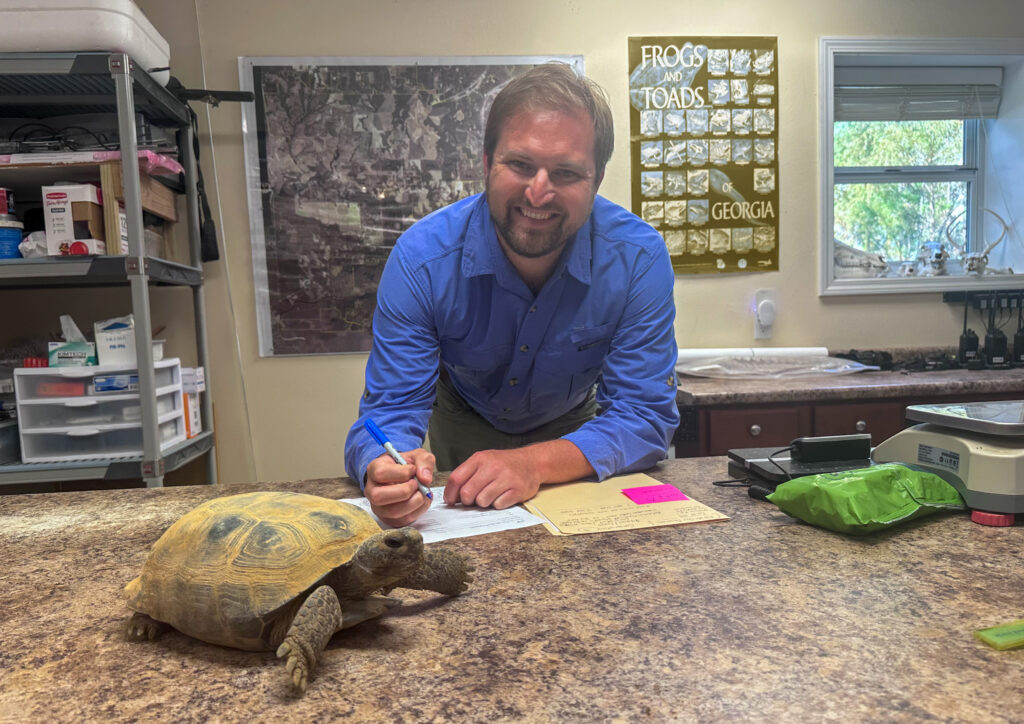
Gopher tortoise burrows can extend more than 30 feet and descend more than 10 feet underground. This means if they are not relocated prior to construction, they are essentially entombed and “it will take them about two years to slowly die,” Derek Breakfield explained. Derek is the operations director for the Nokuse Land Conservancy.
Thankfully, gopher tortoises are state-protected throughout their range, and developers are required to relocate them before construction begins. However, enforcement is not always uniform, and exceptions to this rule do exist.
This is not to mention that gopher tortoises live to be 80 years old and do not reproduce until they are 10-30 years old. Researchers may not accurately understand the success rate of relocation programs for decades to come.
The gopher tortoise Erica and I met had been removed from the path of a pipeline project. Florida state law required it to be released at an approved recipient site fewer than 100 miles from where it was found and within 72 hours of removal from its burrow.
But first, it would have a spa day of sorts. Derek determined its sex (male) and age (approximately 30). He assessed its health for injury and illness and recorded its weight and shell measurements. A blood sample was taken, and the tortoise was given a proper soak in shallow water to ensure good hydration.
Derek also marked the tortoise’s shell for future identification. He was given a number and a scanner tag which was attached to his shell with epoxy. Henceforth, this gopher tortoise will be known as Mr. 1124.
The following morning, Derek, Erica and I climbed into a beat-up Chevy truck with Mr. 1124 safely in a Rubbermaid storage tub that included some sand from his original burrow. We bumped along a two-track road that wound deep into the 55,000-acre Nokuse Preserve, a private refuge working to restore the longleaf pine ecosystem gopher tortoises depend on.
Their burrows support more than 360 species of plants and animals. As a keystone species, if gopher tortoises disappear, it could unravel entire ecosystems. Some rare species such as the threatened Eastern indigo snakes and dusky gopher frog rely entirely on their burrows, while burrowing owls take over abandoned burrows for nesting and roosting.
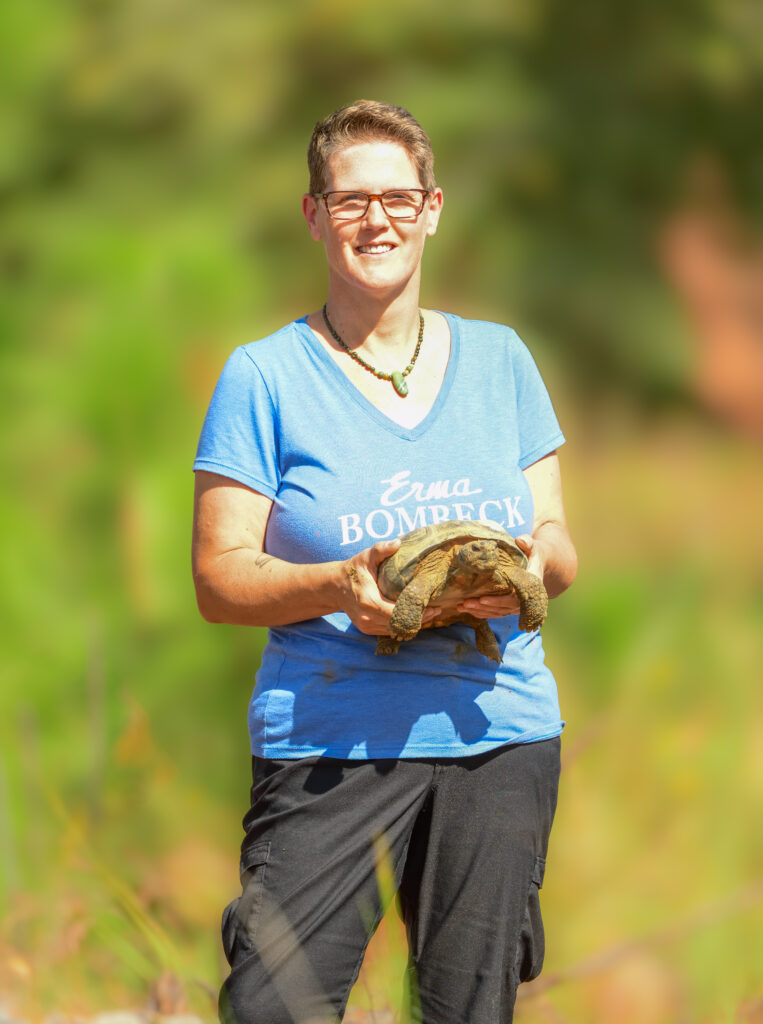
Gopher tortoises are an ancient species with a strong sense of place. When they are displaced, their instinct is to make their way home. For this reason, relocation pens at Nokuse are 30-50 acres in size and hold about one gopher tortoise per 1.5 acres.
Each pen is surrounded by a short black silt fencing, which isn’t meant to keep predators out, but to keep gopher tortoises in. “We need for them to realize this is their home now,” Derek explained. Mr. 1124 knew where he came from and knew he was not home.
Derek and his team dig starter burrows no deeper than a shovel’s length to encourage rescue gopher tortoises to get started building their new homes. But every gopher tortoise is an individual, and each adjusts at their own pace. Some take to a new burrow right away, and others, Derek said, “Never seem to settle.”
Those reluctant to burrow face higher risks from predators. To give them the best chance of survival, relocated tortoises remain in their pens for about a year to acclimate before release.
The best thing we can do is preserve active gopher tortoise burrows and the longleaf pine ecosystem that supports them. Federal status would help bolster range-wide habitat protections while also creating stronger, more uniform standards that ensure their enforcement.
However, since development projects prioritizing humans dominate the landscape, relocation is the next best option and at least prevents gopher tortoises from being buried alive.
Derek let me do the honor of releasing Mr. 1124, and when I set him next to a starter burrow he scooted right inside, tucking in for safety. I’d love to think it was a sign that he’d stay right there, start digging and make himself a new burrow. But just as likely, he waited until we left and then emerged to see if he could make his way back home.
Bonnie Jean Feldkamp is a syndicated columnist. Banner photo: A gopher tortoise emerges from its burrow in South Florida (iStock image).
Sign up for The Invading Sea newsletter by visiting here. To support The Invading Sea, click here to make a donation. If you are interested in submitting an opinion piece to The Invading Sea, email Editor Nathan Crabbe at ncrabbe@fau.edu.

Hello. My name is Mark, I am 64. My wife and I have lived in a development for almost 35 years in Lake county at 561 and Loghouse road in Cresent West. It was the first development in this Clermont area as back in 1985 it was being developed by the Priebes. We live at the end of a cul de sac and there is a Gopher Tortoise I would say is my friend. I have seen many hatchings over the decades.
She is not alone. There are 50 undeveloped acres next to us and a developer is planning 85 holmes. basically a nightmare added to our already unique deadlock location of not enough road for what is already here.
There is a meeting in Tavares November 4th in regards to this development. I fear I am the only one that knows about the Gopher habitats in this 50 acres because they (Tortious) are at their last natural stand in this old woods surrounded by developments. This 50 acres is on Log House Road and is boxed in by Development communities.
I have never been to one of these meeting for the public to speak and noticed an article on this mater is fresh in the news. Would you be interested in using this property as a last stand for these Gophers habitat on this 50 acres on Log House Road ?(next to the recycling plant) If you look on Maps you will see a perfect square green area. I live at the dead end behind it. Most people have come and gone many times over. My wife and I have lived in this house we built when we were in our 20’s. These Gophers have always been here and now there is a “Meeting ” in Tavares on November 4. I need professional help. I know people care about traffic because it is over the top but this is about more than that… this habitat is the last stand for many. This being fresh in the news might be an opportunity to be heard.
Thank you for your time, Mark