


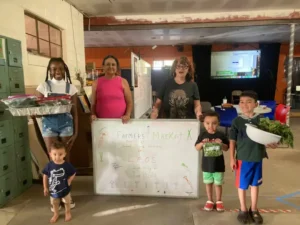
Leo’s Community Development Center in Superior, Arizona, serves people before they even enter the building. The free clothing rack and food stand outside are always open, and people take what they need and leave what they can.
Free community meals every Wednesday night bring in a mix of people from all walks of life. Once a month, workshops on emergency preparedness or resiliency practices follow the meal. Organizers encourage folks to “come for the lasagna, stay for the FEMA training.” They are in the planning stages of adding a solar array with battery backup to power the center in an emergency.
A growing number of rural leaders are creating community-led, resource-rich solutions for disruptions called community resilience hubs. In disaster situations, actions at the governmental level can take days. People are awakening to the fact that neighbors are the real first responders, and thinking ahead is vital. The hubs provide some level of preparation and support for residents in a disruption and beyond.
Community Lighthouses in New Orleans was one of the first to implement this approach. Citizens concerned about the challenges of flooding and power outages sought something more than what the city and state were doing. A grassroots effort created a network of neighborhood-based, solar-plus-power hubs in churches. With simple switch technology, the same arrays can operate on or off the grid, depending on the need.
“Community Lighthouses highlighted the opportunity for communities to take resilience into their own hands on a national stage,” said Austin Counts, the solar and electrification manager at Appalachian Voices.
“Community resilience hub” is an emerging concept and an emerging term. It can range from a mobile solar energy source to a central building able to feed community members in a crisis to a community center offering year-round services, like Leo’s. The one thing practitioners agree on: the importance of flexibility to give residents autonomy and control.
“The concept is different for every community,” said Counts. “I love the idea of more funding, but want to make sure the same mission stays true: to go in and listen to specific communities about what resources they need from the hub. They need to control how to plan ahead of time rather than react.”
A regional response
Emergency electricity is the primary focus of Counts and a burgeoning network of other hub leaders in Appalachia. Losing power can disrupt water pumping, food preservation, communication systems, and essential medical equipment, such as CPAPs.
“Solar creates its own power wherever you put it, and it’s cleaner and quieter,” said Jamie Trowbridge, a solar installer. “In remote power disaster situations, solar plus battery is the cheapest and best option.”
Trowbridge knows its importance firsthand. He lives in western North Carolina and stepped in to help the small town of Barnardsville after Hurricane Helene heavily damaged the community.
Grid-based electricity was down. Fuel-powered generators were tenuous because gas station pumps weren’t operational, and roads to the stations weren’t accessible. Communication was unreliable, so he left a written note at a solar company about needing equipment. A staff member with Footprint Project, a national green energy nonprofit, delivered a solar trailer the next day.
The nonprofit’s response in North Carolina was its largest ever, supporting over 70 sites and deploying $400,000 worth of sustainable response equipment. It has since opened a new state-based office, and Trowbridge is on staff.
The initial crisis in North Carolina is over, but the crucial need for electricity microgrids in the storm’s aftermath left a powerful imprint on the region. Footprint and a network of local, state, and federal governments, philanthropic organizations, and funders are working to increase the neighbor-to-neighbor aid provided by permanent community resilience hubs in rural Appalachian towns.
In neighboring Virginia, nonprofit Appalachian Voices works with the 300 residents of Dungannon. They were motivated to create a hub because of their aging population, high flood risk, remoteness, and communication challenges. Counts and his team first hosted a series of community meetings to gather ideas and address concerns.
Together, they identified the old train depot as the right location for their hub. The historic structure had fallen into disrepair. Appalachian Voices helped locals complete weatherization and an upgraded heat pump so that solar infrastructure could be installed.
The State Energy Office of North Carolina just announced a major investment of $5 million to fund microgrids at up to 24 new community resilience hubs, a collaboration with the Footprint Project, Land of Sky Regional Council, and others. The Appalachian Solar Finance Fund, Invest Appalachia, and the Appalachian Funders Network are working together to invest in hubs. Regional leaders are partnering to create community resilience after the next storm.
Year-round resilience
Hub practitioners in the Resilience Hub Collaborative are preparing for more than disasters. They enhance resilience year-round, in everyday life, during a disruption, and in recovery. By providing a place of belonging and communal care, they are lifelines in underserved rural communities.
“Studies have shown for decades that connectivity, social cohesion, is the number one indicator for successful recovery from disruptions,” said Ki Baja, an experienced hub organizer with the collaborative. “For people who don’t have access to resources in their everyday lives, disruption makes it so much worse.”
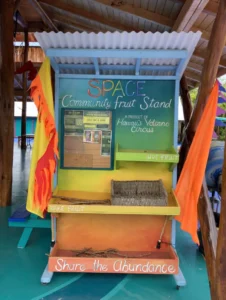
The Seaview Performing Arts Center for Education, or SPACE, began as the Hawaii Volcano Circus. As part of the social circus movement, its programs focused on empowerment, bodily confidence, and working with fear.
In 2018, acidic vog from a volcanic eruption damaged buildings in SPACE’s home of Pahoa and made it difficult to breathe. Then the 2020 Covid pandemic interrupted circus arts classes and performances.
As the only community center in the area, SPACE reimagined how it could meet a greater span of needs. The components of the Resilience Hub Collaborative framework – including programs, connectivity, built & natural spaces, power systems, operations, and transportation – guided the expansion.
“The framing is super comprehensive,” said Paola Vidulich with SPACE. “It’s given us confidence that we really know what we are doing in a rural, forward-thinking, holistic way about what it means to be resilient, not just in a disaster.”
Now, SPACE sponsors a hybrid school for homeschoolers alongside arts programs for all ages. A digital equity initiative provides community-accessible fiber internet access. Classes on microfarming teach families how to grow food in a unique tropical environment. Periodic classes cover disaster preparedness, and future plans include a workforce development approach based on the circular economy and native wisdom.
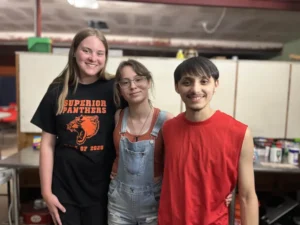
“We used to be this weird little arts organization, and now people see we are doing all of this,” said Vidulich. “With the social and economic crises happening, the framing speaks in a language that more and more people understand.”
Leo’s Community Development Center is the foundation of the Pinal-Gila Resilience Hub Network. Leader Chris Casillas sees collaboration and connection as foundational to its work.
The town of Superior has only about 3,000 residents, and Leo’s has had challenges finding funding. By supporting the creation of two nearby hubs and banding together, the network could tell a larger story. It has attracted two development grants that Leo couldn’t secure alone.
In addition, Pinal-Gila provides small-scale, home-based solutions. One project constructed and installed 4’x16’ raised garden beds for more than 100 families. Native tree plantings supply shade and reduce wildfire risk.
“By distributing self-reliant capabilities through our neighborhood, we are also increasing the resilience of nearby homes,” said Casillas.
“Ninety-nine point nine percent of the time it is not a disaster we are responding to,” he continued, about the importance of a year-round presence. “People who come experience a strong sense of belonging. Building trust every day is an advantage in a disaster as people listen to those they trust.”
This article first appeared on The Daily Yonder and is republished here under a Creative Commons Attribution-NoDerivatives 4.0 International License. Banner photo: Footprint Project’s first permanent solar installation on a North Carolina community resilience hub at the Celo Community Center (Photo by Cat Hebson).
Sign up for The Invading Sea newsletter by visiting here. To support The Invading Sea, click here to make a donation. If you are interested in submitting an opinion piece to The Invading Sea, email Editor Nathan Crabbe at ncrabbe@fau.edu.
