


By Annie Reisewitz, University of Miami News
The world’s transition to renewable energy — and progress toward lowering carbon emissions — depends on expanding offshore energy, particularly wind power. A new study published in the journal Marine and Coastal Fisheries provides new insight into how proposed development areas in the Gulf of Mexico are already being used, helping ensure that the transition to renewable energy does not disrupt existing commercial activities in the region.
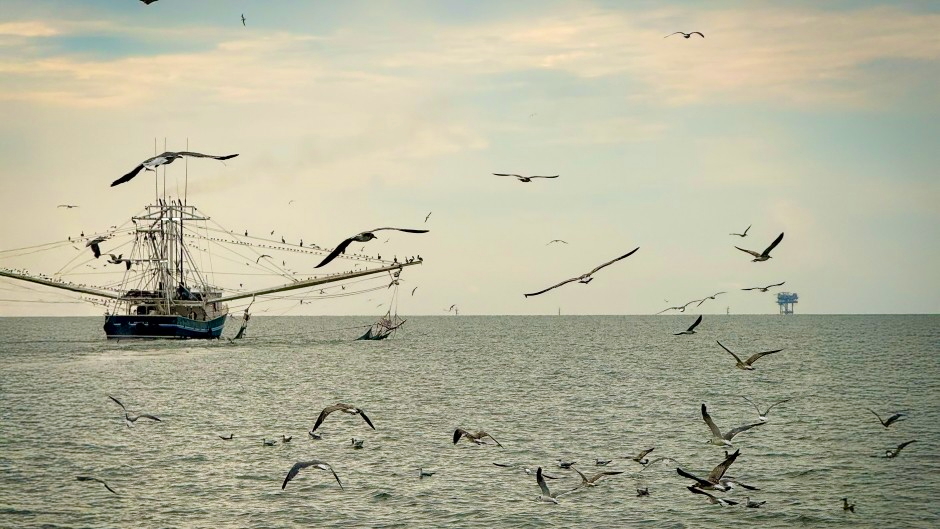
A research team led by scientists at the University of Miami Rosenstiel School of Marine, Atmospheric, and Earth Science Cooperative Institute for Marine and Atmospheric Studies (CIMAS) used GPS data collected from shrimp vessels to analyze how these vessels operate around oil rigs, distinguishing between fishing and transit behavior.
Examining interactions between the oil industry and shrimp fleets provides a useful analogue for assessing how planned wind farm locations and associated transmission lines could impact traditional shrimping grounds, where dredges are commonly used to harvest shrimp.
The study found that wind energy areas designated in the Gulf largely avoid regions heavily used by the shrimp industry, suggesting that offshore wind development would have minimal impact on shrimping activities.
“To balance offshore energy development with fishing, we need high-resolution vessel data like this to see where activities overlap,” said the study’s lead author Brendan Turley, a scientist at CIMAS and NOAA Fisheries. “As the ocean becomes more industrialized, combining different data sources is key to preventing conflicts between economically important marine industries.”
The researchers also found that shrimpers generally avoid oil rigs, but in areas with many rigs, there is a “sweet spot” distance of roughly three miles between rigs that shrimpers like to trawl, which likely balances safety with maximizing the area available for trawling.
As the ocean becomes increasingly industrialized, careful stakeholder planning and communication are essential, as demonstrated by the shrimp industry’s long coexistence with offshore energy infrastructure.
“Beyond commercial activity, oil rigs also serve as popular recreational fishing and diving sites, highlighting that offshore infrastructure has complex, nuanced impacts rather than being simply labeled ‘good’ or ‘bad,” said Turley.
The study, titled “Spatial Dynamics of the Gulf Shrimp Fishery: Mechanistic Drivers and Potential Implications for Offshore Energy Development,” was published on Nov. 6 in the journal Marine and Coastal Fisheries. For more information, visit https://news.miami.edu/rosenstiel/stories/2025/11/study-finds-offshore-wind-areas-in-the-gulf-pose-minimal-impact-to-shrimping-grounds.html.
Sign up for The Invading Sea newsletter by visiting here. To support The Invading Sea, click here to make a donation. If you are interested in submitting an opinion piece to The Invading Sea, email Editor Nathan Crabbe. Banner photo: Offshore wind turbines (iStock image).
