


Florida State University oceanographers have discovered a significant connection between small-scale microbial processes and ecosystem-wide dynamics, offering new insights into the mechanisms driving marine carbon storage.
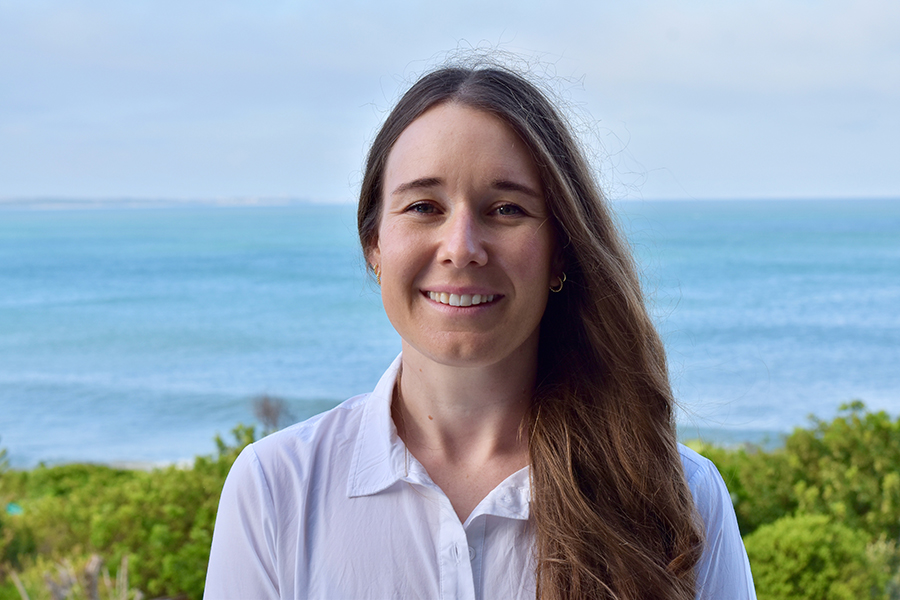
Heather Forrer, a Ph.D. graduate from FSU’s Department of Earth, Ocean and Atmospheric Science (EOAS), led new research spanning multiple ocean regions that found upper ocean ecosystem conditions, such as nutrient availability and microbial interactions, play a major role in shaping the composition of carbon-rich particles sinking into the deep ocean.
The particles, surprisingly, continued to carry the imprint of surface ecosystem dynamics even at great depths, shaping how carbon is ultimately sequestered. The research was published today in the Proceedings of the National Academy of Sciences.
Because the ocean is Earth’s largest active carbon sink, pulling carbon dioxide from the atmosphere and storing it for long periods, understanding these processes has important implications for the global carbon cycle.
“This work was central to my dissertation, representing years of experimentation, perseverance and collaboration,” said Forrer, who earned a doctorate in oceanography from FSU last year. “It feels like a huge personal milestone and great contribution to the broader field, offering a new approach to longstanding, globally relevant questions.”
On land, plants absorb carbon dioxide, converting it into organic matter and oxygen through photosynthesis. This same process is performed by tiny, ocean-dwelling plants called phytoplankton, which establish the base of the complex marine food web. The organic matter produced in this system ranges from microscopic particles unable to be seen with the naked eye to particles as thick as a nickel.
“Some of these particles sink from the sunlit surface into the ocean’s depths, effectively removing carbon from the atmosphere and storing it for decades to millennia,” Forrer said. “However, as this organic matter descends, it undergoes complex transformations that have long puzzled scientists. Understanding these changes is critical, as the rate and extent to which they occur determine how long this carbon is locked away.”
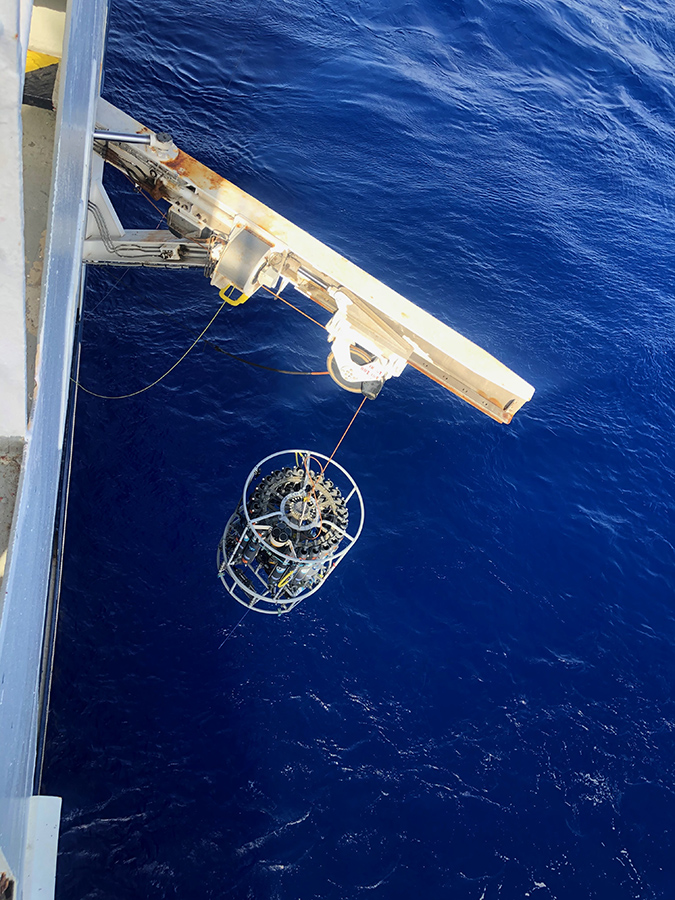
These transformations are driven by microorganisms, or microbes, which influence organic matter’s sinking rate by reshaping or degrading the particles. The research team collected sinking particles from the Gulf, California Current Ecosystem and tropical Indian Ocean to examine molecular changes as they descend into the deep ocean.
MagLab research
“Heather is an incredibly driven and intelligent early career scientist,” said Michael Stukel, EOAS chair and study co-author. “This publication is crucial to understanding the biological carbon pump and places our department at the vanguard of the field. It also highlights the incredible science that can be done in collaboration with other FSU departments and centers, such as the FSU-headquartered National High Magnetic Field Laboratory, which allowed us to characterize organic matter in sinking particles at a previously unseen level.”

Using the National MagLab’s advanced ultrahigh-resolution mass spectrometer — which harnesses a powerful magnetic field to identify molecules with extreme precision — the researchers were able to, for the first time, directly compare the molecular composition of sinking particles collected in different ocean regions at different depths.
They found that in nutrient-rich regions like California’s upwelling region, where particles are produced and sink quickly, more “fresh” carbon reached greater depths with very little molecular change, suggesting a strong carbon sequestration pathway. By contrast, nutrient-poor regions like the Gulf feature slower-sinking particles, which are more extensively processed by microbes, showing greater molecular changes since formation and contributing less effectively to carbon storage.
“These topics, as foreign as they may seem, are intimately connected to our everyday lives,” Forrer said. “The air we breathe and Earth’s climate are largely controlled by the ocean and the processes investigated in this publication. By better understanding these fine-scale processes, we can gain a clearer picture of how the ocean functions today and more accurately predict how resilient these marine carbon storage pathways are in a warming world.”
Collaboration and support
In addition to Stukel, co-authors include FSU professor of oceanography and environmental science Robert Spencer; Amy Holt, an FSU alumna and postdoctoral fellow at the University of Alaska Southeast; Sven Kranz, an associate professor of BioSciences at Rice University; Amy McKenna, an analytical chemist with the National MagLab’s Ion Cyclotron Resonance Facility and Colorado State University; and Huan Chen, a National MagLab research faculty member.
This research was supported by the National Science Foundation-funded California Current Ecosystem Long-Term Ecological Research (CCE LTER) and Bluefin Larvae in Oligotrophic Ocean Foodwebs, Investigation of Nitrogen to Zooplankton (BLOOFINZ-IO) projects and the National Oceanic and Atmospheric Administration’s RESTORE Science Program, named for the Resources and Ecosystems Sustainability, Tourist Opportunities, and Revived Economies of the Gulf States Act and established to support the Gulf ecosystem’s long-term sustainability.
To learn more about research conducted in FSU’s Department of Earth, Ocean and Atmospheric Science, visit eoas.fsu.edu. This piece was originally published at https://news.fsu.edu/news/science-technology/2025/11/24/fsu-oceanographers-present-new-conceptual-framework-to-answer-age-old-question-what-happens-to-carbon-as-it-sinks-through-the-ocean/. Banner photo: The surface of the Atlantic Ocean (iStock image).
Sign up for The Invading Sea newsletter by visiting here. To support The Invading Sea, click here to make a donation. If you are interested in submitting an opinion piece to The Invading Sea, email Editor Nathan Crabbe.
