


By Britta Baechler, University of Toronto, and Erin Murphy, Arizona State University
Plastics are everywhere, and the ocean is no exception: 11 million metric tons of plastics enter the ocean every year, where they spread far and wide, making their way to the deepest trenches and remote Arctic islands.
We have long known that marine animals can mistake plastic bags and other plastic pollution for food. To date, every family of marine mammal and seabird, and all seven species of sea turtles, have been documented to ingest plastics — nearly 1,300 species in total.
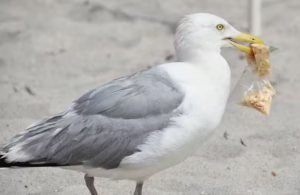
We also know that eating plastics can prove fatal for wildlife. When swallowed, macroplastics — plastics larger than five millimetres in size in any single direction — can block or puncture an animal’s organs or cause lethal twisting of the digestive tract, also known as torsion.
But understanding the link between ingestion of these large plastics and animal death has long been difficult. In an effort to investigate this connection, our team at the Ocean Conservancy non-profit collaborated with experts at the University of Toronto, the Federal University of Alagoas and the University of Tasmania to answer a deceptively simple question: How much ingested plastic is too much?
This question led us to undertake an ambitious effort to compile more than 10,000 animal autopsies — called necropsies — where both cause of death and data on plastic ingestion were known. These necropsies had been reported in peer-reviewed literature, in stranding network databases (collections of information about marine wildlife that have become stranded) and in two original datasets.
What we found
Our dataset included 31 species of mammals, 57 species of seabirds and all seven species of sea turtles. We then modeled the relationship between plastics in the gut and likelihood of death for each group, looking both at total pieces of plastics as well as volume of plastics.
First, we found that plastic consumption was common among all types of animals: Nearly half of sea turtles, over one-third of seabirds and one in eight marine mammals had plastic in their guts. For sea turtles who ingested plastic, roughly 5% died directly as a result — an alarming figure given that five of seven sea turtle species are already endangered.
Second, we found that the lethal dose was much smaller than we had initially guessed, especially for small seabirds.
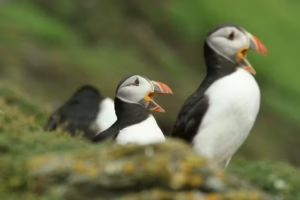
For example, if an Atlantic puffin consumes plastic around the size of three sugar cubes, it faces a 90% chance of death.
A loggerhead sea turtle that consumes just over two baseballs’ worth of plastic has the same odds. And for a harbour porpoise, consuming a soccer ball’s worth of plastic is fatal 90% of the time.
Third, we found that not all plastics cause equal harm. When modelling lethal ingestion thresholds, we looked at the number of plastic pieces and the volume of plastic, and found that the type of plastic is actually very important, as each impacts the gastrointestinal tract differently.
For seabirds, rubber materials like balloons were the deadliest; consuming just six pea-sized shards could be lethal. For marine mammals, lost fishing gear — also known as ghost gear — posed the greatest risk: as few as 28 tennis ball-sized pieces could kill a sperm whale.
Nearly half of the individual animals in our dataset who had ingested plastics were red-listed as threatened by the International Union for Conservation of Nature — that is, near-threatened, vulnerable, endangered or critically endangered.
Protecting marine life from plastics
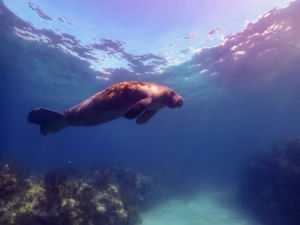
The most impactful way to protect ocean wildlife is to reduce how much plastic enters the ocean in the first place. By pinpointing which plastics are deadliest to key marine species, we can help guide targeted actions such as bans on some of the most dangerous items like balloons, fishing line and plastic bags.
Last year, Florida banned the intentional release of balloons with major implications for protecting seabirds and manatees, which also featured heavily in our dataset.
The research also demonstrates the potentially significant impact of removing plastics from shorelines, waterways and the ocean through cleanups and other removal efforts.
By modelling lethal doses, providing our data open-access for anyone to search or us and generating this new framework to help guide risk-assessment efforts, we hope our findings will inform the continued development and implementation of solutions that protect vulnerable ocean species from the dangers of ocean plastics.
Britta Baechler is an adjunct professor in the Department of Physical and Environmental Sciences at the University of Toronto and Erin Murphy is an adjunct faculty member in the Center for Biodiversity Outcomes at the Arizona State University.
This article is republished from The Conversation under a Creative Commons license. Read the original article. Banner photo: A sea turtle and a plastic bag (Troy Mayne/Ocean Conservancy).
Sign up for The Invading Sea newsletter by visiting here. To support The Invading Sea, click here to make a donation. If you are interested in submitting an opinion piece to The Invading Sea, email Editor Nathan Crabbe.
