


By Kristy Walson
Owning a home in Orlando should feel like security. Instead, it feels like living inside a stress test of climate economics. My 1936 home has weathered hurricanes, humidity and time itself. I’ve never filed an insurance claim. Yet my premiums have doubled — three years in a row. This year, I would have paid more in insurance than my mortgage.
Like many Floridian homeowners being priced out of insurance, I turned to the state’s “insurer of last resort,” Citizens Property Insurance Corp. They agreed to cover me — but only if I replaced my roof, even though it was leak-free and within its lifespan. Early replacement meant tearing off a perfectly good roof and doubling the embodied carbon of its materials. Months later, my brand-new roof leaks. So much for “preventative” action.
Walking away from homeowner’s insurance isn’t an option; mortgage lenders require coverage. Even worse, many insurers now refuse to cover homes built before 1990. That forces owners toward new construction – the most carbon-intensive path imaginable. My almost century-old home has outlasted countless storms, yet the system values a code-minimum new build more than a proven survivor.
We have a broken system that rewards risk, not resilience.
The wrong incentives
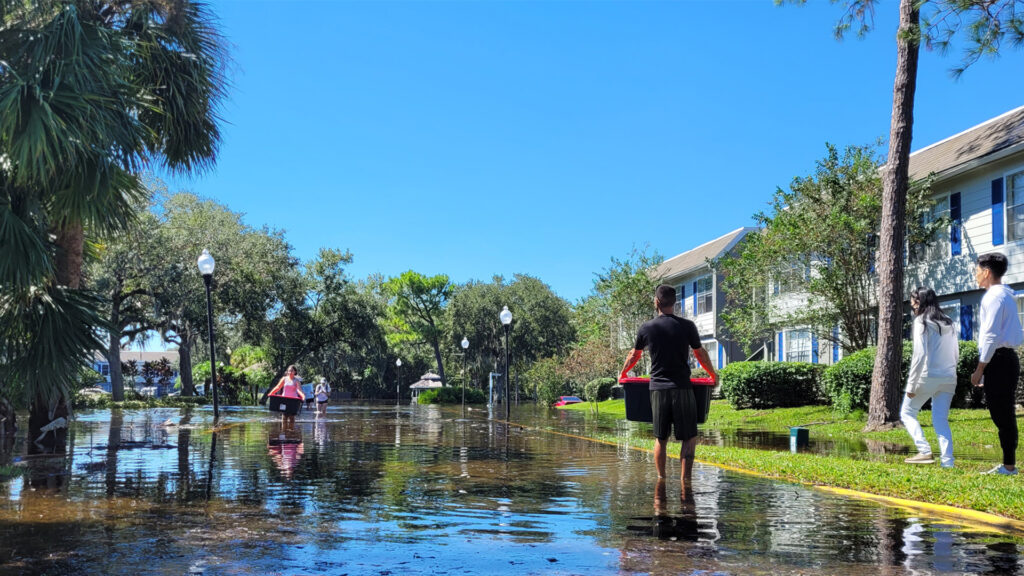
My story is hardly unique — it’s a symptom of a deeper market failure. Between 2018 and 2023, insurers canceled nearly 2 million homeowner policies across the U.S., roughly four times the normal rate. Some policyholders received no warning. Many had spotless claims histories.
Insurers are pulling out of Florida, California and Louisiana in droves. Behind the headlines is a financial domino effect. Local insurers depend on global reinsurers — giants like Swiss Re and Munich Re — to shoulder catastrophe risk. When billion-dollar disasters hit worldwide, reinsurers raise rates. Local carriers then pass those hikes to homeowners or abandon high-risk markets altogether.
It’s a vicious cycle: Climate disasters drive up losses, which drive up premiums, which drive disinvestment and displacement. Because insurers price policies based on exposure, not individual history, everyone pays more when risk rises nearby. When luxury coastal homes are rebuilt after a hurricane, inland property owners — who may never have seen a flood — foot part of the bill.
Meanwhile, the climate cost compounds. Sky-high premiums on older homes push communities toward demolition and new construction, wasting materials and accelerating emissions. We’re punishing the very act of preservation, replacing resilience with waste.
The canary and the carbon
Former California Insurance Commissioner Dave Jones put it bluntly: “Insurance is the canary in the coal mine with regard to climate change. And the canary is expiring.” He even went on to say that in some states, the canary has expired. The insurance market is telling us what climate scientists have warned for decades: We’re not prepared. Every ton of CO₂ we emit intensifies the next storm, wildfire, or flood — and the insurance market is the first to show the strain.
We can’t insure our way out of a warming world. But we can design, retrofit, and invest our way toward stability. Programs like IBHS FORTIFIED, FEMA’s Community Rating System and FM Global’s resilience credits prove that stronger buildings lower both losses and premiums.
The data is clear: Resilient buildings perform better financially, and those that also decarbonize perform best of all. That’s because resilience and decarbonization are two sides of the same coin. A high-efficiency, all-electric building with solar and battery storage isn’t just low-carbon — it’s more likely to stay operational during heat waves or outages. The same upgrades that cut emissions also keep people safe when the grid goes down.
A market in transition
The insurance crisis isn’t just a market failure — it’s a warning signal. It shows what happens when climate risk collides with outdated infrastructure, weak building codes and policy inertia. Ignoring it would be not only irresponsible but economically reckless.
We need a new framework that treats resilience, insurability and decarbonization as co-equal pillars of building performance. That means updating codes for functional recovery, rewarding retrofit over replacement and investing in communities before disasters strike. It also means recognizing that insurance access is now a climate equity issue; without reform, millions will be priced out of homeownership entirely.
My home in Orlando is small, sturdy and imperfect — but it’s proof that buildings can endure when we take care of them. The questions are whether our systems — insurance, finance and policy — can do the same. And how long it will take before we decide that resilience is not a luxury, but the only rational investment left?
Kristy Walson is a mechanical engineer and sustainability consultant. This opinion piece was originally published by the Orlando Sentinel, which is a media partner of The Invading Sea. Banner photo: U.S. Army Corps of Engineers workers install temporary roofing on homes of Florida Panhandle residents as part of Operation Blue Roof following Hurricane Michael in 2018 (Pfc. Kaleah Fields/CAISE, via Defense Visual Information Distribution Service).
Sign up for The Invading Sea newsletter by visiting here. To support The Invading Sea, click here to make a donation. If you are interested in submitting an opinion piece to The Invading Sea, email Editor Nathan Crabbe.
