


By Arielle Perry, FAU’s School for Environmental, Coastal, and Ocean Sustainability
Coral reefs are more than just marine habitats — they play an important role in supporting and protecting coastal economies.
A recent study found that coral protection can save South Florida residents millions of dollars in future flood damage.
By breaking up waves before they reach the coast, coral reefs serve as a natural barrier, helping shield coastal communities from storms and flooding.
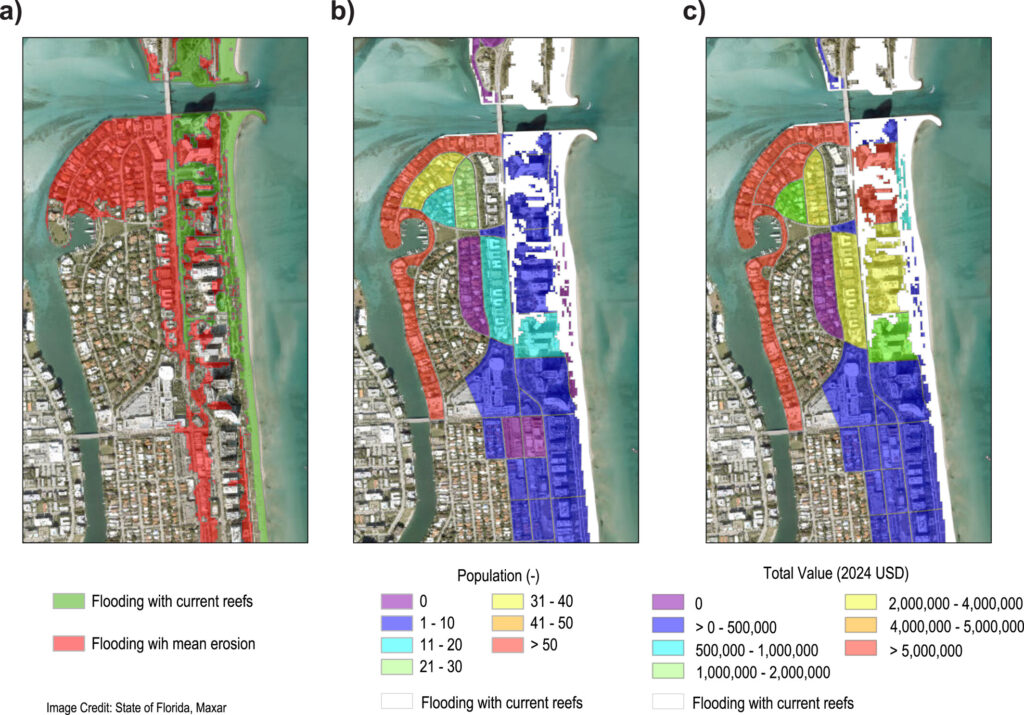
“Coral reefs are national natural infrastructure … Their biggest benefit to the U.S. is coastal protection, and that coastal protection can be hundreds of millions of dollars annually,” said Curt Storlazzi, U.S. Geological Survey research geologist and lead author of the study.
Corals have faced increased threats over recent decades such as rising ocean temperatures and diseases. Two Florida coral species were recently declared functionally extinct, driven by a variety of stressors including bleaching, disease and hurricane damage.
To assess the impact of future reef degradation on flood risk in South Florida, Storlazzi and his colleagues ran models of different storm scenarios across 267 miles of Florida’s coastline.
Comparing flooding outcomes of current and future degraded reefs, the researchers determined that projected reef degradation could generate an additional $850 million in additional economic losses per year.
Expected reef degradation is predicted to accelerate annual flood risk to people by 42% and building flood risk by 47%, impacting more than 7,315 people and 1,400 buildings.
The study also found that coral reef degradation would disproportionately increase flood risk not for beachfront areas that typically flood, but for areas located further inland. The resulting impact falls most heavily on populations of vulnerable groups including minorities, children and people in poverty.
“And so I don’t want to say coral reefs are a social issue, but … relative to the general population, it helps more of those folks” at greater risk during natural hazards, Storlazzi said.
Storlazzi said the kind of cost-benefit analysis provided by the study can help convey the importance of coral reef protection to policymakers.
“A lot of people think about lives and dollars, and so if we can quantify the value in those terms that make sense to more decision makers then … I think that helps everyone,” he said.
Arielle Perry is a master’s student in the Environmental Science Program at Florida Atlantic University and is a graduate research assistant at FAU’s School for Environmental, Coastal, and Ocean Sustainability and the Florida Office of Ocean Economy. The school hosts The Invading Sea. Banner photo: A snorkeler explore a coral reef off the Florida Keys (iStock image).
Sign up for The Invading Sea newsletter by visiting here. To support The Invading Sea, click here to make a donation. If you are interested in submitting an opinion piece to The Invading Sea, email Editor Nathan Crabbe.
