


This article originally appeared on Inside Climate News, a nonprofit, non-partisan news organization that covers climate, energy and the environment. Sign up for their newsletter here.
By Kiley Price, Inside Climate News
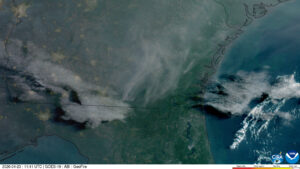
Drought and fire are a dangerous duo. The Southeastern United States is witnessing this firsthand as several major blazes burn tens of thousands of acres across the parched region, destroying homes and prompting evacuations in some areas. Florida and Georgia have been particularly hard hit, and strong winds and unusually low humidity have made it difficult to combat the flames.
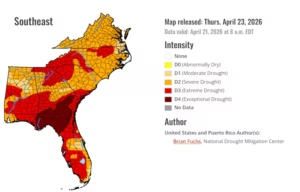
With much of the Southeast in a long-standing drought since July 2025, dried-out vegetation has provided ample fuel for wildfires to spread the minute they spark. That can even be something as small as a balloon hitting a power line, which is likely what ignited one of the largest fires tearing through Georgia this month, officials say.
Typically, forest managers ignite planned, controlled fires known as prescribed burns earlier in the season to clear this brittle brush. But this technique was on hold in certain areas amid the drought over concerns that small burns could quickly get out of control. Among this dried-out vegetation are the felled trees and branches left behind by Hurricane Helene in 2024, showing the lingering and compounding risks of climate disasters, experts say.
A drought-stricken ‘tinderbox’
Throughout March, I reported on the widespread drought afflicting the Western U.S., which experts say could ramp up fire risk throughout the summer.
The situation in the Southeast is proof of that risk. Overall, fire is not uncommon during spring in the region, which technically has more blazes than any other part of the country in a given year, though many are small or planned for agriculture or prescribed burns. However, the current spate of wildfires stands out, experts say.
“It’s unusual to see this level of wildfire activity across the Southeast in April. Widespread drought has left fuels extremely dry. Drought is the driving force behind this fire risk,” said AccuWeather meteorologist Brandon Buckingham.
In Florida, fires have burned through nearly 120,000 acres so far this year after the “intensity and extent of the drought ratcheted up starting in January 2026,” according to NASA. Meanwhile, Georgia Gov. Brian Kemp declared a state of emergency last week for much of the southern part of the state, where just two large fires have scorched more than 50,000 acres. One of them has become the most destructive wildfire in the state’s history, CBS News reports.
Despite days of firefighting and a short rain spell over the weekend, the flames are far from fully contained. Smaller, scattered fires burn in other states such as South Carolina and North Carolina, where statewide burn bans remain in place.
“The fact that you have all this vegetation here in North Carolina or across the Southeast U.S., and in a drought, it gets very dry and that becomes material that can become fuel for the wildfires,” Lauren Lowman, an associate professor in environmental engineering at Wake Forest University, told me on Monday.
I spoke to Lowman last March about wildfires in the Southeastern U.S., when she first explained to me the interplay between hurricane damage and wildfire. In September 2024, Hurricane Helene passed through millions of acres of forestland in Florida, North Carolina and Georgia, leaving a graveyard of downed trees that dried out and provided ample kindling for wildfires. Two years later, much of the wood debris remains in parts of the forest—as does the fire risk.
“There’s a ton of old Hurricane Helene debris down in the woods,” Seth Hawkins, a Georgia Forestry Commission spokesperson, told the Current GA. “It’s lying around, and it’s just a tinderbox out there.”
Vegetation whiplash
As climate change accelerates, droughts in the Southeastern U.S. are expected to become more common, research shows. These warming and increasingly dry conditions “could reduce the window of time each year when forest managers can safely implement prescribed fire,” according to a 2025 report by the U.S. Forest Service.
Shifts from severe rain to drought can lead to rapid swings in extremes known as “weather whiplash.” This dynamic, in turn, can fuel a response from plants on the ground—what Lowman calls “vegetation whiplash.”
“You’ll get more plants growing after these hurricanes, and a lot of water, and so they become lusher and greener,” Lowman said. “And if that’s followed by an extreme drought, and, you know, conditions dry out, and then you’re left with even more wildfire fuel (and) potential to burn afterwards.”
At the same time, people are increasingly moving closer to this vegetation at the wildland-urban interface, where homes start to overlap with undeveloped land and forests. Given that humans cause the vast majority of wildland fires in the U.S. (remember the balloon?), their presence increases the likelihood of ignitions.
As the Southeast contends with wildfires raging through the region, communities out West are preparing for their own fire season after an historic snow drought. Though it’s difficult to flesh out the global warming connection with a single fire season, research shows it’s clear that compounding climate risks are setting the stage for more frequent and severe wildfires to burn in many areas.
“That’s the thing that stands out when you’re thinking about climate change, is just seeing year after year, or day after day, in some cases, records being broken,” Lowman said. “If you’re going to say, like, what’s normal? It’s not normal to see records broken consistently.”
Banner photo: A wildfire on the St. Johns National Wildlife Refuge (U.S. Fish and Wildlife Service Southeast Region, Public domain, via Wikimedia Commons).
Sign up for The Invading Sea newsletter by visiting here. To support The Invading Sea, click here to make a donation. If you are interested in submitting an opinion piece to The Invading Sea, email Editor Nathan Crabbe.
