


This story was originally published by Grist. Sign up for Grist’s weekly newsletter here.
By Matt Simon, Grist
Johnny Appleseed was ahead of his time. Not because he fed so many people by planting apple trees (really, he got them drunk instead, as his real goal was encouraging the production of cider), but because he created so much shade to enjoy on hot days. More than two centuries later, American cities are wishing they had better followed Appleseed’s lead, as rising temperatures and a lack of tree cover combine to make urban life increasingly stifling.
Two new studies show how simply planting more trees can provide huge temperature benefits, not to mention how the additional plant life would boost biodiversity and improve mental health for urbanites. The first finds that tree cover can cancel half of the heat island effect, in which the urban jungle gets much hotter than the surrounding countryside. The second compares neighborhoods in 65 American cities, finding that canopy-deprived areas suffer up to 40% more excess heat than heavily greened spots.
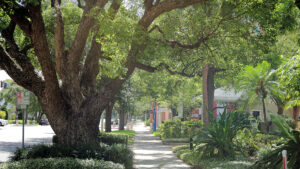
Places like New York and Atlanta and Los Angeles, then, don’t just have to foster and maintain their “gray” infrastructure — roads and sidewalks and such — but their living infrastructure as well. “Heat is already a major public health threat. It kills 350,000 people a year by some estimates, and it’s worse in cities,” said Robert McDonald, the Nature Conservancy’s lead scientist for nature-based solutions and the Europe region, who spearheaded the first paper. “The urban heat island effect would be about double what it is now if world cities didn’t have trees.”
By increasing their canopies, metropolises dress themselves like their more comfortable rural counterparts. A vegetated area cools itself both because plants “sweat” by releasing moisture from their leaves, and because trees provide shade. By contrast, concrete absorbs the sun’s energy, driving temperatures up, and releases it throughout the night. That beats back the cooling typically experienced in the evening, meaning urbanites without air conditioning don’t get respite. This is especially dangerous for vulnerable groups like the elderly, and it’s one reason heat kills more Americans every year than all other extreme weather events combined.
Such conditions are especially dangerous for those living in lower-income neighborhoods, which tend to have significantly less tree canopy than richer areas. In industrialized areas, for example, vast stretches of concrete absorb and radiate heat. In urban centers, policymakers may have prioritized building dense housing without incorporating ample tree cover. Compare that to the suburbs, which have plenty of parks, curbside trees and yards to cool things down.
The differences in greenery between neighborhoods translates into striking differences in temperatures. The second study calculated this “cooling dividend,” or the difference in the average urban heat island in areas with low and high canopy cover. It found gaps reaching almost 4 degrees Fahrenheit. If you’re lucky enough to live where there’s lots of trees, you might experience 20 to 40 percent less excess heat. The report found that this is playing out regularly across the U.S.
“I think what maybe was surprising is that there was a dramatic amount of consistency,” said Steve Whitesell, executive editor at the Healthy Green Spaces Coalition, which authored the report. “In other words, they were all showing an impact.”
The trick is not just planting enough trees, but planting the right kind. The biggest species provide the most shade, of course. But more cryptically, some provide more evaporative cooling than others — drought-adapted trees, for instance, try to retain as much water as they can. A neighborhood might also want to prioritize food production, opting for trees that create both shade and fruit. Favoring native varieties will also help support native animal life, like birds and pollinating insects.
Climate change, though, is complicating these calculations. Even in rural areas, without the added temperatures of the urban heat island effect, some places are getting so hot that native plants are moving north in search of cooler climes. Within cities, they are blasted with still more heat — and temperatures will only climb from here. So urban arborists aren’t just planting species that will thrive today, but will survive the climate of tomorrow.
“I think that for us to use trees as a type of living infrastructure, that can counter those increased temperatures, is paramount,” said Edith de Guzman, a cooperative extension researcher at the University of California, Los Angeles, who studies urban heat but wasn’t involved in either study. “I think it’s pretty much the most important thing we can do.”
But trees alone can’t save urbanites. McDonald’s study found that even if cities planted as many as possible, it would only offset 20% of the potential running up of temperatures due to climate change. Designers will have to deploy other techniques, like reflective rooftops, to manage the heat. That’s especially important in poorer nations, whose cities are rapidly growing but have much less tree cover than richer countries, the study found.
“It’s just to say that climate change is a big enough challenge that while planting more tree cover helps with temperatures, it won’t do the job by itself,” McDonald said.
Urban areas have been here before, McDonald added. As the Industrial Revolution kicked in, people in overpopulated metropolises would have to travel to the countryside to glimpse greenery. An exception was London, with its many publicly available green spaces, which Paris took as inspiration when it essentially rebuilt itself in the 1800s and made room for massive parks. Today, planners are similarly bringing some of the country back into the city, blurring the lines between rural and urban.
“We know how to increase tree cover, if we put our minds to it,” McDonald said. “But it takes effort and time.”
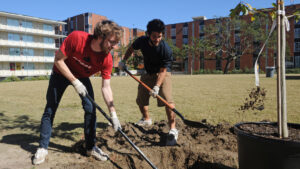
This article originally appeared in Grist at https://grist.org/cities/the-solution-to-urban-heat-is-much-much-simpler-than-you-think/. Grist is a nonprofit, independent media organization dedicated to telling stories of climate solutions and a just future. Learn more at Grist.org. Banner photo: Trees are planted at an Arbor Day event in Los Angeles (Jon Viscott/West Hollywood, CC BY-SA 2.0,via flickr).
Sign up for The Invading Sea newsletter by visiting here. To support The Invading Sea, click here to make a donation. If you are interested in submitting an opinion piece to The Invading Sea, email Editor Nathan Crabbe. To learn more about the urban heat island effect, watch the short video below.
