


By Theresa Rueger, Chancey MacDonald and Melissa Versteeg, Newcastle University
As the world contemplates dealing with more extreme temperatures, one coral reef fish has found a novel way to beat the heat: shrinking.
Wanting to know how clownfish cope with changes to their environment, we repeatedly measured 134 wild fish in Kimbe Bay, Papua New Guinea, during a marine heatwave that started in March 2023 and is part of an ongoing global mass coral bleaching event. Clownfish have unique markings, which make it easy to identify and measure them underwater.
To our complete surprise, we found that 100 of the fish we measured shrank during our study from February to August 2023. Those that shrank had a better chance of surviving the heatwave.
The clownfish, Amphiprion percula, lives in small social groups within anemones on coral reefs. As the movie “Finding Nemo” indicated, clownfish rarely, if ever, leave their host anemone because the anemone offers them protection from predators.
Sadly, this also means that clownfish cannot move to cooler areas as marine heatwaves become more common on coral reefs due to rising global temperatures. Clownfish need other strategies to survive the heat.
This is the first time that coral reef fish have been shown to shrink in response to heat stress. And by shrink, we don’t mean getting skinnier – we mean getting shorter.
This is surprising because growth in vertebrates (animals with backbones, like us) is generally considered to be a one-way street. You get larger over time and you might stop growing if stressed or as you reach your maximum length, but it is rare to find vertebrates shrinking, especially over periods as short as a month, and in response to environmental conditions.
It may also seem counter-intuitive to shrink. After all, smaller individuals are more prone to being eaten and they breed less. Here, however, being smaller increased the chances of survival for clownfish, possibly because smaller fish need less food and are typically more efficient at foraging and using oxygen, which is scarcer in hot water.
If you shrink, I shrink
We found that there is a social component to shrinking and surviving a heatwave.
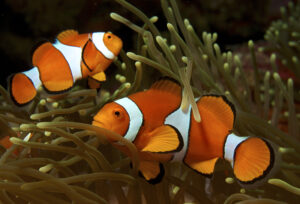
A remarkable feature of clownfish social groups is that they maintain strict hierarchies based on size. This means growth – and shrinking – don’t just affect the individual in question, but also risks conflict within the group that could force a fish to be evicted, which usually leads to death. So, shrinking is a risky proposition.
On each anemone the biggest clownfish is female, the second biggest is male, and together they form a breeding pair. To avoid fights in the pair, males control their growth to keep a fixed size ratio between the two.
In our study, breeding pairs in which both fish shrank were more likely to survive the heatwave than if only one, or neither, fish shrank.
We also found that those fish who shrank by a lot could catch up and grow rapidly when conditions improved. That means that it’s not just the shrinking that helps, but being able to shrink and grow flexibly to meet your needs.
While not all fish beat the heat and survived, none of the fish that shrank multiple times in our study died, and even shrinking once increased a clownfish’s survival probability during the heatwave by 78%.
Our research didn’t investigate how clownfish do this, but studies on other vertebrates might give us clues. Marine iguanas on the Galápagos Islands for example shrink during El Niño years, when water temperatures in the eastern and central tropical Pacific Ocean warm. This reduces the amount of food and prompts the reptiles to shrink by absorbing part of their bones.
The average size of many marine fish species around the globe is getting smaller according to long-term surveys. This could partly be a result of fishing removing larger fish from populations, as well as the warming climate altering the growth or maximum sizes of fish.
If our finding of adult fish shrinking in response to environmental stress is more widespread, it could be another reason why fish in the world’s ocean are getting smaller.
Theresa Rueger is a senior lecturer in tropical marine biology, Chancey MacDonald is a NERC independent research fellow in coral reef ecology and Melissa Versteeg is a PhD candidate in marine sciences, all at Newcastle University.
This article is republished from The Conversation under a Creative Commons license. Read the original article. Banner photo: A clownfish in a sea anemone (Diego Delso, CC BY-SA 4.0, via Wikimedia Commons).
Sign up for The Invading Sea newsletter by visiting here. To support The Invading Sea, click here to make a donation. If you are interested in submitting an opinion piece to The Invading Sea, email Editor Nathan Crabbe at ncrabbe@fau.edu. To learn more about coral bleaching, watch the video below.
