


By Alessandro Silvano, University of Southampton
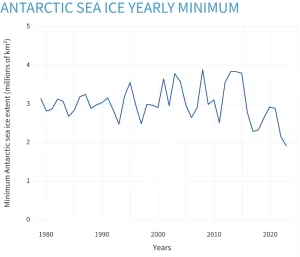
The ocean around Antarctica is rapidly getting saltier at the same time as sea ice is retreating at a record pace. Since 2015, the frozen continent has lost sea ice similar to the size of Greenland. That ice hasn’t returned, marking the largest global environmental change during the past decade.
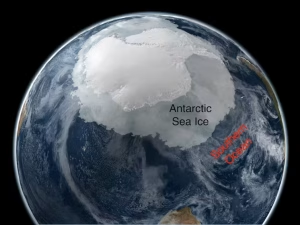
This finding caught us off guard – melting ice typically makes the ocean fresher. But new satellite data shows the opposite is happening, and that’s a big problem. Saltier water at the ocean surface behaves differently than fresher seawater by drawing up heat from the deep ocean and making it harder for sea ice to regrow.
The loss of Antarctic sea ice has global consequences. Less sea ice means less habitat for penguins and other ice-dwelling species. More of the heat stored in the ocean is released into the atmosphere when ice melts, increasing the number and intensity of storms and accelerating global warming. This brings heatwaves on land and melts even more of the Antarctic ice sheet, which raises sea levels globally.
Our new study has revealed that the Southern Ocean is changing, but in a different way to what we expected. We may have passed a tipping point and entered a new state defined by persistent sea ice decline, sustained by a newly discovered feedback loop.
A surprising discovery
Monitoring the Southern Ocean is no small task. It’s one of the most remote and stormy places on Earth, and is covered in darkness for several months a year. Thanks to new European Space Agency satellites and underwater robots which stay below the ocean surface measuring temperature and salinity, we can now observe what is happening in real time.
Our team at the University of Southampton worked with colleagues at the Barcelona Expert Centre and the European Space Agency to develop new algorithms to track ocean surface conditions in polar regions from satellites. By combining satellite observations with data from underwater robots, we built a 15-year picture of changes in ocean salinity, temperature and sea ice.
What we found was astonishing. Around 2015, surface salinity in the Southern Ocean began rising sharply – just as sea ice extent started to crash. This reversal was completely unexpected. For decades, the surface had been getting fresher and colder, helping sea ice expand.
To understand why this matters, it helps to think of the Southern Ocean as a series of layers. Normally, the cold, fresh surface water sits on top of warmer, saltier water deep below. This layering (or stratification, as scientists call it) traps heat in the ocean depths, keeping surface waters cool and helping sea ice to form.
Saltier water is denser and therefore heavier. So, when surface waters become saltier, they sink more readily, stirring the ocean’s layers and allowing heat from the deep to rise. This upward heat flux can melt sea ice from below, even during winter, making it harder for ice to reform. This vertical circulation also draws up more salt from deeper layers, reinforcing the cycle.
A powerful feedback loop is created: more salinity brings more heat to the surface, which melts more ice, which then allows more heat to be absorbed from the Sun. My colleagues and I saw these processes first hand in 2016-2017 with the return of the Maud Rise polynya, which is a gaping hole in the sea ice that is nearly four times the size of Wales and last appeared in the 1970s.
What happens in Antarctica doesn’t stay there
Losing Antarctic sea ice is a planetary problem. Sea ice acts like a giant mirror reflecting sunlight back into space. Without it, more energy stays in the Earth system, speeding up global warming, intensifying storms and driving sea level rise in coastal cities worldwide.
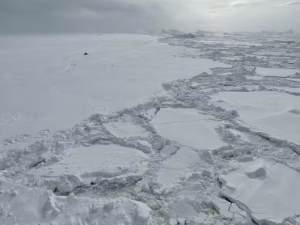
Wildlife also suffers. Emperor penguins rely on sea ice to breed and raise their chicks. Tiny krill – shrimp-like crustaceans which form the foundation of the Antarctic food chain as food for whales and seals – feed on algae that grow beneath the ice. Without that ice, entire ecosystems start to unravel.
What’s happening at the bottom of the world is rippling outward, reshaping weather systems, ocean currents and life on land and sea.
Antarctica is no longer the stable, frozen continent we once believed it to be. It is changing rapidly, and in ways that current climate models didn’t foresee. Until recently, those models assumed a warming world would increase precipitation and ice-melting, freshening surface waters and helping keep Antarctic sea ice relatively stable. That assumption no longer holds.
Our findings show that the salinity of surface water is rising, the ocean’s layered structure is breaking down and sea ice is declining faster than expected. If we don’t update our scientific models, we risk being caught off guard by changes we could have prepared for. Indeed, the ultimate driver of the 2015 salinity increase remains uncertain, underscoring the need for scientists to revise their perspective on the Antarctic system and highlighting the urgency of further research.
We need to keep watching, yet ongoing satellite and ocean monitoring is threatened by funding cuts. This research offers us an early warning signal, a planetary thermometer and a strategic tool for tracking a rapidly shifting climate. Without accurate, continuous data, it will be impossible to adapt to the changes in store.
Alessandro Silvano is a NERC independent research fellow in oceanography at the University of Southampton.
This article is republished from The Conversation under a Creative Commons license. Read the original article. Banner photo: Adelie penguins on an ice floe (Jerzy Strzelecki, CC BY 3.0, via Wikimedia Commons).
Sign up for The Invading Sea newsletter by visiting here. To support The Invading Sea, click here to make a donation. If you are interested in submitting an opinion piece to The Invading Sea, email Editor Nathan Crabbe at ncrabbe@fau.edu.
