


By Boluwatife S. Olubusoye and James V Cizdziel, University of Mississippi
Every few years, the tires on your car wear thin and need to be replaced. But where does that lost tire material go?
The answer, unfortunately, is often waterways, where the tiny microplastic particles from the tires’ synthetic rubber carry several chemicals that can transfer into fish, crabs and perhaps even the people who eat them.
We are analytical and environmental chemists who are studying ways to remove those microplastics – and the toxic chemicals they carry – before they reach waterways and the aquatic organisms that live there.
Microplastics, macro-problem
Millions of metric tons of plastic waste enter the world’s oceans every year. In recent times, tire wear particles have been found to account for about 45% of all microplastics in both terrestrial and aquatic systems.
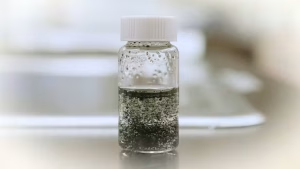
Tires shed tiny microplastics as they move over roadways. Rain washes those tire wear particles into ditches, where they flow into streams, lakes, rivers and oceans.
Along the way, fish, crabs, oysters and other aquatic life often find these tire wear particles in their food. With each bite, the fish also consume extremely toxic chemicals that can affect both the fish themselves and whatever creatures eat them.
Some fish species, like rainbow trout, brook trout and coho salmon, are dying from toxic chemicals linked to tire wear particles.
Researchers in 2020 found that more than half of the coho salmon returning to streams in Washington state died before spawning, largely because of 6PPD-Q, a chemical stemming from 6PPD, which is added to tires to help keep them from degrading.
But the effects of tire wear particles aren’t just on aquatic organisms. Humans and animals alike may be exposed to airborne tire wear particles, especially people and animals who live near major roadways.
In a study in China, the same chemical, 6PPD-Q, was also found in the urine of children and adults. While the effects of this chemical on the human body are still being studied, recent research shows that exposure to this chemical could harm multiple human organs, including the liver, lungs and kidneys.
In Oxford, Mississippi, we identified more than 30,000 tire wear particles in 24 liters of stormwater runoff from roads and parking lots after two rainstorms. In heavy traffic areas, we believe the concentrations could be much higher.
The Interstate Technology and Regulatory Council, a states-led coalition, in 2023 recommended identifying and deploying alternatives to 6PPD in tires to reduce 6PPD-Q in the environment. But tire manufacturers say there’s no suitable replacement yet.
What can communities do to reduce harm?
At the University of Mississippi, we are experimenting with sustainable ways of removing tire wear particles from waterways with accessible and low-cost natural materials from agricultural wastes.
The idea is simple: Capture the tire wear particles before they reach the streams, rivers and oceans.
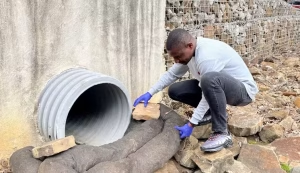
In a recent study, we tested pine wood chips and biochar – a form or charcoal made from heating rice husks in a limited oxygen chamber, a process known as pyrolysis – and found they could remove approximately 90% of tire wear particles from water runoff at our test sites in Oxford.
Biochar is an established material for removing contaminants from water due to its large surface area and pores, abundant chemical binding groups, high stability, strong adsorption capacity and low cost. Wood chips, because of their rich composition of natural organic compounds, have also been shown to remove contaminants. Other scientists have also used sand to filter out microplastics, but its removal rate was low compared with biochar.
We designed a biofiltration system using biochar and wood chips in a filter sock and placed it at the mouth of a drainage outlet. Then we collected stormwater runoff samples and measured the tire wear particles before and after the biofilters were in place during two storms over the span of two months. The concentration of tire wear particles was found to be significantly lower after the biofilter was in place.
The unique elongated and jagged features of tire wear particles make it easy for them to get trapped or entangled in the pores of these materials during a storm event. Even the smallest tire wear particles were trapped in the intricate network of these materials.
Using biomass filters in the future
We believe this approach holds strong potential for scalability to mitigate tire wear particle pollution and other contaminants during rainstorms.
Since biochar and wood chips can be generated from agricultural waste, they are relatively inexpensive and readily available to local communities.
Long-term monitoring studies will be needed, especially in heavy traffic environments, to fully determine the effectiveness and scalability of the approach. The source of the filtering material is also important. There have been some concerns about whether raw farm waste that has not undergone pyrolysis could release organic pollutants.
Like most filters, the biofilters would need to be replaced over time – with used filters disposed of properly – since the contaminants build up and the filters degrade.
Plastic waste is harming the environment, the food people eat and potentially human health. We believe biofilters made from plant waste could be an effective and relatively inexpensive, environmentally friendly solution.
Boluwatife S. Olubusoye is a Ph.D. candidate in chemistry and James V Cizdziel is a professor of chemistry, both at the University of Mississippi.
This article is republished from The Conversation under a Creative Commons license. Read the original article. Banner photo: Motor vehicle tires on a road (iStock image).
Sign up for The Invading Sea newsletter by visiting here. To support The Invading Sea, click here to make a donation. If you are interested in submitting an opinion piece to The Invading Sea, email Editor Nathan Crabbe at ncrabbe@fau.edu.
