


By Bob Norberg, Third Act Florida
Small-scale solar provides a hedge against increases in electric bills that Floridians cannot control on their own.
Roughly 75% of the electricity in Florida is currently produced by utilities using so-called natural gas, the largest component of which is methane. No matter what our policymakers tell us about making the U.S. the world leader in methane gas production, the price of methane is set by global supply and demand.
In particular, energy prices are impacted by geopolitical risks such as turmoil in the Middle East, sanctions against Russia and growth in demand from different countries. Global prices have spiked by more than 100% three times since 2021. These externalities have a substantial impact on our electricity costs. Methane price volatility is reflected in the “fuel adjustment” line on your electric bill.
Furthermore, utilities regularly request rate increases for such things as expansion investments, “hardening” their facilities and weather disaster clean-up. This makes electric bills a frustrating cost of living that most consumers cannot control.
The utility monopolies pass price increases right through to consumers, who have no recourse but to pay higher prices for electricity – unless we produce our own electricity!
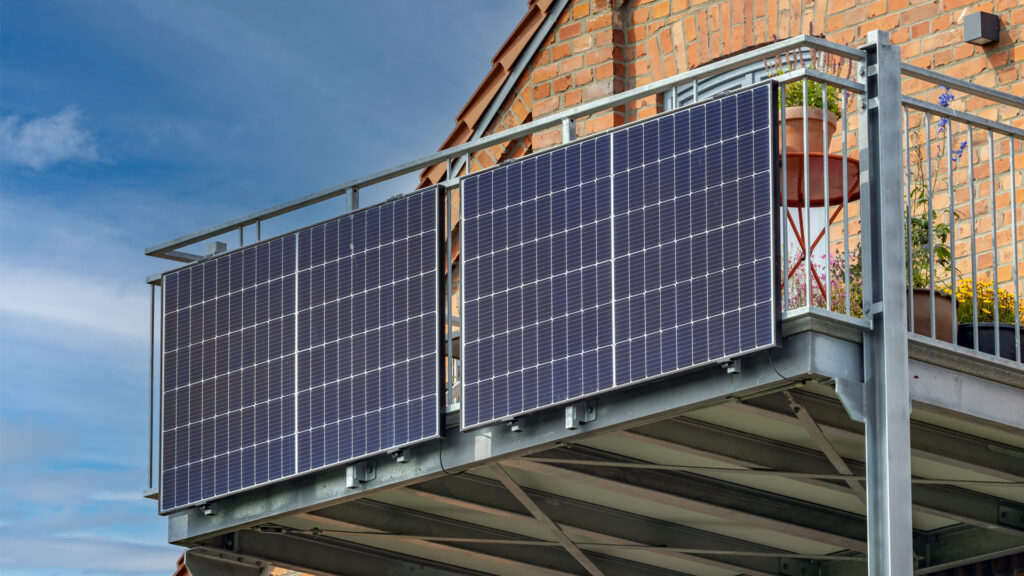
Recent developments in solar power generation and storage have made it possible for residents and businesses to generate their own electricity with small scale, plug-and-play solar collection and storage systems. These systems provide an alternative to residents who cannot, or will not, install full-scale solar systems on their roofs.
For some residents, rooftop solar systems are too costly, too obtrusive or simply not feasible. However small-scale solar systems may be a viable alternative to produce some percentage of your electricity needs. These include solar systems that are small enough to fit on a balcony or a backyard deck.
Left unhindered by our policymakers, these systems will continue to evolve, becoming more efficient generators of electricity and lower-cost storage mediums. Therefore, with a smaller initial investment, residents can hedge their exposure to utility rate increases by producing their own electricity at a fixed cost for the life of the system.
Also exerting pressure on demand for electricity from our utilities are the exponential growth projections from commercial and industrial users. Think AI data center build-out, manufacturing capacity growth and the electrification of industrial processes.
With complicity from our governor-appointed Public Service Commission, it is easy to see that residential consumers will continue to carry the burden of the cost risks and profit maximization efforts of our utility monopolies. Residents need to prepare to generate their own electricity and decouple their needs from the utility monopolies.
However, there is still work to do to make the regulatory environment friendly to small-scale solar for everyone. Smart solar standards would allow consumers to exercise their will to choose how much they want to be dependent on the utility monopolies, versus independently supplying their own electricity.

This would include modifying a Florida law (F.S.163.04) that is supposed to protect the right of property owners to install renewable energy devices. Lawmakers should eliminate language saying that the law “shall not apply to patio railings in condominiums, cooperatives, or apartments,” which was obliviously added as a last-minute attempt to appease the utility and multi-family home lobbyists.
As an economist, it can be difficult to justify purchasing solar generation and storage capacity based on the intrinsic benefits of reducing individual carbon output and having emergency backup when the inevitable storm shuts off your power. These are substantial justifications but current pricing of alternative fuels, capabilities of current technology and regulatory barriers and costs make a return-on-investment decision challenging.
However, as a risk manager decoupling from an uncontrollable cost to a long-term, fixed cost can make sense. The intrinsic benefits are an additional justification.
Small-scale solar collection and storage, i.e. balcony or backyard solar, can provide a hedge for residential consumers against the rising, and uncontrollable, cost of utility-provided electricity.
Bob Norberg is a retired economist who lives in Gainesville and serves as co-facilitator for Third Act Florida, a diverse community of Florida seniors working together to protest against the causes of climate change and protect our democracy. Banner photo: A man adjusts solar panels on his deck (iStock image).
Sign up for The Invading Sea newsletter by visiting here. To support The Invading Sea, click here to make a donation. If you are interested in submitting an opinion piece to The Invading Sea, email Editor Nathan Crabbe at ncrabbe@fau.edu.
