


This article originally appeared on Inside Climate News, a nonprofit, non-partisan news organization that covers climate, energy and the environment. Sign up for their newsletter here.
By Kiley Price, Inside Climate News
For nearly three years, drivers on San Carlos Island in Florida passed by an unusual sight tangled in the mangroves on the shoulder of a major road: a large white boat. The abandoned vessel was a relic of 2022’s Hurricane Ian, which displaced more than 7,000 vessels amid severe winds, torrential downpour and catastrophic storm surge.
Last month, the boat was finally removed.
It’s “a little emotional, but it’s a sign of progress,” John Cassidy, a boat captain in the area, told Gulf Coast News. “We gotta get everything out of here.”
Around the U.S., thousands of abandoned, derelict vessels — many ruined by climate-fueled tropical storms — pollute oceans and waterways, disrupting local ecosystems. Addressing the problem can be time consuming and costly, often averaging more than $24,000 to remove a single boat.
Many states lack a protocol for dealing with this supersized litter. To help fill in the gaps, the National Oceanic and Atmospheric Administration is working with nonprofits to fund projects for tackling abandoned vessels.
But the upcoming peak of the Atlantic hurricane season could introduce a wave of new ghost ships into waterways even as states scramble to clean up the messes of storms past.
Constant reminder
Research shows that a hurricane’s footprint can linger for decades after the storm hits. Next week marks the 20th anniversary of Hurricane Katrina, and many areas are still rebuilding in some capacity. Black communities were especially hard hit, and still struggle with mental and physical health issues brought by the storm, Essence reports.
Boats probably aren’t top of mind when it comes to storm damage. But they are often particularly vulnerable when a hurricane hits due to their location.
“These vessels end up being displaced or removed from where they were to another location, damaged [or] destroyed,” Michael Moore, who helps run the abandoned derelict vessel program at the nonprofit BoatUS Foundation, told me. “If it ends up 30 miles away from where it was … in a nice, secure location to an upland wetland forested area, or maritime forest, how do you get to it? It presents a challenge.”
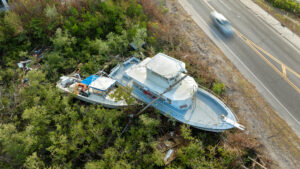
Last year, Hurricanes Helene and Milton hit back-to-back in Florida — often considered the “Boat Capital of the U.S.” — and displaced hundreds of vessels in the southwest region of the state, the St. Augustine Record reports.
The problem can get worse when boats are not removed swiftly. For example, in 2015, an 83-foot steel-hulled fishing vessel broke free of its mooring during a typhoon off the Northern Mariana Islands, and sat grounded on the coast until another typhoon further chipped away at the vessel in 2018. The boat was finally removed in 2021, according to NOAA.
Even without damage from a storm, officials say owners sometimes simply set their boats adrift or leave them to decay because proper disposal can be costly and many landfills do not accept them. Florida officials recently facilitated a $195,000 mission to remove a 100-foot submarine that corroded in a canal off the Keys for decades, USA Today reports. The owner was fined $1,200 in 2023 and given 12 months of probation, which he completed, Keys Weekly reports.
These sitting vessels can wreak havoc on ecosystems, leaking fuels and oil that poison coral, fish and seabirds, according to NOAA. Over time, more pieces of these ships may break off, spreading microplastics and debris throughout the water. Derelict vessels also pose navigational risks for active boaters who don’t see the threat at the surface.
“If a propeller gets tangled up in it, that could be many thousands of dollars to repair,” boat captain Steve Eftimiades told CBS News. Experts say up to 500 abandoned boats pollute New York City waters, but the city is preparing to launch a new boat turn-in program to mitigate the problem.
Gear associated with boating activities such as fishing can also come loose in storms, inundating the ocean with nets or ropes that entangle marine life. Since Hurricane Fiona hit eastern Canada in 2022, the government has helped recover more than 690 tons of lost gear. As I’ve covered extensively, rope entanglement is one of the top threats to marine life like North Atlantic right whales.
Keeping things afloat
A number of reasons explain why ghost boats can haunt the waterways for so long, from financial barriers to actual barriers; many of the boats are tucked into hard-to-reach and fragile ecosystems such as coral reefs. The situation can become especially complicated if a boat has been sitting in the ecosystem for so long that fish may have built habitat around it, Moore said.
“You have to ask … now is it more detrimental to actually remove it because it’s become part of the environment?” he said, emphasizing that environmental reviews are a crucial part of the abandoned boat removal process.
Additionally, many states such as New Jersey, Maine and North Carolina lack laws or policies related to abandoned vessels, so holding boat owners accountable can be difficult.
However, the tides may be shifting in some areas. In July, a new law went into effect that enables the Florida Fish and Wildlife Conservation Commission to remove derelict boats without owner consent under certain conditions, and imposes strict penalties on owners who fail to recover the vessels themselves.
Meanwhile, with funding under the Infrastructure Investment and Jobs Act, NOAA has allocated tens of millions of dollars to marine debris removal efforts in recent years. With NOAA funding, BoatUS launched a program at the end of July that provides grants to help remove more than 300 abandoned and derelict boats.
The efforts will span two unincorporated communities and six states, including Alaska, Washington and Maine, with an aim to recycle materials from abandoned vessels. BoatUS also developed a database to identify and track abandoned vessels across the country.
But as hurricane season ramps up, Moore stressed the importance of securing boats before a storm hits. Get them out of the water, he said, or secure them tightly to a dock.
“Just staying aware, being able to look at what the forecast and the models say [for extreme] events like hurricanes,” is crucial, he said. “Make sure that your boat can stay afloat.”
Banner photo: An abandoned boat in front of mangroves in Key Largo (iStock image). Sign up for The Invading Sea newsletter by visiting here. To support The Invading Sea, click here to make a donation. If you are interested in submitting an opinion piece to The Invading Sea, email Editor Nathan Crabbe at ncrabbe@fau.edu.
