


By Dyllan Furness, USF College of Marine Science
Charter captain Rob Gorta has fished Tampa Bay for nearly 30 years and like many in his industry, he’s concerned about the impact of pollution on his livelihood.
That’s why Gorta, a retired petty officer third class of the U.S. Coast Guard, has partnered with University of South Florida Professor Steve Murawski and his team on the Tampa Bay Surveillance (TBS) project, a five-year study of “contaminants of emerging and known concern.”
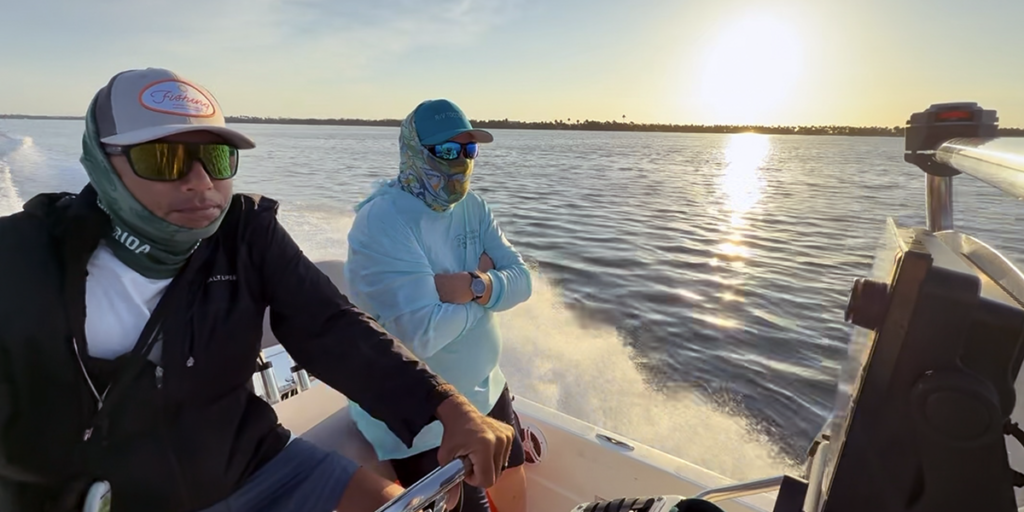
“This research will help by telling us more about the pollution in Tampa Bay and how it impacts our fish,” Gorta said.
The bay is a major economic driver for the region. Between fisheries, tourism and other sectors, the Tampa Bay Regional Planning Council reports the bay has an annual economic output of $32 billion.
Captain Rob Gorta and USF Professor Steve Murawski traverse Tampa Bay on a sampling trip in August. Photos by Dyllan Furness, USF College of Marine Science.
Murawski and his team at the USF College of Marine Science have installed 17 racks across Tampa Bay designed to attract barnacles. By extracting soft tissue samples from the barnacles, as well as samples from oysters, fishes, water and sediments, they hope to make clear the complicated state of contamination in Florida’s largest estuary.
“We know from our past studies that Tampa Bay contains these contaminants of concern,” said Murawski, endowed chair of biological oceanography and principal investigator of the project, which is funded by the National Oceanic and Atmospheric Administration and the South Carolina Sea Grant Consortium. “We want to determine their distribution and concentration in the bay, and help figure out how they’re getting here.”
The researchers’ comprehensive approach of examining samples from different regions of Tampa Bay allows them to paint a picture of chemical contamination.
The contaminants in question include chemical compounds from pesticides and herbicides used on lawns, pharmaceuticals flushed down toilets, and so-called “forever chemicals” — per- and polyfluoroalkyl substances (PFAS) — which are found in everyday products such as plastic bags and non-stick cookware.
The concept for the Tampa Bay Surveillance project began more than 15 years ago with the Deepwater Horizon disaster. On April 20, 2010, the offshore drilling rig exploded, leading to the largest marine oil spill in history. Eleven people and countless birds and marine animals died as a result.
Scientists from USF were on the scene soon after the disaster. Aboard the newly acquired research vessel Weatherbird II for its first scheduled expedition, the team collected water samples and other critical information near the blowout site, thanks to rapid funding granted by the USF Foundation and NOAA.
Murawski went on to lead an international consortium to study the environmental impacts of the oil spill. The research included 18 institutions and $36.6 million in funded research. This interdisciplinary effort culminated in 250 scientific publications and a two-book series synthesizing 10 years of research by the consortium.
“Through our work on the spill, we learned a lot about the impacts of these contaminants and acquired highly specialized equipment to do the science,” Murawski said. “TBS is a natural extension of our work on Deepwater Horizon.”
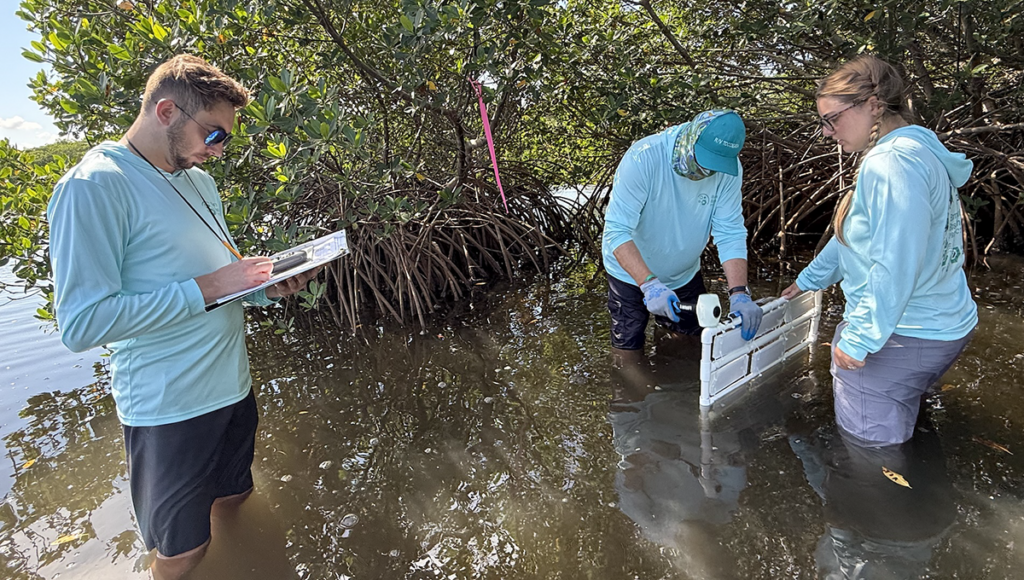
AJ Gross, a graduate student studying under Murawski and Distinguished University Professor Mya Breitbart, joined a recent trip around the bay, where he helped dislodge clumps of oysters, placed them in contaminant-free bags, and put them on ice.
Similarly to barnacles, oysters are filter feeders. They play a crucial role in water quality and can serve as markers for environmental monitoring. Gross explained that the combination of samples taken from different marine organisms in various locations in the bay — from Weedon Island Preserve to a creek just south of Tampa International Airport — may help researchers trace contaminants to their sources.
“By comparing the samples of oysters to samples of barnacles and fish from around the bay, we can make inferences about where these pollutants come from and may be able to help prevent contamination at the source,” Gross said.
Layne Leggett, a graduate student in Murawski’s lab, is charged with sampling and analyzing barnacles for the study. On a recent August afternoon, she checked on hundreds of dime-sized barnacles that clung to a rack that had been submerged in Bayboro Harbor for 12 weeks.
“It’s been amazing to see how quickly these barnacles have grown,” said Leggett, who’s also assisting in the team’s efforts to compare contaminants during different seasons.
Once the rainy season subsides, Leggett will begin to scrape off barnacles and test them for contaminants. A high concentration of contaminants in samples from the rainy season will suggest contamination from storm water runoff. Samples taken during the dry season will most likely be influenced by wastewater and other industrial discharges into the bay.
In this way, the researchers hope to pinpoint problem areas around the bay and help agencies at the city, county, state and federal level manage contaminants in Florida’s coastal waters.
This piece was originally published at https://www.usf.edu/marine-science/news/2025/usf-scientists-build-on-deepwater-horizon-research-with-new-project-targeting-pollutants-in-tampa-bay-and-beyond.aspx. Banner photo: Steve Murawski and AJ Gross examine samples from an oyster bed in Old Tampa Bay (Photo by Dyllan Furness, USF College of Marine Science).
Sign up for The Invading Sea newsletter by visiting here. To support The Invading Sea, click here to make a donation. If you are interested in submitting an opinion piece to The Invading Sea, email Editor Nathan Crabbe at ncrabbe@fau.edu.
