


By Diana Udel, University of Miami News
team of researchers at the University of Miami has developed a global atmospheric modeling framework that blends powerful research capabilities with accessibility for students and scientists alike. Written entirely in Python, a high-level, general-purpose programming language, and designed to run on an interactive Jupyter Notebook, the new tool removes longstanding technical barriers, allowing anyone with a standard laptop to explore cutting-edge climate experiments.
Most existing climate models rely on legacy Fortran code and complicated setups that are costly and time-consuming for students to use. By contrast, this open-source framework simplifies the process. Users can run experiments, analyze data, and visualize results directly within a notebook environment. Educators can tailor classroom exercises to different levels of complexity, while advanced researchers can adapt the model for original investigations into atmospheric dynamics.
“Python’s widespread use — and its clarity for beginners — were critical to our decision,” said Ben Kirtman, dean of the University of Miami Rosenstiel School of Marine, Atmospheric, and Earth Science and lead author of the study. “It also supports advanced features like machine learning and artificial intelligence for handling large datasets, which simply aren’t as accessible in traditional Fortran models.”
Kirtman’s motivation to re-code models in Python came after watching his students spend hours troubleshooting code just to get experiments running. The delays often hindered their progress and slowed research momentum.
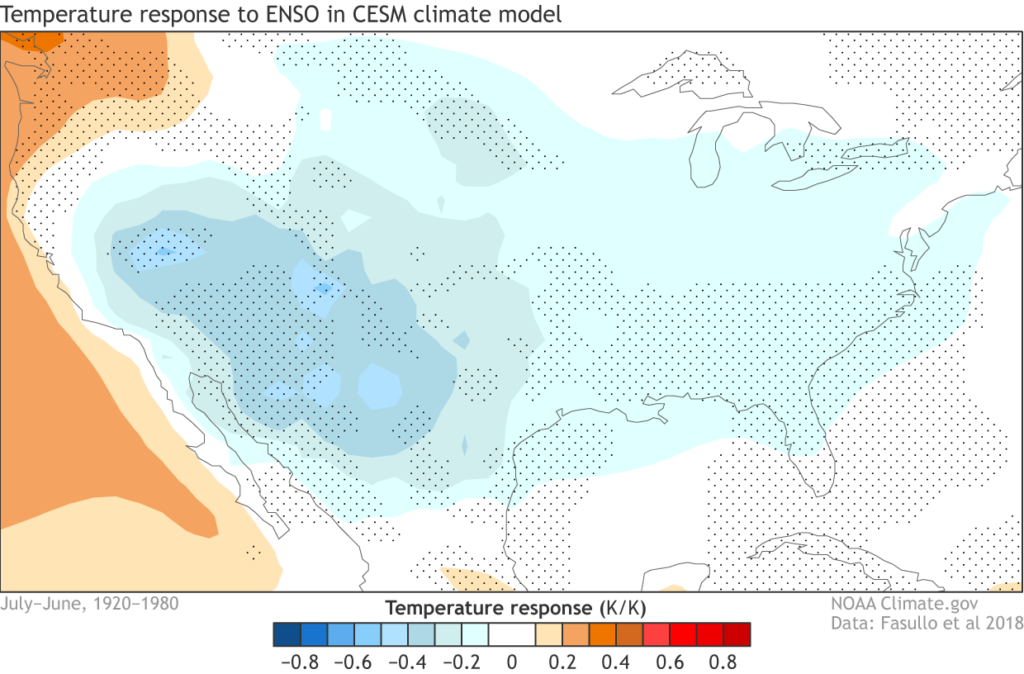
Marybeth Arcodia, a co-author of the study and assistant professor in the Department of Atmospheric Sciences at the Rosenstiel School, experienced those setbacks firsthand as a graduate student in Kirtman’s lab. Her research explored long-term climate scenarios and weather patterns such as the El Niño–Southern Oscillation (ENSO), a recurring climate pattern that involves changes in the temperature of waters in the central and eastern tropical Pacific Ocean. Teleconnections like ENSO, where climate anomalies in one region affect distant parts of the globe, require models that can capture large-scale interactions.
“In its first demonstrations, the model successfully replicated global climate patterns associated with El Niño events, highlighting its ability to capture these complex phenomena,” Arcodia said.
Several innovations set this framework apart. Its Python-based core makes it easy to learn and modify. Adjustable atmospheric settings allow users to experiment with different levels of complexity, from simplified backgrounds to detailed formulations. The model can also simulate real-world influences such as heat sources, land features, and ocean conditions, opening opportunities for both classroom exercises and advanced research.
The team collaborated with the Frost Institute for Data Science and Computing to handle the substantial datasets needed for development. With its successful initial demonstrations, the framework shows strong potential for both education and scientific discovery.
Looking ahead, Kirtman is developing an experiential climate modeling course for undergraduate and graduate students, enabling them to design and test their own climate scenarios with the new tool. To maximize impact, the framework is available as open-source software on GitHub, ensuring global access for educators, students, and researchers.
The study, “A Simplified-Physics Atmosphere General Circulation Model for Idealized Climate Dynamics Studies,” was published Aug. 22 online in the Bulletin of the American Meteorological Society. For more information, visit https://news.miami.edu/rosenstiel/stories/2025/09/university-of-miami-scientists-launch-accessible-global-climate-modeling-framework.html.
Sign up for The Invading Sea newsletter by visiting here. To support The Invading Sea, click here to make a donation. If you are interested in submitting an opinion piece to The Invading Sea, email Editor Nathan Crabbe at ncrabbe@fau.edu. Banner photo: Ocean waters (iStock image).

This new Python climate model sounds like a game changer – finally, students can code their way to El Niño victory without spending hours debugging! Who needs hours troubleshooting when you can spend them trying to explain *why* the model thinks Miami is suddenly Arctic? Kirtman and Arcodia are brilliant for tackling the code nightmare issue; its like giving researchers superpowers and educators a lifeline. The open-source move is a winner too – now everyone can play climate scientist, maybe even accidentally trigger a virtual La Niña just by looking at it too hard. Bring on the course – Im ready to design a scenario where everyone gets a surprise heatwave, just for laughs. What could possibly go wrong? 😉hẹn giờ online