


By Katie Carpenter, Everwild Media
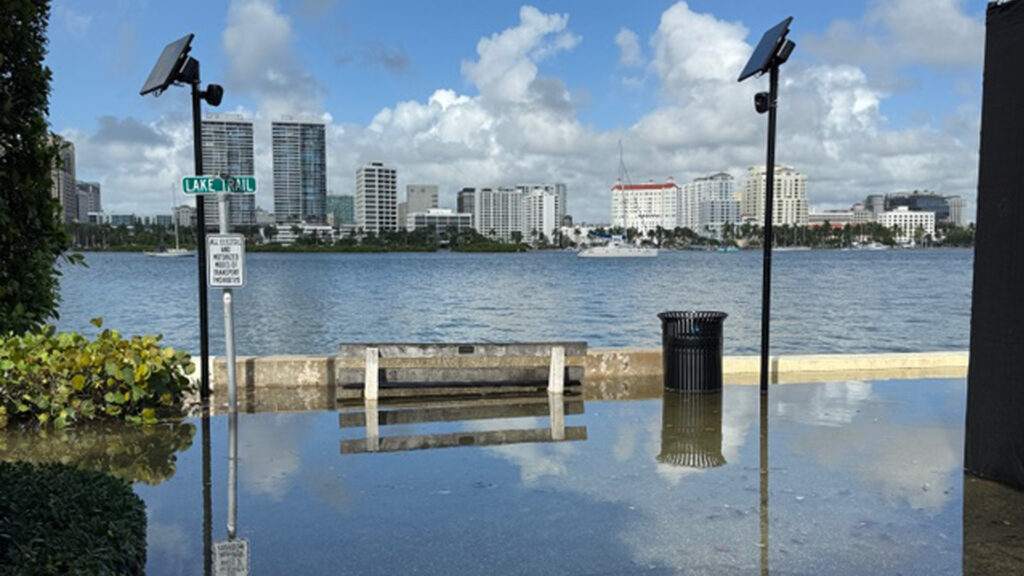
Media coverage of our massive king tides this month has been extensive and opened more eyes to worsening flood risk in Florida. But it’s mostly been overshadowed by even worse news.
When two problems coincide, they can magnify both impacts. King tides during a government shutdown reveal to us how precarious our flood risk situation really is. The shutdown has already hurt so many people, with jobs lost, services suspended and paychecks not certain to arrive. Flood insurance policy purchases are also suspended during the shutdown.
With those sales halted, guess what else you can’t buy or sell? Homes! That is, if you need a mortgage. Flood insurance is required in order to obtain a mortgage, if the property is in a Special Flood Hazard Area, which is a lot of Florida. Or else you have to go to the private insurance market. You also can’t renew a federal flood policy, or increase your coverage, when the National Flood Insurance Program (NFIP) office at the Federal Emergency Management Agency is closed.
The shutdown is causing agony around the country. The issue that no one can buy flood insurance is just one detail that disadvantages Florida and other southeastern states. Right now, we have king tides, with coastal storms stirring things up, plus sea level rise that scientists say is accelerating. We see houses up to the Carolinas falling into the sea, while Florida neighborhoods are swamped.
“This is exceptional, I don’t remember it ever this bad,” longtime Miami resident Gerald Wolfe told the Miami Herald as he tried to unload his boat at a marina last week. A resident of Boynton Beach posted a video of a shark swimming in a parking lot. You can hear his astonished voice: “Only in Florida do you see something like this!”
Five days into the king tide and 12 days into the shutdown, saltwater was still swirling around our calves on my street. We watch Stanley Steemer and Servpro trucks sloshing by, cars stalled out on the sidewalk and low-lying homes with water up above the foundation line. If you have friends that don’t want to talk about climate change, just mention mold.
Florida has almost 2 million flood insurance policyholders, nearly 20% of all NFIP policies, the most of any state. “If your driver’s license says ‘Florida,’ you’re going to flood,” former FEMA Administrator Deanne Criswell told Central Florida Public Media.
There are over 25,000 real estate closings with a mortgage requiring flood insurance per month in Florida, according to Redfin. If the shutdown goes on much longer, there could be a messy traffic jam at the for-sale door or, more troubling, people caught between places to live.
While waiting on hold for a FEMA rep to pick up the phone, I checked out the Realtor.com web site for more information. On the top of the page, it cautions: “The National Flood Insurance Program (NFIP), which insures nearly 5 million properties across the U.S., has officially lapsed following the government shutdown. FEMA can no longer write new or renew existing policies under the program, leaving flood-prone homeowners in a dangerous lurch.”
It’s a “lurch!” And even if your insurance coverage is secure, there’s no guarantee that flood claims will be paid on time if water gets into your house when the NFIP is closed. We’re not out of the woods storm-wise, as hurricane season lasts until Nov. 30.
Maybe we should fix our storm drains, or raise the sea walls or elevate our streets. Yet it’s unlikely any of that’s going to be proposed during a shutdown. Climate change denial gets very loud when the solutions are going to cost real money.
States and cities can rarely afford climate change adaptation solutions on their own, and the federal government also eliminated the FEMA resilient grants programs. When the Building Resilient Infrastructure and Communities grants were cancelled earlier this year, the head of the U.S. division of the International Association of Emergency Managers Carrie Speranza called it “devastating.”
It’s no secret that many in our administration don’t like to mention climate change, or its causes and impacts. It’s risky to say the words in public, even around here with my sneakers in a puddle. It might be best to just let your neighbors know to be ready: We still have more king tides coming to Florida this year – watch especially for the full-moon periods around Nov. 3-8 and Dec. 2-7.
Regardless of what some may say, flooding is real, flood insurance is needed, flood prevention grants save homes and communities, and FEMA is still the only number many have to call. Let’s hope someone answers the phone. We all need the federal government to be open.
Katie Carpenter is a West Palm Beach-based filmmaker with Everwild Media (www.everwildmedia.com), producing documentaries about conservation, climate change and solutions. Banner photo: A truck drives through king tide flooding in West Palm Beach (Credit: Katie Carpenter). To learn more about king tides, watch the short video below.
Sign up for The Invading Sea newsletter by visiting here. To support The Invading Sea, click here to make a donation. If you are interested in submitting an opinion piece to The Invading Sea, email Editor Nathan Crabbe at ncrabbe@fau.edu.

If you live near the Gulf of Mexico or the Atlantic coast and are less than Thirty feet above sea level flooding is in your future.