


By Roshanak (Roshi) Nateghi, Georgetown University
The Trump administration’s widespread cancellation and freezing of clean energy funding is also hitting essential work to improve the nation’s power grid. That includes investments in grid modernization, energy storage and efforts to protect communities from outages during extreme weather and cyberattacks. Ending these projects leaves Americans vulnerable to more frequent and longer-lasting power outages.
The Department of Energy has defended the cancellations, saying that “the projects did not adequately advance the nation’s energy needs, were not economically viable and would not provide a positive return on investment of taxpayer dollars.” Yet before any funds are actually released through these programs, each grant must pass evaluations based on the department’s standards. Those included rigorous assessments of technical merits, potential risks and cost-benefit analyses — all designed to ensure alignment with national energy priorities and responsible stewardship of public funds.
I am an associate professor studying sustainability, with over 15 years of experience in energy systems reliability and resilience. In the past, I also served as a Department of Energy program manager focused on grid resilience. I know that many of these canceled grants were foundational investments in the science and infrastructure necessary to keep the lights on, especially when the grid is under stress.
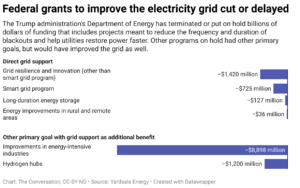
The dollar-value estimates vary, and some of the money has already been spent. A list of canceled projects maintained by energy analysis company Yardsale totals about $5 billion. An Oct. 2 announcement from the department touts $7.5 billion in cuts to 321 awards across 223 projects. Additional documents leaked to Politico reportedly identified additional awards under review. Some media reports suggest the full value of at-risk commitments may reach $24 billion — a figure that has not been publicly confirmed or refuted by the Trump administration.
These were not speculative ventures. And some of them were competitively awarded projects that the department funded specifically to enhance grid efficiency, reliability and resilience.
Grid improvement funding
For years, the federal government has been criticized for investing too little in the nation’s electricity grid. The long-term planning — and spending — required to ensure the grid reliably serves the public often falls victim to short-term political cycles and shifting priorities across both parties.
But these recent cuts come amid increasingly frequent extreme weather, increased cybersecurity threats to the systems that keep the lights on, and aging grid equipment that is nearing the end of its life.
These projects sought to make the grid more reliable so it can withstand storms, hackers, accidents and other problems.
National laboratories

In addition to those project cancellations, President Donald Trump’s proposed budget for 2026 contains deep cuts to the Office of Energy Efficiency and Renewable Energy, a primary funding source for several national laboratories, including the National Renewable Energy Laboratory, which may face widespread layoffs.
Among other work, these labs conduct fundamental grid-related research like developing and testing ways to send more electricity over existing power lines, creating computational models to simulate how the U.S. grid responds to extreme weather or cyberattacks, and analyzing real-time operational data to identify vulnerabilities and enhance reliability.
These efforts are necessary to design, operate and manage the grid, and to figure out how best to integrate new technologies.
Grid resilience and modernization
Some of the projects that have lost funding sought to upgrade grid management – including improved sensing of real-time voltage and frequency changes in the electricity sent to homes and businesses.
That program, the Grid Resilience and Innovation Partnerships Program, also funded efforts to automate grid operations, allowing faster response to outages or changes in output from power plants. It also supported developing microgrids – localized systems that can operate independently during outages. The canceled projects in that program, estimated to total $724.6 million, were in 24 states.

For example, a $19.5 million project in the Upper Midwest would have installed smart sensors and software to detect overloaded power lines or equipment failures, helping people respond faster to outages and prevent blackouts.
A $50 million project in California would have boosted the capacity of existing subtransmission lines, improving power stability and grid flexibility by installing a smart substation, without needing new transmission corridors.
Microgrid projects in New York, New Mexico and Hawaii would have kept essential services running during disasters, cyberattacks and planned power outages.
Another canceled project included $11 million to help utilities in 12 states use electric school buses as backup batteries, delivering power during emergencies and peak demand, like on hot summer days.
Several transmission projects were also canceled, including a $464 million effort in the Midwest to coordinate multiple grid connections from new generation sites.
Long-duration energy storage
The grid must meet demand at all times, even when wind and solar generation is low or when extreme weather downs power lines. A key element of that stability involves storing massive amounts of electricity for when it’s needed.
One canceled project would have spent $70 million turning retired coal plants in Minnesota and Colorado into buildings holding iron-air batteries capable of powering several thousand homes for as many as four days.
Rural and remote energy systems
Another terminated program sought to help people who live in rural or remote places, who are often served by just one or two power lines rather than a grid that can reroute power around an interruption.
A $30 million small-scale bioenergy project would have helped three rural California communities convert forest and agricultural waste into electricity.
Not all of the terminated initiatives were explicitly designed for resilience. Some would have strengthened grid stability as a byproduct of their main goals. The rollback of $1.2 billion in hydrogen hub investments, for example, undermines projects that would have paired industrial decarbonization with large-scale energy storage to balance renewable power. Similarly, several canceled industrial modernization projects, such as hybrid electric furnaces and low-carbon cement plants, were structured to manage power demand and integrate clean energy, to improve grid stability and flexibility.
The reliability paradox
The administration has said that these cuts will save money. In practice, however, they shift spending from prevention of extended outages to recovery from them.
Without advances in technology and equipment, grid operators face more frequent outages, longer restoration times and rising maintenance costs. Without investment in systems that can withstand storms or hackers, taxpayers and ratepayers will ultimately bear the costs of repairing the damage.
Some of the projects now on hold were intended to allow hospitals, schools and emergency centers to reduce blackout risks and speed power restoration. These are essential reliability and public safety functions, not partisan initiatives.
Canceling programs to improve the grid leaves utilities and their customers dependent on emergency stopgaps — diesel generators, rolling blackouts and reactive maintenance — instead of forward-looking solutions.
Roshanak (Roshi) Nateghi is an associate professor of sustainability at Georgetown University.
This article is republished from The Conversation under a Creative Commons license. Read the original article. Banner photo: High-voltage power lines (iStock image).
Sign up for The Invading Sea newsletter by visiting here. To support The Invading Sea, click here to make a donation. If you are interested in submitting an opinion piece to The Invading Sea, email Editor Nathan Crabbe at ncrabbe@fau.edu.
