


This story was originally published by The Revelator. Subscribe to their newsletter.
Bird populations across the globe have been decreasing sharply for decades. A landmark study published in 2019 estimated that the total number of breeding birds in North America had dropped by almost 30% since 1970, and similarly sobering declines have been reported in Europe, the Neotropics, and other regions.
But what factor or combination of factors is causing the world’s ecosystems to lose their birds?
The authors of the 2019 paper on bird populations in North America — also nicknamed the “3 billion birds paper,” after its estimate for the number of birds that have vanished from the continent — drew on a wide variety of data sources to reach their conclusions. Although they didn’t directly study the causes of the decline they identified, the website they created to further publicize the problem pointed to habitat loss and degradation as likely being the biggest driver, along with other factors including pesticides, collisions with human-built structures and predation by domestic cats.
It may be time to add climate change to that list. Two studies published this year suggest that climate change — specifically the extreme weather events it fuels — is not just a looming threat to birds in the future but has already played a large role in bird declines in some areas of the world.
The first, published this summer in Biological Conservation, focused on how intensifying droughts have affected birds in the deserts of southwestern North America.
Using 25 years of Breeding Bird Survey data, researchers analyzed how bird populations in the region were affected by droughts ranging from three months to three years in duration. They found that in severe annual droughts, populations of the studied species dropped by as much as 34%.
The overall diversity of the bird communities captured in the surveys declined as well; not only were there fewer total birds, but fewer species at each survey site.
According to the study’s authors, this suggests that year-long droughts, which are increasing in frequency due to climate change, are a key driver of desert bird population declines.
Under typical situations, “you would expect (drought) to be bad for, say, 90% of species, but with a few that seem to actually do better under drought,” according to Merjin van den Bosch, a spatial ecologist at Colorado State University who was one of the lead authors of the study. In this case, however, not a single species included in the analysis appeared to benefit even slightly.
Some birds, such as black-throated sparrows, were more heavily hit than others, but “it was really just overwhelmingly bad.”
Around the same time, another study, published in Nature Ecology & Evolution by a different research team and looking at a different type of extreme weather in a different biome, reached a similar conclusion.
James Watson, a professor at the University of Queensland and one of the second study’s authors, explains that in the Australian birdwatching community “there has been this conversation for 20 or 30 years that we’re starting to see birds not come back after these big drought events.”
But despite the anecdotal feelings, the problem had not been scientifically quantified. “As a scientist who studies human impacts on biodiversity, I recognized that there was no science showing that, there was no smoking gun,” Watson says.
When Maximilian Kotz, a researcher from Germany’s Potsdam Institute for Climate Impact Research, visited the University of Queensland, the two decided to collaborate on an effort to model the various factors that might be contributing to the global bird declines captured by a project called the Living Planet Index. Their analysis included habitat loss and long-term changes in average temperature as well as extreme events such as heat waves and floods.
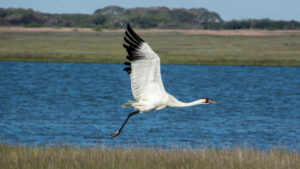
In this case, it was heat waves that proved most important. Their results show that heat waves fueled by climate change have already led to declines of as much as 38% in bird populations in the world’s tropical regions, where animals tend to be adapted to thrive in much narrower temperature ranges. Passerines (the group of birds colloquially called “songbirds”) made up majority of their dataset, but they also found significant effects for birds of prey and other groups that include quails, cranes, herons and their relatives.
Watson says he’s alarmed by this because most attempts to predict how species will fare in the future under climate change focus on gradual, ongoing changes, not extreme events such as heat waves.
They’re “blind to this most obvious problem,” he says.
So has climate change toppled habitat loss as the number-one threat to the world’s birds?
“I hate false dichotomies,” says Watson. “Habitat loss or climate change, it’s a tedious argument, because they’re entirely interlinked.”
Andrew Stillman, an ecologist at the Cornell Lab of Ornithology who was not involved in either study, agrees.
“It’s safe to say that habitat loss and fragmentation is a primary issue behind modern bird declines,” he wrote via email. “Of course, this overgeneralization comes with all sorts of caveats,” because threats to birds differ in different regions of the globe.
But, adds Stillman, “Climate change ‘turns up the temperature’ on all the other threats that birds face. It’s the Great Multiplier… We need to remember that when it comes to the biodiversity crisis, it’s not a salad bar of threats — it’s a soup! At a salad bar, each component of the salad is boxed in and separate. If the world worked this way, it would be easy to point to a single threat as the sole factor for bird declines. In a soup, all the components interact with each other and mix into a threat cocktail.”
Climate change may also feel like a more daunting problem to solve than habitat loss.
“People might feel like, with habitat loss, stop cutting down the forest and you’re pretty much there,” says Merjin van den Bosch. “But stop climate change? Especially in today’s world, that seems pretty far away.”
That doesn’t mean, however, that there’s nothing to be done. For example, van den Bosch’s study found evidence that population declines were reduced in areas with even a small amount of open water, suggesting that conserving existing water sources and potentially providing artificial ones could help buffer desert birds from the worst effects of drought. And Watson argues that a focus on keeping populations healthy and their habitats well-managed will give species the best possible chance of adapting to the changing climate.
In other words, the problems plaguing the world’s birds are closely linked — and so are their potential solutions.
“It’s very difficult to communicate that climate change does really seem to be becoming a primary threat without giving the impression that you’re taking away from the importance of habitat loss,” says van den Bosch. “I don’t think anyone that at this point can say, oh, this (threat) is the biggest one, that one’s the biggest one. Both are very important, and often they go hand in hand.”
Banner photo: A boat-tailed grackle on a sabal palm at Sweetwater Wetlands Park in Gainesville (iStock image).
Sign up for The Invading Sea newsletter by visiting here. To support The Invading Sea, click here to make a donation. If you are interested in submitting an opinion piece to The Invading Sea, email Editor Nathan Crabbe at ncrabbe@fau.edu.
