


By Huma Tariq Malik and Thomas Borch, Colorado State University
As the world’s climate warms and droughts and water shortages are becoming more common, farmers are struggling to produce enough food. Farmers continue to adapt, but there are ways for you to help, too.
For decades, farmers have sought to conserve water in agriculture, with a focus on improving irrigation efficiency. That has included decreasing the practice of flood irrigation, in which water flows through trenches between rows of plants. Instead, many farmers are adopting more precise methods of delivering water to plants’ roots, such as sprinklers and drip systems.
In recent years, policymakers, researchers and consumers have come to look more closely at opportunities to conserve water throughout the entire process of growing, shipping, selling and eating food. Working with colleagues, we have identified several key ways to reduce water used in agriculture – some of which directly involve farmers, but two of which everyone can follow, to help reduce how much water is used to grow the food they eat.
Some work for farmers
Farmers can match crops to local land, water and climate conditions to reduce stress on scarce resources and make food production more sustainable in the long run. That could include reducing the amount of alfalfa and other hay crops used to feed livestock, or swapping out wheat and sorghum and instead planting corn and potatoes.
The condition of the soil also matters. Many farmers have focused on short-term productivity, relying on fertilizers or frequent tillage to boost yields from one season to the next. But over time, those practices wear down the soil, making it less fertile and less able to hold water.
Soil is not just a surface to grow things on. It is a living system that can be built and fed or depleted. Practices such as planting cover crops in the off-season to protect the soil, reducing tillage, applying compost and rotating different types of crops can all help soil hold more water and support crops even during droughts.
A choice for consumers
Adapting on-farm practices addresses only part of the water conservation effort.
While crops are grown in fields, they move through a vast network of processors, distributors, supermarkets and households before being eaten, wasted or lost. At each link in this chain, consumers’ choices determine how much agricultural water is ultimately saved.
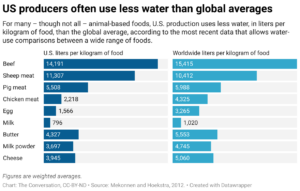
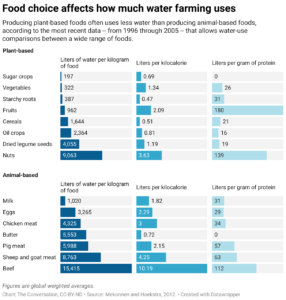
People’s dietary preferences, in particular, play a major role in agricultural water use. Producing meat requires significantly more water than growing plant-based foods.
Per capita, Americans consume nearly three times the global average amount of meat each year.
While eliminating meat altogether is not everyone’s goal, even modest shifts in diet, whether reducing overall meat consumption or selecting proteins that use less water to produce, can ease the strain. Producing a pound of beef requires an estimated 1,800 gallons of water, compared with about 500 gallons for a pound of chicken.
Replacing all meat with the equivalent quantities of plant-based foods with comparable nutrition profiles could cut the average American’s food-related water use by nearly 30%. Even replacing a small amount of meat with plant-based foods or meats that require less water can make a difference.
While a single meal may seem inconsequential, if multiplied across millions of households these choices translate into meaningful water savings.
A second savings opportunity
Perhaps the simplest and most powerful step people can take to save water used in agriculture is to cut back on food waste.
In the United States, 22% of total water use is tied to producing food that ultimately goes uneaten.
In developing countries, losses often result from limited storage and transportation, but in high-income nations like the United States, most waste happens at the retail and household level. In the U.S., households alone account for nearly 50% of all food discarded nationwide.
This creates a major opportunity for everyone to contribute to water conservation. Understanding the water embedded in different foods can make people more mindful about what ends up in the trash.
And on top of feeling good about helping the environment, there’s a financial reward: Wasting less food also means saving the money spent on food that would have gone to waste.
Huma Tariq Malik is a Ph.D. student in soil and crop sciences and Thomas Borch is a professor of environmental and agricultural chemistry, both at Colorado State University.
This article is republished from The Conversation under a Creative Commons license. Read the original article. Banner photo: Crops are watered on a Florida farm (iStock image).
Sign up for The Invading Sea newsletter by visiting here. To support The Invading Sea, click here to make a donation. If you are interested in submitting an opinion piece to The Invading Sea, email Editor Nathan Crabbe at ncrabbe@fau.edu.
