


By Holden Grace Wilkins, FSU News
When militia attacks disrupted shipping lanes in the Red Sea, few imagined the ripple effects would reach the clouds over the South Atlantic. But for Florida State University atmospheric scientist Michael Diamond, the rerouting of cargo ships offered a rare opportunity to clarify a pressing climate question — How much do cleaner fuels change how clouds form?
In research published in Atmospheric Chemistry and Physics, Diamond and FSU Department of Earth, Ocean, and Atmospheric Science graduate student Lilli Boss showed that new fuel regulations that cut sulfur by about 80% also lowered cloud droplet formation by about 67% compared with earlier, dirtier fuels.
“The unexpected rerouting of global shipping gave us a unique opportunity to quantify aerosol-cloud interactions, reducing the largest source of uncertainty in global climate projections,” said Diamond. “When your ‘laboratory’ is the atmosphere, it’s not every day you can run experiments like this one. It was an invaluable opportunity to get a more accurate picture of what’s happening on Earth.”
The findings could help refine global climate models, offering policymakers and scientists more accurate climate predictions and insight into how environmental policy can protect human health.
Cleaner fuel, fewer clouds
In January 2020, the International Maritime Organization (IMO) mandated a major reduction in sulfur content in marine fuels to decrease air pollution. Aerosols from ship emissions, especially sulfate, influence cloud formation and brightness, which in turn affect Earth’s energy balance.
Referred to as aerosol-cloud interactions, these particles cause clouds to form with smaller, more numerous droplets, making them brighter and thus more reflective of sunlight. This creates a cooling effect, which has historically masked about one-third of the warming caused by greenhouse gases.
But air pollution’s effects are marked by huge uncertainty and variability. Unlike long-lived greenhouse gases such as carbon dioxide, or CO2, which linger in the atmosphere for centuries, aerosols stay only for days or weeks. This short lifespan, coupled with the unpredictable nature of clouds, makes aerosol-cloud interactions the single largest source of uncertainty in global climate projections.
Diamond’s previous research had shown that clouds in major shipping corridors were forming with larger and less numerous droplets after IMO 2020. Scientists are currently debating what role the resulting increase in sunlight absorbed over the ocean played in the 2023 and 2024 marine heatwaves in the Atlantic Ocean. Different groups also disagree about how much cloudiness declined after IMO 2020, with estimates ranging from a relatively small 10% change to a massive 80% decrease.
A ‘natural’ experiment
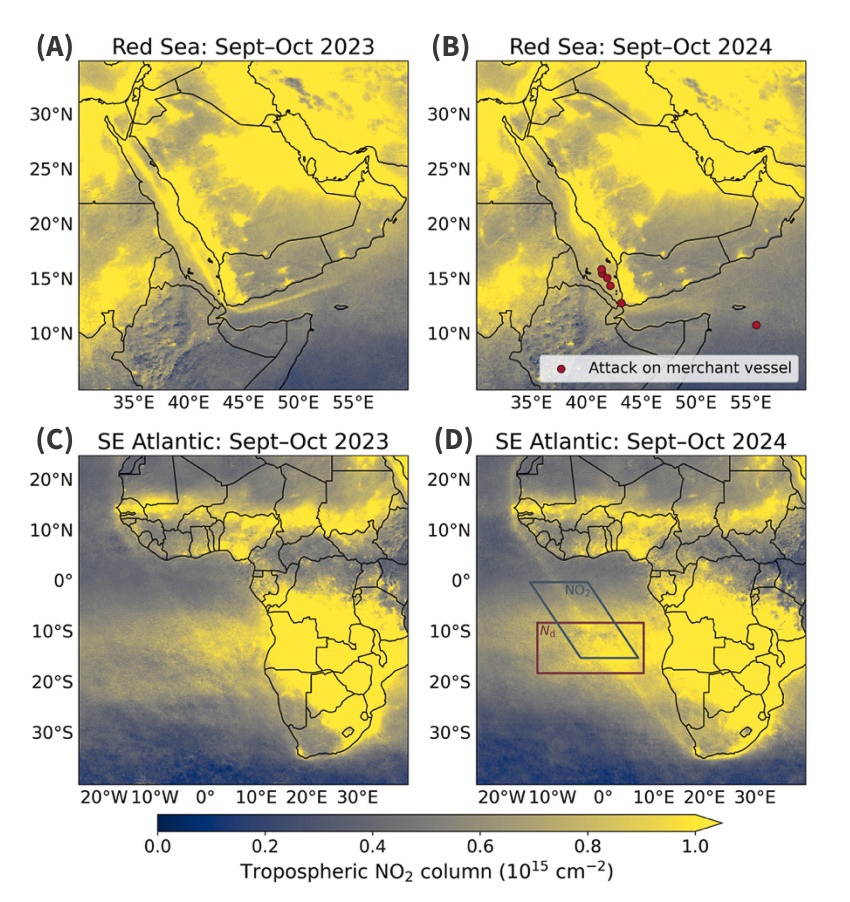
Beginning in November 2023, attacks in the Bab al-Mandab Strait caused a sharp decline in Red Sea traffic and a surge in shipping around the Cape of Good Hope. As a result, the South Atlantic region — which is highly susceptible to ship emissions because of its persistent, low-lying clouds — experienced a sudden, massive increase in ship volume.
Because the rerouting was driven by conflict rather than weather or policy, researchers could observe how clouds changed in direct response to ship emissions alone. Such clear cause-and-effect situations are almost impossible to create in controlled experiments, making this a valuable natural test case.
Satellite data revealed a clear increase in nitrogen dioxide, or NO2, over the southeastern Atlantic Ocean. NO2, a gas emitted by ship engines that was unaffected by the 2020 IMO fuel regulations, served as a reliable indicator of increased ship activity, confirming a surge in traffic through the region and allowing scientists to directly compare pre- and post-regulation conditions under heavy ship traffic.
Key findings
With roughly twice as many ships in operation during 2024, the overall impact on cloud droplet formation was only slightly weaker than before IMO 2020. However, by comparing NO2, which was unaffected by the sulfur-reducing regulations, with cloud droplet number, which is sensitive to sulfur, Diamond and Boss found a 67% reduction in ships’ cloud-altering abilities after the IMO regulations went into effect.
Their result provides further strong evidence that cleaner fuels have reduced shipping’s influence on cloud formation and helps to quantify the relationship between pollution and cloud response, which is an important constraint for improving climate simulations.
Why it matters
Quantifying how clouds respond to changes in aerosols remains one of the biggest challenges in studying the climate.
This research helps reduce the error bars that currently limit estimates of Earth’s energy balance. By narrowing this uncertainty, policymakers can make better-informed decisions about balancing environmental regulations with long-term climate goals. These findings also highlight the complex trade-offs in air-quality policy, showing how actions aimed at protecting human health can simultaneously reshape the planet’s climate response.
Although these aerosols temporarily cool the planet, this comes at the cost of human health. Exposure to sulfur particles, potent air pollutants, is linked to respiratory and cardiovascular diseases. The IMO regulation is estimated to have already prevented tens of thousands of premature deaths.
This piece was originally published at https://news.fsu.edu/news/science-technology/2025/11/21/when-trade-routes-shift-so-do-clouds-florida-state-university-researchers-uncover-ripple-effects-of-new-global-shipping-regulations/. Banner photo: A container ship at sunset (XEON, CC BY 3.0, via Wikimedia Commons).
Sign up for The Invading Sea newsletter by visiting here. To support The Invading Sea, click here to make a donation. If you are interested in submitting an opinion piece to The Invading Sea, email Editor Nathan Crabbe.
